
APPSC
▼
Test Series
▼
Download year-wise APPSC Group 2 Prelims & Mains previous papers (2024 to 2008) in one place to understand the exam pattern, track weightage, and boost your preparation for Executive & Non-Executive posts.
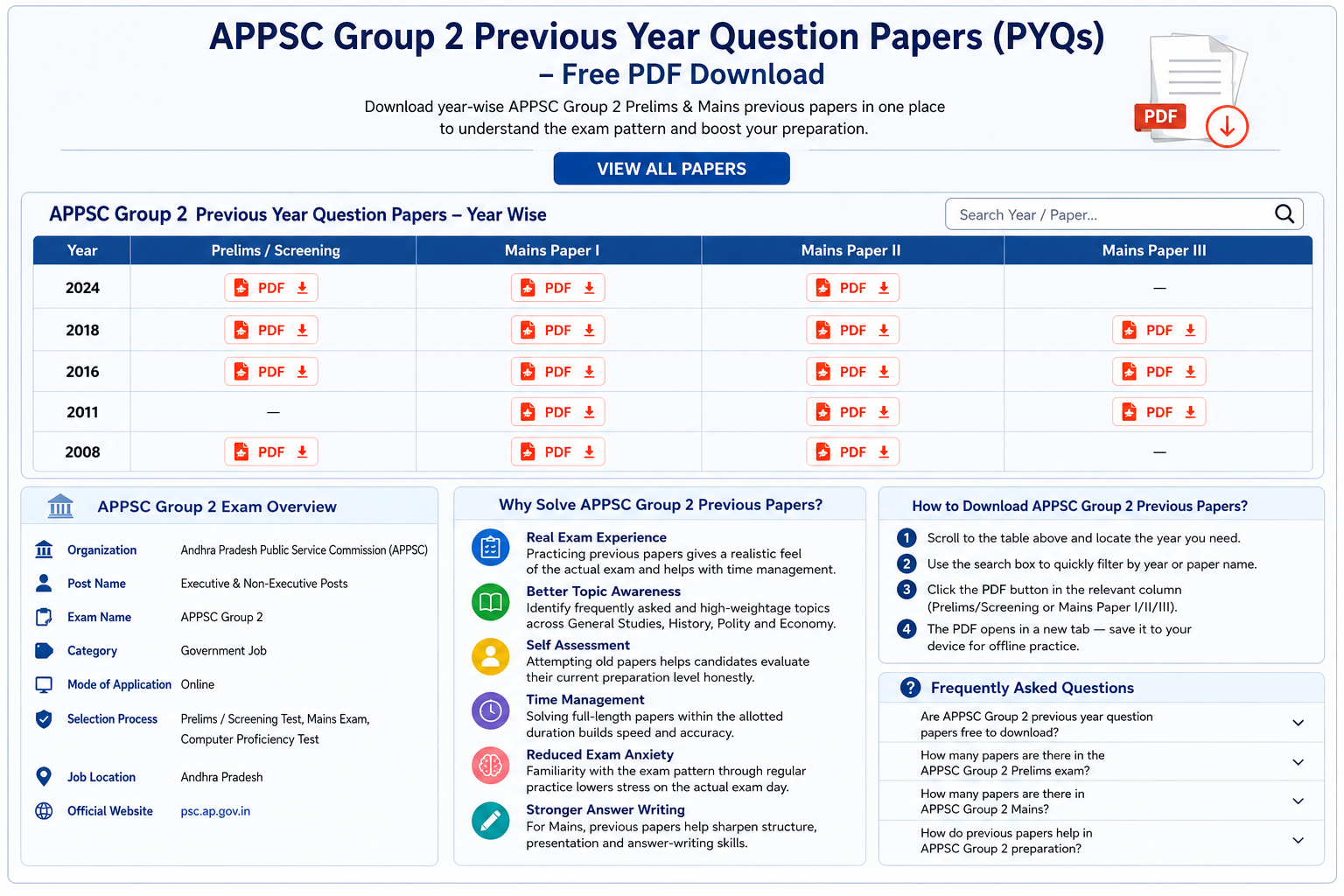
Candidates preparing for the APPSC Group 2 Services Exam should make previous year question papers a core part of their daily study routine. These papers reveal the actual exam format, highlight frequently repeated topics in Andhra Pradesh History and Polity, and help build the speed and accuracy needed to clear the screening test with confidence.
The APPSC Group 2 recruitment process is conducted in the following stages:
Each year's Prelims/Screening paper and Mains papers are listed side by side below. Click the PDF button to download the exact paper you need. Use the search bar to quickly filter by year or paper name.
Before analyzing the previous papers, it is crucial to understand the exam structure. The APPSC Group 2 exam pattern underwent a major revision in 2024. Below is the comparison between the standard pattern and the new 2024 pattern.
| Stage | Paper | Subjects | Duration | Marks |
|---|---|---|---|---|
| Prelims (Screening) | Paper I | General Studies & Mental Ability | 150 Mins | 150 |
| Mains | Paper I | General Studies & Mental Ability | 150 Mins | 150 |
| Paper II | Social History of AP & Indian Constitution | 150 Mins | 150 | |
| Paper III | Planning & Economy of AP & India | 150 Mins | 150 |
| Stage | Paper | Subjects | Duration | Marks |
|---|---|---|---|---|
| Prelims (Screening) | Paper I | General Studies & Mental Ability | 150 Mins | 150 |
| Mains | Paper I | General Studies (Comprehensive) | 150 Mins | 150 |
Simply downloading the PDFs isn't enough. Top rankers use previous papers strategically. Follow this 4-step analysis method:
| Organization | Andhra Pradesh Public Service Commission (APPSC) |
| Post Name | Executive & Non-Executive Posts (Group 2 Services) |
| Exam Name | APPSC Group 2 |
| Category | Government Job (State Level) |
| Mode of Application | Online |
| Selection Process | Prelims / Screening Test, Mains Exam, Computer Proficiency Test |
| Job Location | Andhra Pradesh |
| Official Website | psc.ap.gov.in |
Practicing previous papers gives a realistic feel of the actual exam and helps with time management.
Identify frequently asked and high-weightage topics across General Studies, History, Polity and Economy.
Attempting old papers helps candidates evaluate their current preparation level honestly.
Solving full-length papers within the allotted duration builds speed and accuracy.
Familiarity with the exam pattern through regular practice lowers stress on the actual exam day.
For Mains, previous papers help sharpen structure, presentation and answer-writing skills.
Along with previous papers, utilize these resources to build a comprehensive study plan:
Yes, all APPSC Group 2 Prelims and Mains previous papers on this page are completely free to download in PDF format.
The Prelims / Screening Test consists of a single paper covering General Studies and Mental Ability. It is 150 marks and lasts for 150 minutes.
In most cycles the APPSC Group 2 Mains exam consists of three papers covering General Studies & Mental Ability, Social History of AP & the Constitution, and Planning & Economy. The 2024 cycle was an exception, with only one comprehensive Mains paper.
Yes, there is a negative marking of 1/3rd of the marks assigned to that question for every wrong answer in the Prelims / Screening Test.
Yes, the APPSC Group 2 question papers are generally available in both Telugu and English mediums, reflecting the actual exam language options provided by the commission.