
World Bank Income Classification System
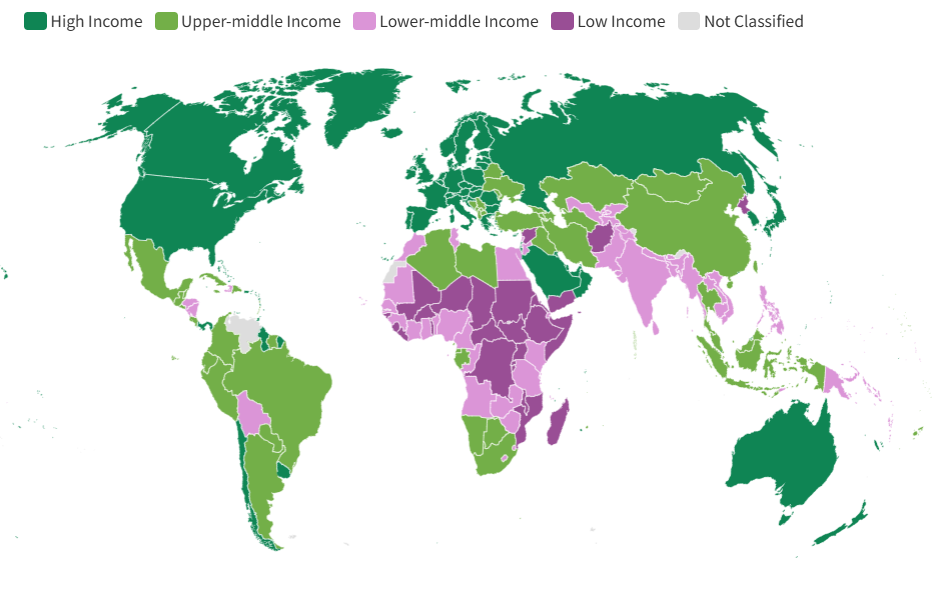
Purpose:
-
To classify countries based on their Gross National Income (GNI) per capita for policy, research, and comparison purposes.
Classification Groups (2024 thresholds in USD):
-
Low-income: GNI per capita of $1,135 or less
-
Lower-middle income: $1,136 to $4,495
-
Upper-middle income: $4,496 to $13,935
-
High-income: More than $13,935
How It Works:
-
GNI per capita includes average income of residents, even income earned abroad.
-
GNI is converted from local currencies to U.S. dollars using exchange rates.
-
Classifications are absolute, based on fixed thresholds, not relative comparisons.
Updates and Adjustments:
-
Income thresholds are updated yearly to adjust for global inflation.
-
A country’s classification can change yearly due to:
-
Economic growth or decline
-
Exchange rate shifts
-
Population data revisions
-
Historical Background:
-
Introduced in late 1980s.
-
Initially linked to World Bank lending policies (e.g., concessional loans).
-
Over time, became a standalone statistical tool, not tied to lending.
Trends Over Time:
-
Upward mobility: Most countries have moved up the income ladder due to growth.
-
Downward shifts: Some countries, like Syria and Yemen, dropped from lower-middle to low income (2017) due to war/economic crisis.
-
Population distribution has changed:
-
In 2004: 37% of the world population was in low-income countries.
-
In 2024: Less than 10% are in low-income; upper-middle income group grew to 35%.
-
Key Features:
-
Absolute measure, not percentile-based.
-
Helps in tracking global economic development.
-
Shows how income disparities evolve over time.