
Weimar Triangle
Context
India’s External Affairs Minister recently participated in India’s first-ever engagement in the Weimar Triangle, with French and Polish counterparts along with German representatives.
Areas of cooperation discussed
Trade and market access
Technology and innovation
Defence and security
Strategic and geopolitical issues
India–EU relations
Weimar Triangle
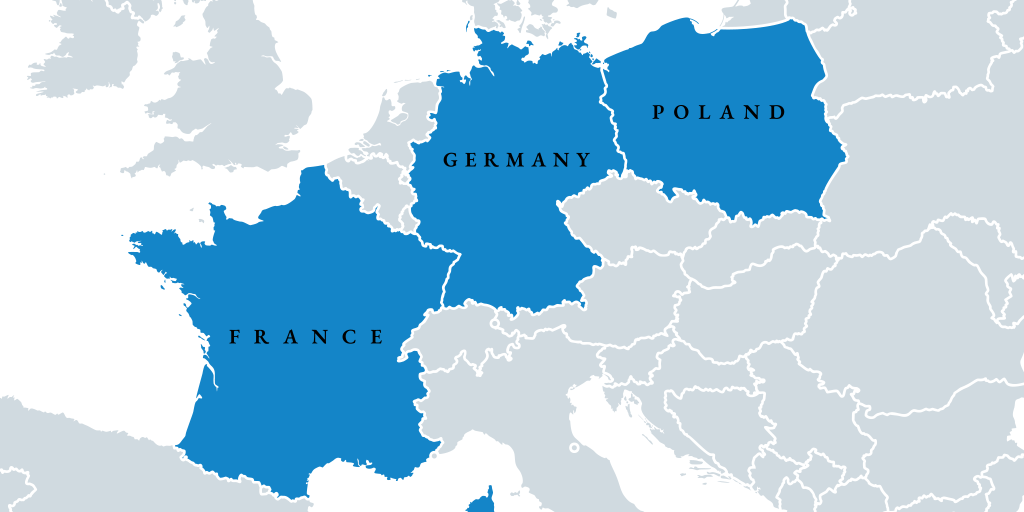
What is the Weimar Triangle
A regional political cooperation framework involving:
France
Germany
Poland
Established in 1991 in Weimar, Germany, in the immediate aftermath of the Cold War.
Objectives
To involve France in German–Polish reconciliation.
To strengthen political dialogue and cooperation among the three countries.
To support Poland’s integration into NATO and the European Union.
Functioning
No permanent institutional structure.
Operates through:
Meetings of heads of government
Foreign ministers’ meetings
European affairs ministers’ coordination
Cooperation extends beyond diplomacy to:
Parliamentary exchanges
Military cooperation
Scientific and cultural collaboration
Youth and academic exchanges
Outcomes
Poland joined NATO in 1999.
Poland became a member of the European Union in 2004.
Continues as a political coordination platform within Europe.
Prelims practice MCQs
Q. The Weimar Triangle, often mentioned in European geopolitics, consists of which of the following countries?
A. France, Italy and Spain
B. Germany, Austria and Poland
C. France, Germany and Poland
D. France, Germany and the United Kingdom
Correct answer: C
Explanation:
The Weimar Triangle is a regional cooperation framework involving France, Germany and Poland.
Q. With reference to the Weimar Triangle, consider the following statements:
It has a permanent secretariat headquartered in Brussels.
It supported Poland’s accession to NATO and the European Union.
It operates mainly through summit-level and ministerial meetings.
Which of the statements given above are correct?
A. 1 and 2 only
B. 2 and 3 only
C. 1 and 3 only
D. 1, 2 and 3
Correct answer: B
Explanation:
The Weimar Triangle has no permanent institutional structure.
It supported Poland’s NATO (1999) and EU (2004) accession.
It functions through meetings of leaders and ministers.
Q4. India’s recent engagement wit