
Waste-picker enumeration data and NAMASTE Scheme
Background
The Union Government released nationwide data for the first time on the enumeration of waste-pickers.
Data was tabled in Parliament by the Ministry of Social Justice and Empowerment.
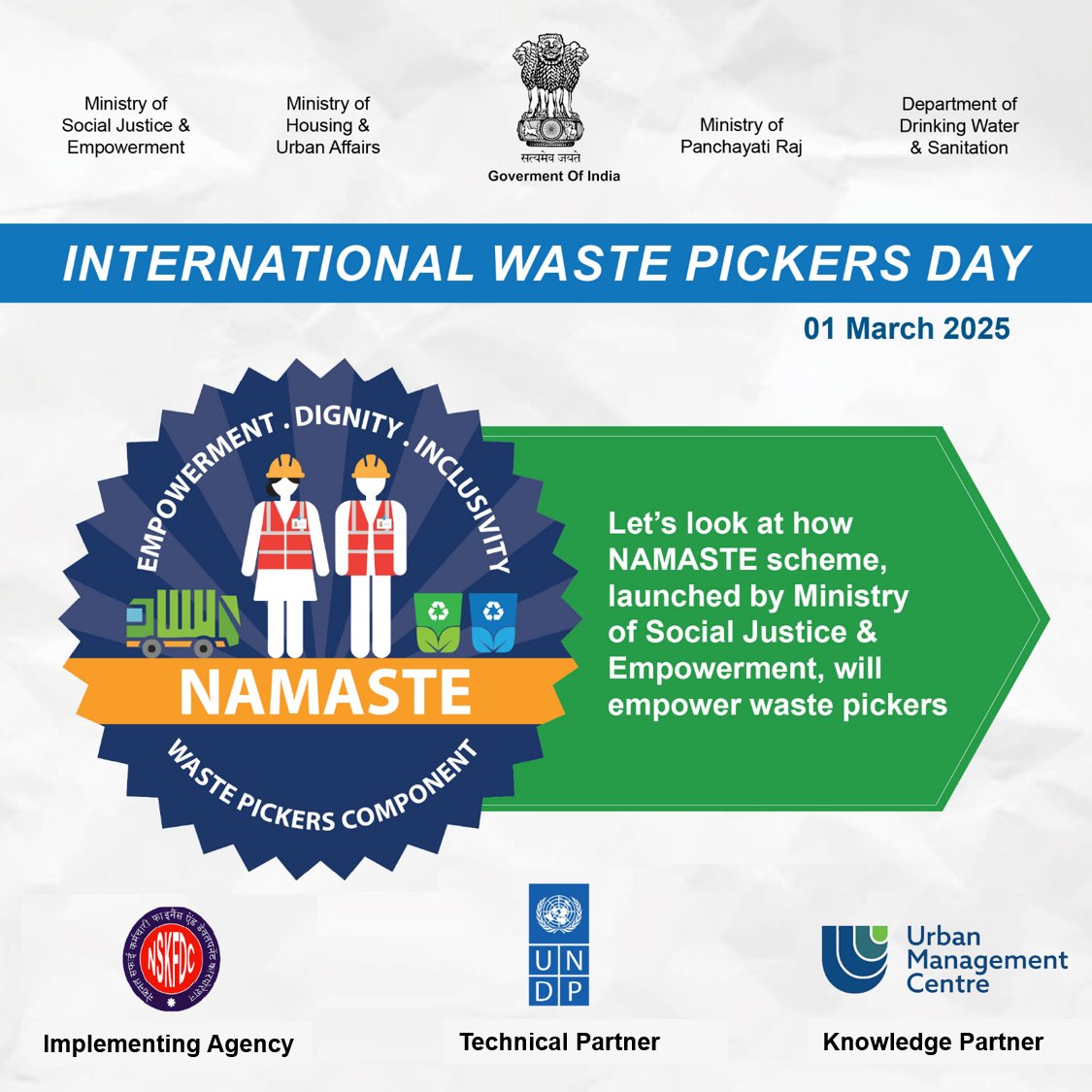
Enumeration is being carried out under the NAMASTE scheme.
Coverage: Urban areas of 35 States and Union Territories.
Data validated till January 23, 2026.
Overall numbers
Total waste-pickers profiled and validated: 1.52 lakh
Gender composition:
Women: 48.7% (74,427)
Men: 51.3% (78,374)
Transgender persons: 0.007% (12)
Social category composition (All India)
SC: 60.3% (92,089)
OBC: 13.7% (20,954)
ST: 10.5% (≈16,000)
SC + ST + OBC combined: 84.5%
General category: 10.7% (16,329)
“Other” category: 7,402
Waste-picking remains a caste-linked, socially vulnerable occupation, overwhelmingly dominated by historically marginalised communities.
State and UT level outliers
Delhi:
General category waste-pickers: 4,289 out of ~6,500
General category outnumbered SC/ST/OBC combined
Goa:
General category: 729 out of 1,286
West Bengal:
General category: 42.4% of total profiled
Definition of waste-picker (as per NAMASTE)
Waste-pickers are persons informally engaged in:
Collection and recovery of reusable and recyclable solid waste
From:
Streets
Bins
Material Recovery Facilities
Processing plants
Waste disposal sites
Purpose: Sale to recyclers directly or via intermediaries for livelihood

NAMASTE scheme
NAMASTE – National Action for Mechanised Sanitation Ecosystem
Nodal ministry
Ministry of Social Justice and Empowerment
Launch
Launched as a Central Sector Scheme
Expanded recently to include waste-pickers (earlier focus was sewer and septic tank workers).
Core objectives
Eradicate hazardous cleaning of:
Sewers
Septic tanks
Zero deaths due to manual sewer cleaning
Formal recognition of sanitation workers and waste-pickers by Urban Local Bodies
Mechanisation of sanitation work
Occupational safety, dignity, and rehabilitation
Target groups
Sewer and septic tank workers
Waste-pickers (urban)
Informal sanitation workers engaged in hazardous cleaning
Key components
1. Enumeration and profiling
Door-to-door and ULB-based identification
Creation of a validated national database
First-ever official data on waste-pickers
2. Formal recognition
Issuance of identity cards
Registration with Urban Local Bodies
Inclusion in social security frameworks
3. Safety and mechanisation
Provision of:
Protective equipment (PPE)
Safety gear
Mechanised cleaning equipment
Shift from manual entry to machine-based cleaning
4. Capacity building
Skill training for:
Operation of sanitation machinery
Alternative livelihoods
Support for sanitation worker collectives and SHGs
5. Rehabilitation and social security
Access to:
Health insurance
Welfare schemes
Skill development programmes
Long-term aim: exit from hazardous occupations
Constitutional and legal relevance
Linked to:
Article 17 (Abolition of untouchability)
Article 21 (Right to life with dignity)
Complements:
Prohibition of Employment as Manual Scavengers Act, 2013
Swachh Bharat Mission (Urban)
Prelims Practice MCQs
Q. Under the NAMASTE scheme, a waste-picker is defined as a person engaged in:
A. Door-to-door collection of municipal solid waste under Urban Local Bodies
B. Informal collection and recovery of recyclable and reusable waste for livelihood
C. Cleaning of drains, sewers and septic tanks using protective equipment
D. Operation of mechanised sanitation equipment only
Correct answer: B
Explanation:
NAMASTE defines waste-pickers as informal workers engaged in collection and recovery of recyclable waste for sale, often through intermediaries.
Q. The enumeration of waste-pickers and sanitation workers is being undertaken by which of the following?
A. Ministry of Housing and Urban Affairs
B. Ministry of Labour and Employment
C. Ministry of Social Justice and Empowerment
D. Ministry of Panchayati Raj
Correct answer: C
Explanation:
The data was tabled by the Ministry of Social Justice and Empowerment under the NAMASTE scheme.
Q. With reference to the NAMASTE scheme, consider the following objectives:
Elimination of deaths due to hazardous sewer and septic tank cleaning
Formal recognition of sanitation workers by Urban Local Bodies
Complete privatisation of urban sanitation services
Which of the objectives given above are correct?
A. 1 and 2 only
B. 2 and 3 only
C. 1 only
D. 1, 2 and 3
Correct answer: A
Explanation:
NAMASTE focuses on safety, dignity, mechanisation, and recognition, not privatisation.