
Villages Power Over Half of India’s Manufacturing
Context
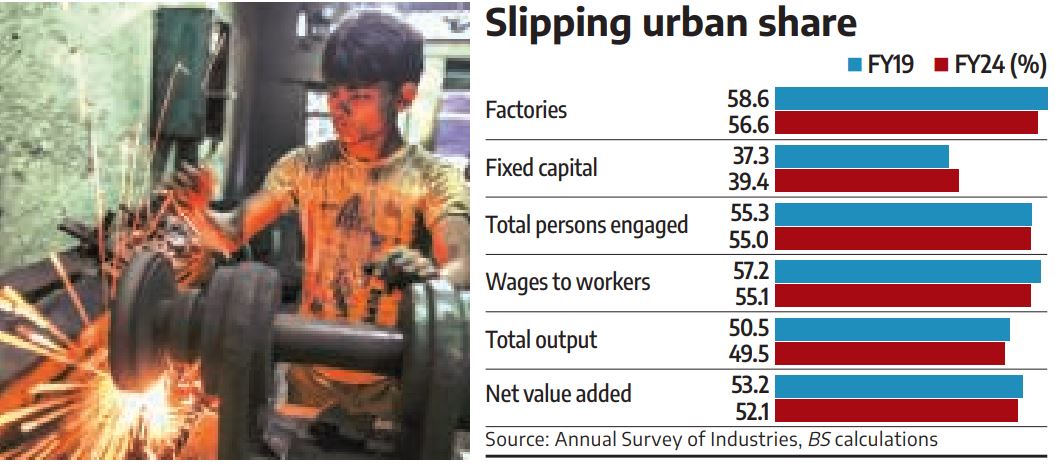
Annual Survey of Industries (ASI) 2023–24 shows that rural areas now contribute 50.5%+ of India’s formal manufacturing output.
Urban share slipped below 50% during the pandemic years and now stands at 49.5%, continuing a four-year rural dominance.
Key Findings
Output Trends: Urban share declined from 50.5% (2018–19) to 49.5% (2023–24).
Other Indicators: Decline in urban share of:
Number of factories
Persons engaged in manufacturing
Wages to workers
Net Value Added (NVA).
Causes:
High land prices and scarcity in cities.
Environmental concerns pushing factories to outskirts/rural belts.
Cities transforming into service hubs while manufacturing shifts outward.
Expert Views
Urban land scarcity and eviction of units drive rural relocation.
Industrial activity prefers rural/semi-urban zones due to pollution norms and resource constraints.
Cities increasingly service-driven (IT, finance, logistics).
Implications
Industrial Geography:
Shift towards peri-urban and rural clusters.
Emergence of new industrial belts outside metros.
Urbanisation vs. Growth Debate:
Urbanisation usually boosts productivity (ADB Institute, 2016).
Shift away may limit knowledge spillovers, labour market efficiency.
Employment & Migration:
Manufacturing slowdown (post-demonetisation, GST, pandemic) worsened job prospects.
Pushback to agriculture → higher disguised unemployment.
Structural Transformation:
2012 NBER study also noted rural relocation of plants, constrained by poor infrastructure and weaker education levels in rural areas.
India risks a premature deindustrialisation trend.