
Viksit Bharat – Guarantee for Rozgar and Ajeevika Mission (Gramin) Bill, 2025 (VB–G RAM G Bill, 2025)
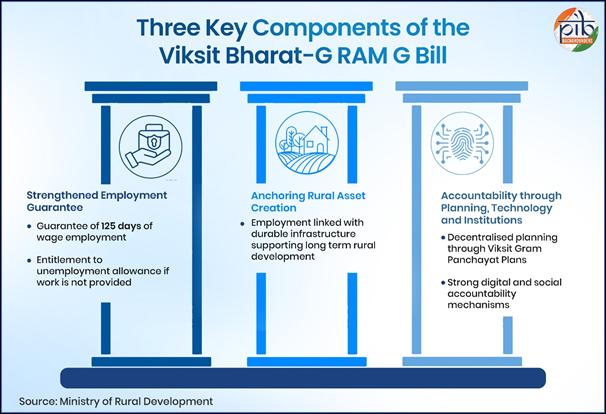
Theme: Reforming MGNREGA for Viksit Bharat 2047
Basic information
Introduced in Lok Sabha: 16 December 2025
Posted by Government: 18 December 2025
Ministry: Ministry of Agriculture and Farmers Welfare
Nature: New statutory framework
Replaces: Mahatma Gandhi National Rural Employment Guarantee Act, 2005 (MGNREGA)
Vision alignment: Viksit Bharat 2047
Core objectives
Strengthen rural income security
Align wage employment with durable rural infrastructure
Improve accountability, predictability, and fiscal discipline
Modernise rural employment in line with changed rural realities
Key takeaways
Employment guarantee enhanced from 100 to 125 days
Shift from demand-driven to normative funding
Conversion to a centrally sponsored scheme
Strong focus on infrastructure + climate resilience
Deep integration with digital governance and national planning systems
Background: Evolution of rural employment policy in India
Pre-MGNREGA phase
Rural Manpower Programme (1960s)
Crash Scheme for Rural Employment (1971)
National Rural Employment Programme
Rural Landless Employment Guarantee Programme
Jawahar Rozgar Yojana (1993)
Sampoorna Grameen Rozgar Yojana (1999)
Employment Assurance Scheme
Food for Work Programme
Turning point
Maharashtra Employment Guarantee Act, 1977
→ Introduced the idea of a statutory right to work
MGNREGA (2005)
First nationwide legal guarantee of wage employment
MGNREGA: Achievements and limitations
Achievements
100 days legal employment guarantee
Increased women participation (48% → 58.15%)
Near-universal digital wage payments
Expansion of Aadhaar-based payment systems
Large number of geo-tagged assets
Structural limitations
Misappropriation and ghost works
Mismatch between expenditure and physical progress
Use of machinery in labour-intensive works
Bypassing digital attendance
Few households achieving full 100 days post-pandemic
Weak administrative capacity at field level
➡️ Incremental reforms proved insufficient
Rationale for a new statutory framework
Rural poverty reduced sharply (27.1% in 2011–12 → 5.3% in 2022–23)
Rural livelihoods diversified beyond agriculture
Higher digital penetration and connectivity
Demand-driven open-ended funding became fiscally unpredictable
Need to link employment with long-term infrastructure and climate goals
Key features of VB–G RAM G Bill, 2025
A. Employment guarantee
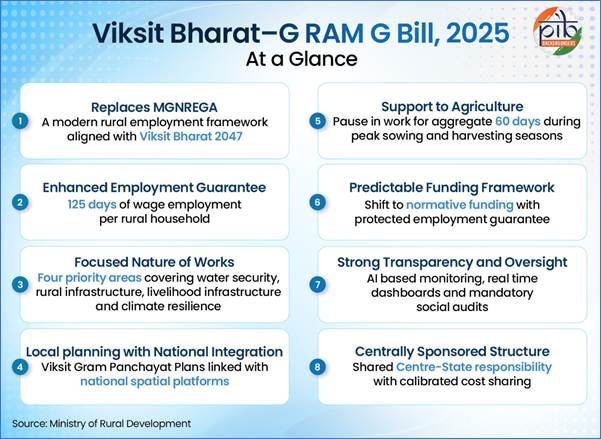
125 days of wage employment per rural household per year
Applies to households whose adult members volunteer for unskilled manual work
Unemployment allowance retained
Payable by State government if work is not provided within 15 days
Liability rests with States
B. Pause during agricultural season
Mandatory no-work period of up to 60 days per year
Covers peak sowing and harvesting seasons
Ensures:
Availability of farm labour
Prevention of wage inflation in agriculture
Workers still get 125 days within remaining 305 days
C. Wage payment
Wages to be paid:
Weekly, or
Not later than 15 days (fortnight)
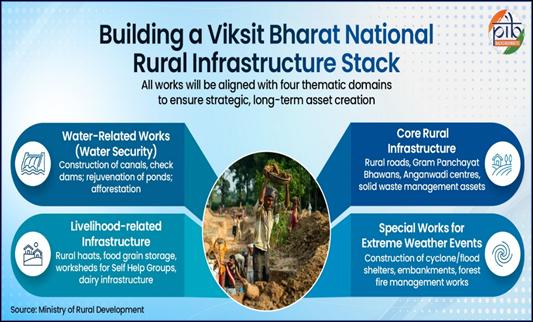
D. Priority areas for works (4 verticals)
Water security
Core rural infrastructure
Livelihood-related infrastructure
Mitigation of extreme weather events
E. Planning framework
Viksit Gram Panchayat Plans prepared locally
Integrated spatially with:
PM Gati Shakti National Master Plan
All assets aggregated into:
Viksit Bharat National Rural Infrastructure Stack
Plans aggregated from:
Gram Panchayat → District → State → National level
Financial architecture
Shift in funding model
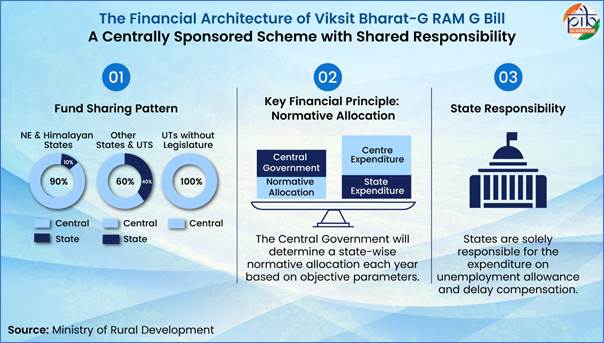
From demand-based to normative allocation
Scheme becomes centrally sponsored
Normative funding means the government decides in advance how much money a State will get, using fixed rules (norms), instead of waiting for States to demand funds during the year. | ||
Cost-sharing pattern
60:40 – Centre : States
90:10 – North-Eastern and Himalayan States
100% Centre – Union Territories without legislatures
Key features
Centre decides state-wise normative allocation
States bear:
Unemployment allowance
Compensation for wage delays
Any expenditure beyond allocation
Why normative funding?
Improves budget predictability
Aligns with standard GoI budgeting practices
Prevents misuse and open-ended fiscal exposure
Does not dilute legal entitlement to employment
Financial magnitude
Total annual requirement: ₹1.51 lakh crore
Central share: ~₹95,692 crore
Administrative strengthening
Administrative expenditure ceiling raised:
From 6% to 9%
Enables:
Better staffing
Training
Technical capacity
Professional programme management
Institutional framework
Central and State Gramin Rozgar Guarantee Councils
Policy guidance
Review and monitoring
Steering Committees
National Steering Committee
Strategic oversight
Normative allocation recommendations
State Steering Committees
Convergence
Aggregation of plans
Coordination with Centre
Panchayati Raj Institutions
Gram Panchayats implement at least 50% of works (by cost)
Gram Sabhas:
Social audits (minimum once in six months)
Public oversight
Technology, transparency and accountability
Biometric authentication
AI-based irregularity detection
Geo-spatial and GPS-based monitoring
Mobile-based real-time dashboards
Weekly public disclosures
Strong enforcement powers to Centre:
Investigation
Suspension of funds
Corrective directions
Benefits
For rural households
Higher income security (125 days)
Predictable employment
Secure digital payments
Reduced distress migration
For farmers
Assured labour during peak seasons
Improved irrigation, storage, connectivity
Reduced wage volatility
For rural economy
Durable infrastructure creation
Climate resilience
Improved market access
Higher village-level consumption
Prelims Practice MCQs
Q. With reference to the Viksit Bharat – Guarantee for Rozgar and Ajeevika Mission (Gramin) Bill, 2025, consider the following statements:
It seeks to replace the Mahatma Gandhi National Rural Employment Guarantee Act, 2005.
It increases the guaranteed days of employment from 100 to 125 days in a financial year.
It removes the provision of unemployment allowance.
Which of the statements given above is/are correct?
A. 1 and 2 only
B. 2 and 3 only
C. 1 only
D. 1, 2 and 3
Correct answer: A
Explanation:
Statement 1 is correct: The Bill replaces MGNREGA, 2005.
Statement 2 is correct: Guaranteed employment is increased to 125 days.
Statement 3 is incorrect: The provision of unemployment allowance is retained.
Q. Which of the following expenditures will continue to be borne solely by State governments under the VB–G RAM G Bill, 2025?
Unemployment allowance
Compensation for delay in wage payments
Administrative costs
Material costs
Select the correct answer using the code below:
A. 1 and 2 only
B. 1, 2 and 3 only
C. 3 and 4 only
D. 1, 2, 3 and 4
Correct answer: A
Explanation:
Unemployment allowance and delay compensation remain State liabilities.
Wages, material, and administrative costs are shared between Centre and States.
Q. With reference to normative allocation under the VB–G RAM G Bill, 2025, consider the following statements:
The central government will determine state-wise normative allocation each year.
Parameters for allocation will be prescribed under Rules.
Expenditure beyond the normative allocation will be borne by the central government.
Which of the statements given above is/are correct?
A. 1 and 2 only
B. 2 and 3 only
C. 1 only
D. 1, 2 and 3
Correct answer: A
Explanation:
Statements 1 and 2 are correct.
Statement 3 is incorrect: States bear expenditure beyond normative allocation.