
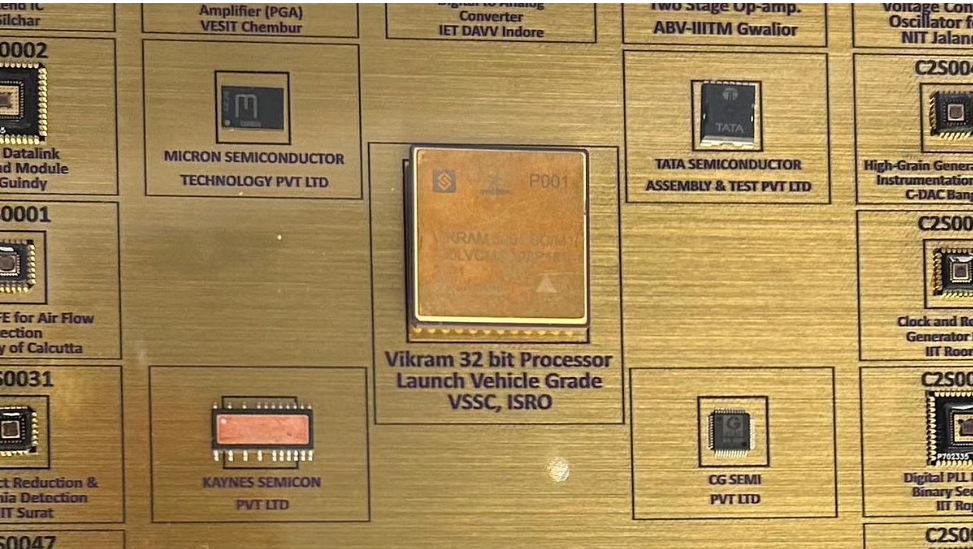
Vikram 32-bit Chip: A Landmark in Indigenous Technology
Context
-
Presented to PM Narendra Modi at Semicon India 2025 by Union IT Minister Ashwini Vaishnaw.
-
Represents India’s growing capabilities in semiconductors, microprocessors, and space avionics.
Technical Features
-
Designed & Developed by:
-
Vikram Sarabhai Space Centre (VSSC), ISRO
-
Semiconductor Laboratory (SCL), Chandigarh
Fabricated at 180nm CMOS semiconductor fab (SCL).
-
-
Application: Space flights – avionics systems of launch vehicles.
-
Evolution:
-
Advanced, refurbished version of 16-bit VIKRAM1601 microprocessor (used since 2009 in ISRO launch vehicles).
-
Now upgraded to 32-bit Launch Vehicle Grade processor → better performance, reliability, precision.
1. VIKRAM3201
First fully “Make-in-India” 32-bit microprocessor qualified for the harsh conditions of launch vehicles.

Evolution:
Based on 16-bit VIKRAM1601 (flying since 2009).
“Make-in-India” VIKRAM1601 version fabricated in 2016 after SCL fab became operational.
Features:
Custom Instruction Set Architecture.
Floating-point computation.
High-level language support (Ada language).
In-house developed Ada compiler, assembler, linker, simulator & IDE.
C compiler under development for wider applications.
Validation: Successfully tested in PSLV-C60 POEM-4 Mission (Mission Management Computer).
2. KALPANA3201
32-bit SPARC V8 RISC microprocessor.
Based on IEEE 1754 Instruction Set Architecture.
Compatible with open-source software toolsets.
ISRO also developed in-house simulator & IDE.
Successfully tested with flight software.
3. Associated Avionics Devices (Miniaturisation push)
Four additional devices handed over:
Reconfigurable Data Acquisition System (RDAS) – two versions with multiple 24-bit Sigma-Delta ADCs on a single chip.
Relay Driver Integrated Circuit.
Multi-Channel Low Drop-out Regulator IC for high-reliability.
→ These contribute to miniaturisation of launch vehicle avionics.

Symbolic & Strategic Importance
-
Atmanirbhar Bharat in Semiconductors:
-
Reduces reliance on foreign processors for critical space missions.
-
Boosts strategic autonomy in defence and space tech.
-
-
Part of Larger Ecosystem:
-
Memento also included 31 prototype chips designed by IITs & NITs (Jammu, Roorkee, Dhanbad, Durgapur, Calicut, Ropar, etc.).
-
Shows academia-industry-government collaboration.
-
-
National Semiconductor Mission Progress:
-
Launched in 2021 to make India a global hub for semiconductor design & manufacturing.
-
5 semiconductor units under construction; pilot line of one unit completed.
-
Two units expected to start production within months.
-
-
Global Confidence:
-
Minister Vaishnaw: “In uncertain times, you should come to India – policies are stable, ecosystem is ready.”
-
Positions India as a semiconductor manufacturing hub.
-
Broader Relevance for India
-
Space Programme: ISRO gains in-house, indigenous processors → higher reliability, cost efficiency, security.
-
Electronics Industry: Push towards domestic chip ecosystem (design + fab + packaging).
-
Geopolitical Angle: Amid U.S.-China chip rivalry, India can become a trusted global alternative.
-
Economic Growth: Foundation for $1 trillion digital economy target by 2030.