
Vanuatu’s Global Climate Justice Campaign
 Click to view full image
Context : Vanuatu, a Pacific island nation facing severe impacts of climate change, is leading a global push for climate justice.
Once-vibrant coral reefs at Havannah Harbour have turned to rubble due to cyclones, starfish infestations, and earthquakes. Sea levels have been rising around Vanuatu at 6 mm per year—double the global average in some areas due to tectonic shifts.
Vanuatu is now spearheading a landmark case at the International Court of Justice (ICJ), backed by over 130 nations, to seek an advisory opinion on nations' legal responsibilities to act on climate change.
Although the ICJ verdict won’t be binding, it may influence future legal action and international accountability.
Climate change has deeply disrupted life in Vanuatu—from destroyed reefs and flooded coastlines to schools functioning in emergency tents and food insecurity in rural areas. Vanuatu also advocates for classifying "ecocide" as an international crime, aiming to protect vulnerable ecosystems and communities from environmental destruction.
About Vanuatu :
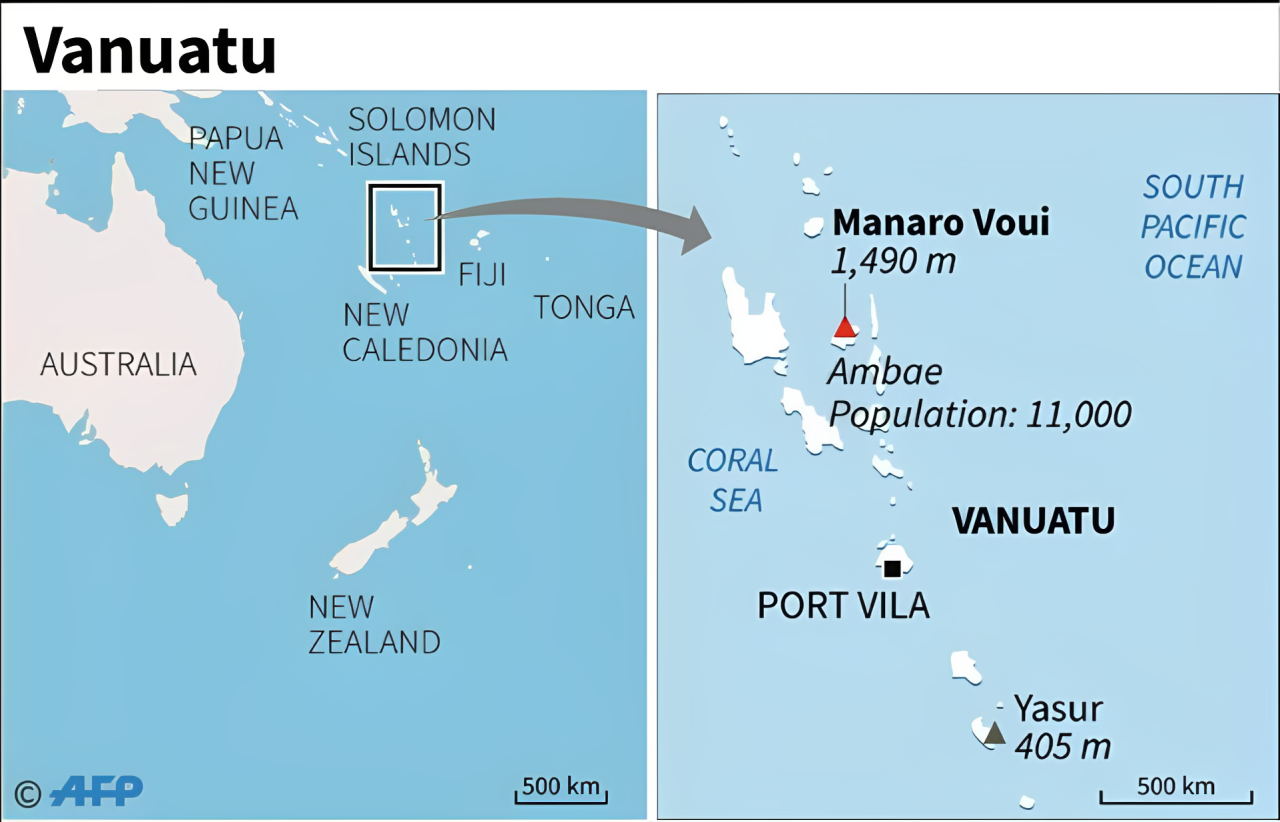
Vanuatu, officially Ripablik blong Vanuatu in Bislama, is a volcanic island nation in Melanesia, located in the South Pacific Ocean—east of Australia and west of Fiji.
Vanuatu is the smallest of the five Melanesian nations — the others being Fiji, Papua New Guinea, Solomon Islands, and New Caledonia. Despite its size, it holds strategic ecological and cultural importance in the South Pacific.
It was first inhabited by Melanesians. The first European contact was in 1606 when Portuguese navigator Fernandes de Queirós, leading a Spanish expedition, arrived at Espíritu Santo, the largest island, and claimed the archipelago for Spain under the name La Austrialia del Espíritu Santo.

History:
The islands were formerly known as the New Hebrides.
The first Europeans to visit were a Spanish expedition in 1606.
In the 1880s, France and the United Kingdom claimed parts of the archipelago. They agreed to jointly manage the islands as the New Hebrides through an Anglo-French condominium in 1906.
Vanuatu gained independence on July 30, 1980.
Other Notable Features:
Mount Tabwemasana on Espiritu Santo is the highest point in Vanuatu.
Vanuatu is known for its active volcanoes, including Mount Yasur, which is considered one of the world's most accessible active volcanoes.