
Vande Mataram, constitutional position
Background
An order dated January 28, 2026 issued by the Ministry of Home Affairs (MHA) reportedly directs that all six stanzas of Vande Mataram be played at official functions, with attendees required to stand at attention.
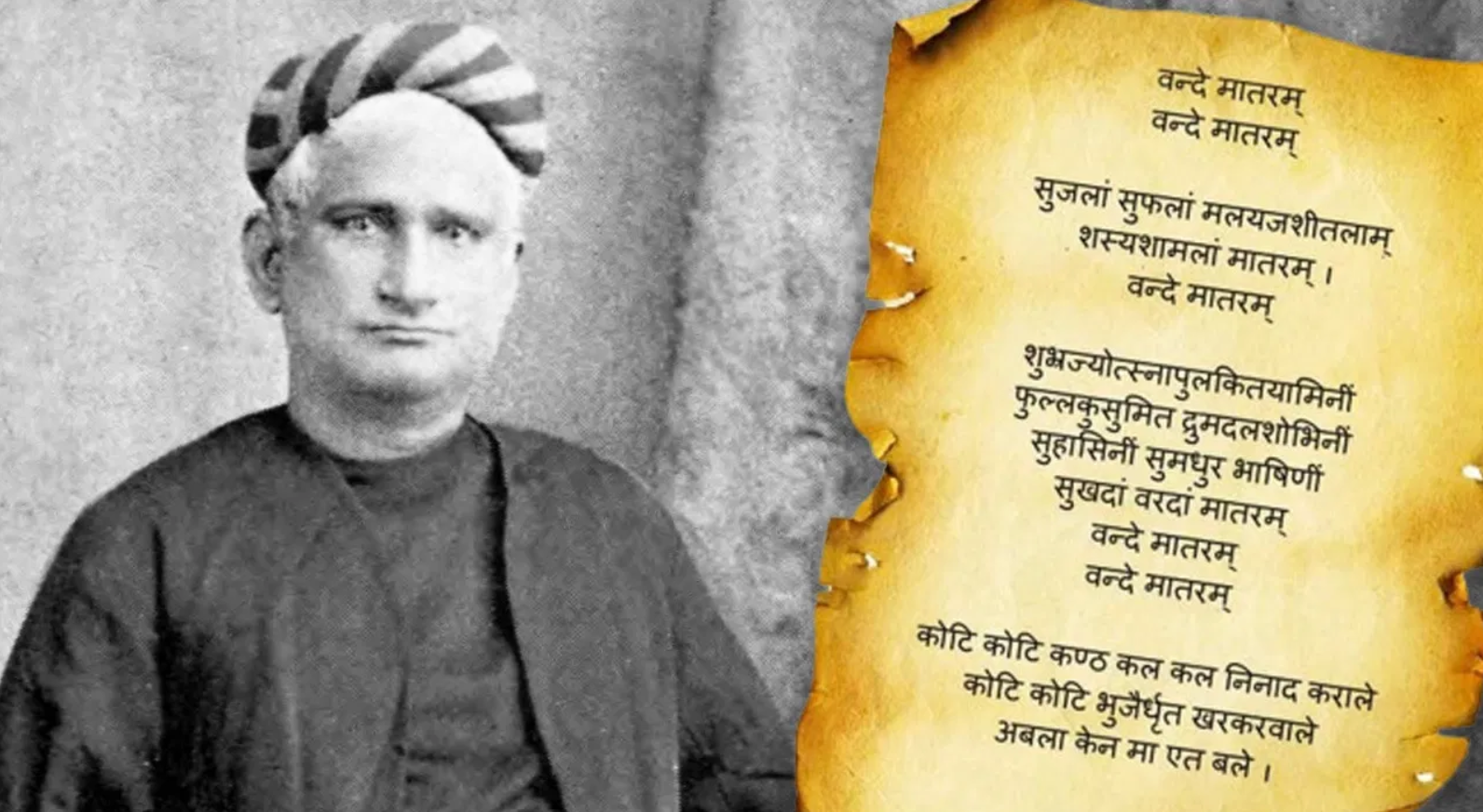
About Vande Mataram
Composed by Bankim Chandra Chatterjee
Originally part of the novel Anandamath
Played a major role during the freedom struggle
Content Structure
Total: Six stanzas
First two stanzas: Describe the motherland in natural imagery (rivers, fields, breeze)
Later four stanzas: Invoke Hindu goddesses such as Durga, Lakshmi and Saraswati
The 1937 Congress Working Committee Settlement
In October 1937:
Resolution moved by Rajendra Prasad
Seconded by Vallabhbhai Patel
Supported by Mahatma Gandhi
Endorsed by Rabindranath Tagore
Decision
Only the first two stanzas would be accepted as the National Song at national gatherings.
Reason
Objections from sections of Muslim community
Later stanzas contain explicit religious invocations
Aim: Preserve unity in a plural society
Constituent Assembly Position (January 24, 1950)
Jana Gana Mana adopted as National Anthem.
Vande Mataram to be “honoured equally” as National Song.
However, only the two-stanza version was recognized.
Key Constitutional Point
Article 51A(a) (Fundamental Duties) mentions:
Respect for National Flag
Respect for National Anthem
It does not mention the National Song.
Legal Framework
1. Prevention of Insults to National Honour Act, 1971
Protects:
National Flag
National Anthem
Constitution
Does not cover Vande Mataram.
2. Fundamental Duties (42nd Constitutional Amendment, 1976)
Added Article 51A.
National Song was not included.
Landmark Judgment: Bijoe Emmanuel Case (1986)
Case: Bijoe Emmanuel and Ors. vs State of Kerala and Ors.
Facts:
Three Jehovah’s Witness students stood respectfully but did not sing the National Anthem.
Expelled from school.
Supreme Court Held:
Expulsion violated Articles 19(1)(a) and 25.
Standing respectfully is sufficient.
Not singing does not amount to disrespect.
The judgment relied on the U.S. case:
West Virginia State Board of Education vs Barnette
Constitutional Provisions Involved
Article 19(1)(a)
Freedom of speech and expression
(Includes right to remain silent)
Article 25
Freedom of conscience and free profession, practice and propagation of religion
Article 51A(a)
Duty to respect National Flag and National Anthem
Key Distinctions
Feature | National Anthem | National Song |
Constitutional Mention | Yes (Article 51A) | No |
Legal Protection | Yes (1971 Act) | No |
Compulsion to Sing | Not allowed (Bijoe Emmanuel) | Even weaker legal basis |
Religious Content | Secular | Later stanzas religious |
Prelims Practice MCQs
Q. With reference to Vande Mataram, consider the following statements:
It was originally composed in Sanskritised Bengali.
It forms part of the novel Anandamath.
It was first sung at the 1896 session of the Indian National Congress.
Which of the statements given above is/are correct?
A. 1 and 2 only
B. 2 and 3 only
C. 1 and 3 only
D. 1, 2 and 3
Answer: D
Explanation:
Vande Mataram was composed in highly Sanskritised Bengali by Bankim Chandra Chattopadhyay. It appeared in his novel Anandamath (1882). It was first sung at the 1896 session of the Indian National Congress by Rabindranath Tagore.
Q. Who among the following first sang Vande Mataram at a session of the Indian National Congress?
A. Aurobindo Ghosh
B. Rabindranath Tagore
C. Sarojini Naidu
D. Subramania Bharati
Answer: B
Explanation:
Vande Mataram was first sung at the 1896 Calcutta session of the Indian National Congress by Rabindranath Tagore.
Q. Consider the following statements regarding Vande Mataram during the freedom struggle:
It became a rallying cry during the Swadeshi Movement.
It was associated with the Anti-Partition Movement of Bengal (1905).
It was never opposed by any section of Indian society.
Which of the statements given above is/are correct?
A. 1 and 2 only
B. 2 and 3 only
C. 1 only
D. 1, 2 and 3
Answer: A
Explanation:
Vande Mataram became a powerful slogan during the Swadeshi Movement and the Anti-Partition agitation of Bengal (1905). However, some sections objected to certain verses due to religious imagery, so Statement 3 is incorrect.