
Vande Mataram -150 Year Commemoration
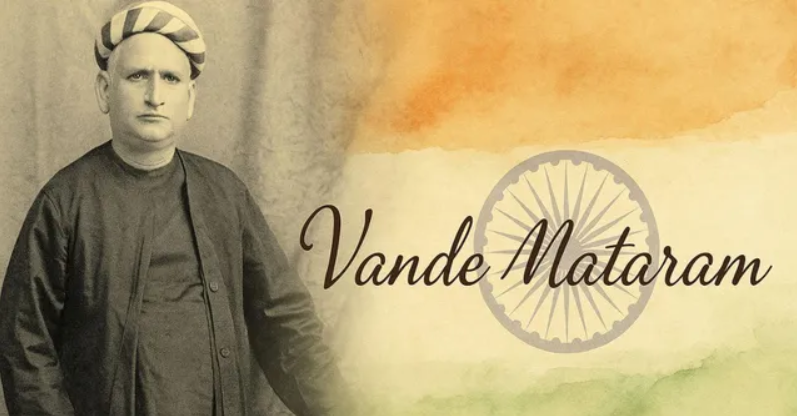
Context: 2025 marks the 150th anniversary (1875) of Vande Mataram.
Government and cultural institutions are observing the milestone through public events, school programmes, and discussions on literary and historical significance.
Origin and Composition
Composed by: Bankim Chandra Chattopadhyay (1838–1894).
Year of composition: Around 1875, written originally in Sanskrit and Bengali.
First published: In 1882 in his novel Anandamath.
The song appears in the novel as a hymn sung by ascetics (sanyasis) dedicated to Bharat Mata (Mother India).
It symbolizes Mother India as the divine mother, combining the ideals of patriotism and spirituality.
Literary Context
The novel Anandamath is set during the Sanyasi Rebellion (1770–1802) in Bengal and portrays ascetics fighting against British oppression.
Devi Choudhurani – A female zamindar-turned-rebel leader, popularised through Bankim Chandra Chattopadhyay’s novel Devi Choudhurani, who became a rebel leader and was associated with the Sanyasi Rebellion (also known as the Fakir and Sanyasi Rebellion)
Vande Mataram serves as the emotional and spiritual core of the novel.
The phrase “Vande Mataram” literally means “I bow to thee, Mother”.
Vande Mataram first appeared in the literary journal Bangadarshan as part of his novel Anandamath in a serialised manner and later as a standalone book in 1882.
Adoption and Political Significance
First public rendition:
1896 – Rabindranath Tagore sang Vande Mataram at the Calcutta Session of the Indian National Congress (INC).
This introduced the song to the national movement.
Congress endorsement:
1905 – During the Bengal Partition movement, the song became a national cry for unity.
It was sung at public meetings, protests, and processions against the partition.
The slogan “Vande Mataram” became synonymous with India’s struggle for freedom.
Controversy and limitation:
Some communities objected to later stanzas of the poem because they invoke Hindu goddesses (Durga, Lakshmi, Saraswati).
To preserve inclusivity, the first two stanzas—which are purely patriotic and non-religious—were accepted for public singing.
Formal adoption:
1937 (Lucknow Session of the INC):
The Indian National Congress officially adopted the first two stanzas of Vande Mataram as the National Song.
Constituent Assembly decision:
24 January 1950: The Constituent Assembly resolved that Vande Mataram shall be honoured equally with the National Anthem (Jana Gana Mana).
However, only Jana Gana Mana was designated as the National Anthem; Vande Mataram retained its position as the National Song.
Key Personalities Associated
Bankim Chandra Chattopadhyay: Author and composer of Vande Mataram; one of the earliest nationalists who used literature to arouse patriotic feeling.
Rabindranath Tagore: Set the song to music and sang it in the 1896 Calcutta Congress session.
Aurobindo Ghosh: Interpreted Vande Mataram philosophically and spiritually; called it “the mantra of India’s freedom.”
Subramania Bharati: Popularised Vande Mataram in South India through Tamil translations and patriotic writings.
Leaders of Swadeshi Movement (1905–1911): Bal Gangadhar Tilak, Lala Lajpat Rai, Bipin Chandra Pal (Lal-Bal-Pal) used Vande Mataram as a slogan of resistance.
Constitutional Status
National Anthem: Jana Gana Mana (adopted 1950).
National Song: Vande Mataram (adopted 1937; reaffirmed in 1950).
The Constitution does not legally define “National Song”, but it enjoys equal respect and honour as per the Constituent Assembly resolution of 1950.
On 24 January 1950, the Constituent Assembly of India adopted Vande Mataram as the Republic's national song.
President of India Rajendra Prasad stated that the song should be honoured equally with the national anthem of India, Jana Gana Mana. While the Constitution of India does not make reference to a "national song", the Government filed an affidavit at the Delhi High Court in November 2022 stating that Jana Gana Mana and Vande Mataram would “stand on the same level”, and that citizens should show equal respect to both
Key Points
Feature | Detail |
Composed by | Bankim Chandra Chattopadhyay |
Language | Sanskrit and Bengali |
Year Written | Around 1875 |
Published in | Anandamath (1882) |
First Sung at | 1896 Calcutta Session, Indian National Congress |
Music Given by | Rabindranath Tagore |
Adopted as National Song | 1937 Lucknow Session, INC |
Constituent Assembly Decision | 24 January 1950 – Equal honour with National Anthem |
Number of Stanzas Accepted for Official Use | First two only |
Associated Movements | Swadeshi Movement (1905), Bengal Partition agitation |
Associated Personalities | Bankim Chandra Chattopadhyay, Rabindranath Tagore, Aurobindo Ghosh, Subramania Bharati, Bal Gangadhar Tilak |
Theme | Worship of Mother India as divine mother symbolising unity and freedom |


Prelims Practice MCQ
Q. With reference to Vande Mataram, consider the following statements:
It was first sung at the Calcutta Session of the Indian National Congress in 1896.
It was written in Sanskrit and first published in Anandamath in 1882.
It was declared the National Anthem of India by the Constituent Assembly.
Which of the statements given above are correct?
A. 1 and 2 only
B. 2 and 3 only
C. 1 and 3 only
D. 1, 2 and 3
Answer: A
Q. In which session of the Indian National Congress was Vande Mataram adopted as the National Song?
A. Calcutta Session, 1896
B. Lucknow Session, 1937
C. Lahore Session, 1929
D. Karachi Session, 1931
Answer: B