
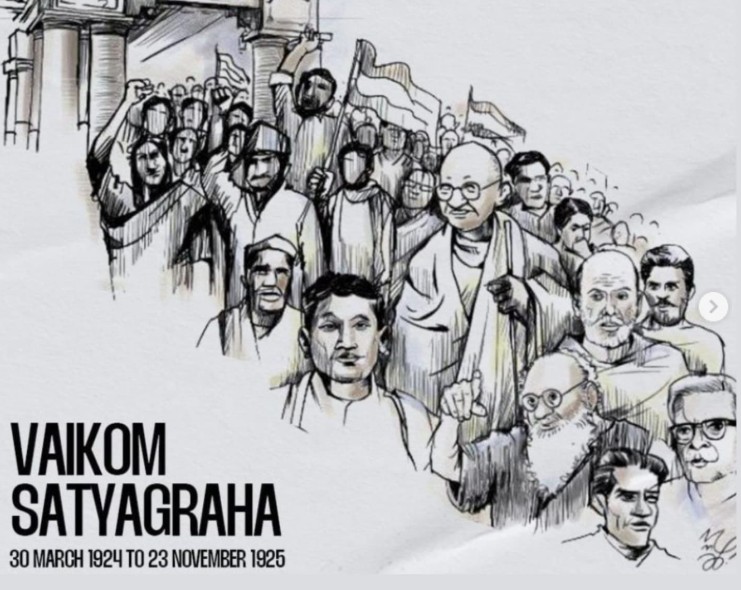
Vaikom Satyagraha (1924–1925)
Context
Periyar, anti-caste struggle, and Vaikom Satyagraha discussion took place at the Kerala Literature Festival, held at Kozhikode Beach.
Basic facts
Vaikom Satyagraha
Duration: March 1924 – November 1925
Location: Vaikom Mahadeva Temple, Kingdom of Travancore
Nature: Non-violent agitation (Satyagraha)
Core demand: Public access to roads surrounding the Vaikom Temple
Social background
Travancore had a rigid and oppressive caste system.
Lower castes were prohibited not only from temple entry, but also from walking on roads around temples.
Discrimination extended to public spaces, not merely religious spaces.
Leadership and organisation
Organised and led mainly by Congress leaders:
T. K. Madhavan
K. Kelappan
K. P. Kesava Menon
Other notable participants:
George Joseph
Mannath Padmanabhan
E. V. Ramasamy
Role of T. K. Madhavan
Ezhava leader and follower of Sri Narayana Guru.
Raised temple entry issue as early as 1917 through Deshabhimani newspaper.
Defied caste restrictions in 1920 by walking beyond notice boards near Vaikom Temple.
Introduced the anti-untouchability resolution at the Indian National Congress session (Kakinada, 1923).
Role of Mahatma Gandhi
Mahatma Gandhi visited Vaikom in March 1925.
Supported the movement but favoured a compromise approach.
His intervention led to negotiations with the Travancore regency.
Outcome of the Satyagraha
Regent Sethu Lakshmi Bayi:
Released arrested protestors.
Opened north, south, and west public roads to all castes.
Eastern road remained closed.
Temple entry itself was not achieved during the Satyagraha.
Full access (including eastern road and temple entry) came only after the Temple Entry Proclamation.
Criticism and significance
Periyar criticised the compromise as incomplete and unjust.
Vaikom Satyagraha:
Popularised non-violent mass protest in Kerala.
Linked social reform with the national movement.
Became a precursor to later temple entry movements.
Prelims Practice MCQs
Q. With reference to the Vaikom Satyagraha, consider the following statements:
It demanded temple entry for lower castes as its immediate objective.
It was conducted entirely within the Gandhian framework of non-violence.
It brought the issue of access to public spaces into the national freedom movement.
Which of the statements given above are correct?
a) 1 and 2 only
b) 2 and 3 only
c) 3 only
d) 1, 2 and 3
Answer: b
Explanation:
Statement 1 is incorrect: the immediate demand was access to public roads, not temple entry.
Statement 2 is correct: it followed non-violent satyagraha methods.
Statement 3 is correct: it linked social reform with the national movement.
Q. The Vaikom Satyagraha is considered a milestone in Kerala’s social reform history because it
a) led directly to universal temple entry
b) abolished caste system in Travancore
c) introduced non-violent mass protest against untouchability
d) resulted in separate electorates for depressed classes
Answer: c
Explanation:
Vaikom Satyagraha marked the first major use of non-violent public protest against caste discrimination in Kerala.
Q. Consider the following leaders:
T. K. Madhavan
K. Kelappan
K. P. Kesava Menon
They were associated with
a) Guruvayur Satyagraha
b) Vaikom Satyagraha
c) Bardoli Satyagraha
d) Temple Entry Proclamation
Answer: b
Explanation:
All three were key Congress leaders who organised and led the Vaikom Satyagraha.
Q. Which of the following best explains the role of Mahatma Gandhi in the Vaikom Satyagraha?
a) He opposed the movement initially and later withdrew support
b) He led the movement from its beginning
c) He intervened to negotiate a compromise settlement
d) He rejected any dialogue with the Travancore government
Answer: c
Explanation:
Gandhi visited Vaikom in 1925 and played a mediatory role, leading to a compromise with the Travancore regency.