
Use of seismometers to track re-entering space debris
Background
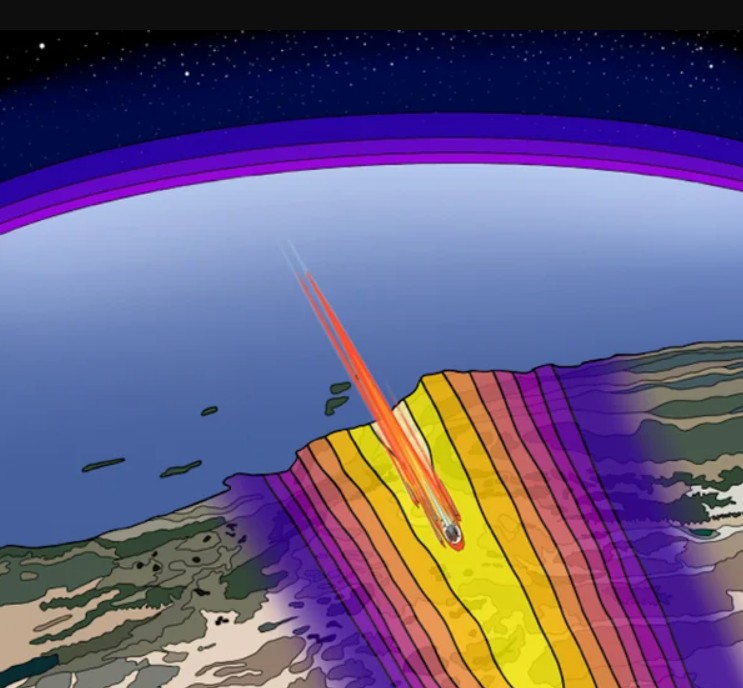
Seismometers, traditionally used to detect earthquakes, can also detect sonic booms produced by orbital debris re-entering Earth’s atmosphere.
When fast-moving space objects pass through the atmosphere, they generate shock waves that couple with the ground and are recorded as seismic signals.
Case study: 2024 reentry event
Researchers analysed the 2024 reentry of the Shenzhou-15 module over California.
Seismic data allowed scientists to:
Reconstruct the speed and trajectory of the falling object.
Determine that the debris landed significantly south of official predictions.
Identify that the spacecraft fragmented in stages, rather than exploding instantaneously.
Scientific significance
Seismic signals showed multiple shock arrivals, indicating progressive breakup during atmospheric descent.
This challenges simplified models that assume single-point disintegration.
Advantages over radar-based tracking
Faster response time: Seismic networks are already deployed and continuously recording.
Higher accuracy for final landing zones when radar coverage is limited.
Cost-effective: Uses existing Earth-based infrastructure.
Useful especially when:
Radar coverage is poor,
Objects are small or fragment unpredictably.
Prelims Practice MCQs
Q. With reference to the use of seismometers in tracking re-entering space debris, consider the following statements:
Sonic booms produced by re-entering objects can generate ground vibrations detectable by seismometers.
Seismic data can help reconstruct both the trajectory and fragmentation pattern of space debris.
Radar systems are completely ineffective once a spacecraft begins atmospheric fragmentation.
Which of the statements given above are correct?
(a) 1 and 2 only
(b) 2 and 3 only
(c) 1 only
(d) 1, 2 and 3
Correct answer: (a)
Explanation:
Statement 1 is correct: Sonic booms couple with the ground and are recorded as seismic signals.
Statement 2 is correct: Multiple seismic arrivals reveal trajectory and staged fragmentation.
Statement 3 is incorrect: Radar remains useful but may have limitations during fragmentation; it is not completely ineffective.