
UN Decolonisation Committee
Context
At the United Nations General Assembly’s Special Political and Decolonisation Committee (Fourth Committee), N. K. Premachandran, MP (Revolutionary Socialist Party, Kerala), made a strong statement on behalf of India.
India described Pakistan as the “fountainhead of terror, violence, bigotry, intolerance, and extremism.”
The statement came during discussions on decolonisation and related political issues, where Pakistan attempted to raise the issue of Jammu and Kashmir.
Violation of International Norms:
India accused Pakistan of illegally occupying parts of Kashmir in violation of UN Security Council Resolution 47 (1948), which required Pakistan to withdraw its forces before any plebiscite.
General Assembly – Decolonization Committee (Fourth Committee and C-24)
1. Introduction
The General Assembly Decolonization Committee refers primarily to the Special Political and Decolonization Committee (Fourth Committee) of the United Nations General Assembly (UNGA).
It handles the implementation of the 1960 Declaration on the Granting of Independence to Colonial Countries and Peoples and oversees related political issues such as peacekeeping, outer space, and information policy.
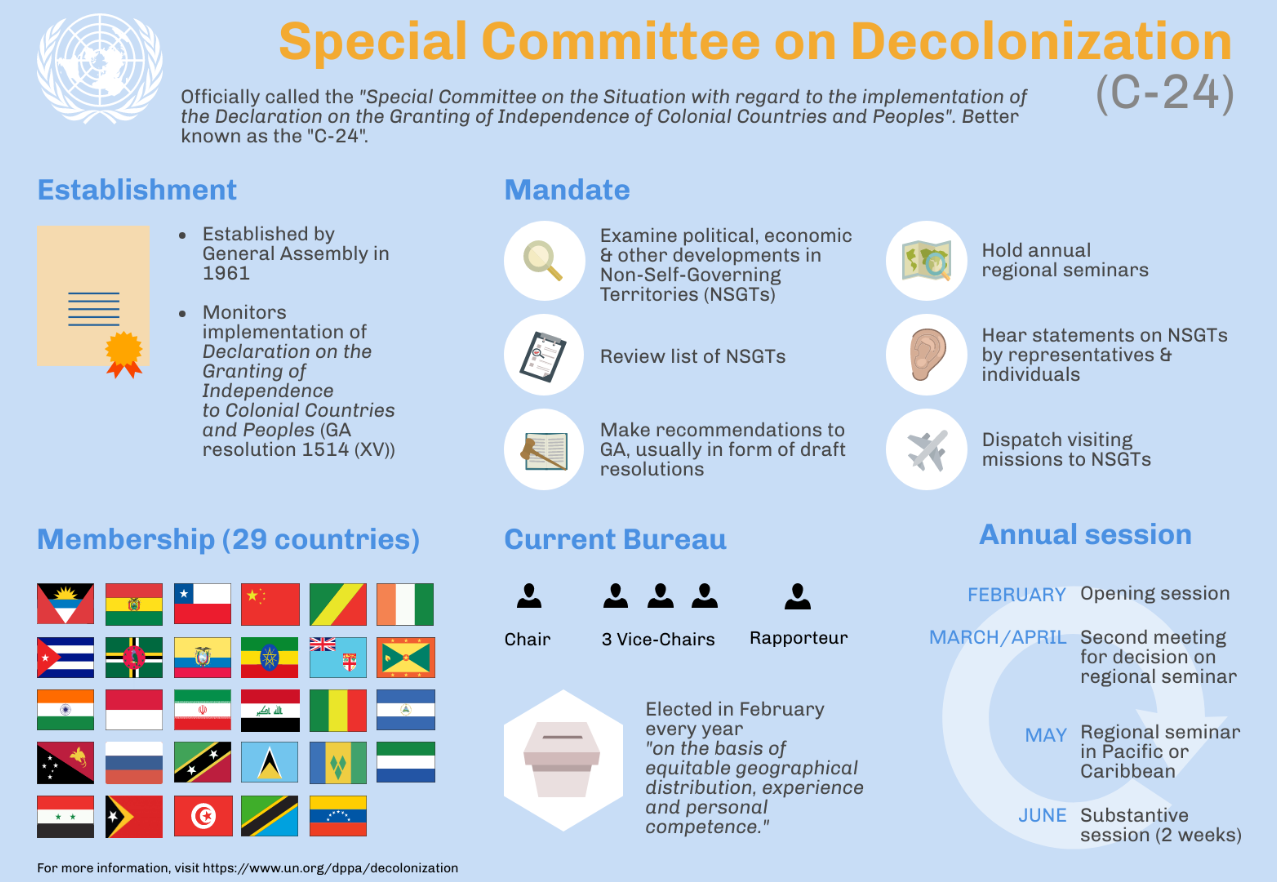
The Special Committee on Decolonization (C-24), created in 1961, is the main UN body exclusively devoted to decolonization matters and reports to the Fourth Committee.
2. Historical Background
Milestone | Details |
UN Charter (1945) | Contained provisions in Chapter XI (Non-Self-Governing Territories) and Chapter XII–XIII (Trusteeship System) recognizing the rights of colonial peoples and obliging Member States to promote self-governance. |
Trusteeship Council | Created to supervise the administration of Trust Territories under UN mandate until independence. |
Declaration on Decolonization (Resolution 1514 (XV), 1960) | Known as the Declaration on the Granting of Independence to Colonial Countries and Peoples. It affirmed the right to self-determination and called for the unconditional end of colonialism. |
Resolution 1654 (XVI), 1961 | Established the Special Committee on Decolonization (C-24) to monitor the implementation of the Declaration. Initially had 17 members, later expanded to 29 members. |
India’s Role | India was the first chair of the Special Committee (C-24) in 1961, reflecting its early leadership in anti-colonial and self-determination movements. |
3. Structure and Relationship
The Fourth Committee (Special Political and Decolonization Committee) is one of the six main committees of the UN General Assembly.
The C-24 functions as a subsidiary body under the General Assembly, submitting its findings and recommendations to the Fourth Committee.
Together, they work to implement the decolonization agenda and support Non-Self-Governing Territories (NSGTs).
4. Key Roles and Functions
(a) Implementation of the 1960 Declaration
C-24 reviews progress in decolonization and recommends actions to promote self-government or independence of colonial territories.
(b) Addressing Non-Self-Governing Territories
Monitors political, economic, and social developments in NSGTs.
Considers information submitted by administering powers.
Promotes capacity building and training for inhabitants of these territories.
(c) Preparation of Resolutions and Reports
The Fourth Committee prepares recommendations and draft resolutions for adoption by the General Assembly on decolonization-related issues.
(d) Other Political Issues under the Fourth Committee
UN Peacekeeping operations
Peaceful uses of outer space
Information policy and media freedom
Assistance to Palestinian refugees (through UNRWA)
Mine action and atomic radiation effects
5. Progress and Current Status
At UN’s founding (1945), around 750 million people lived under colonial rule.
Since then, over 80 former colonies have achieved self-determination, many becoming UN Member States.
The C-24 continues to advocate for dialogue between administering powers and local populations to facilitate self-government.