
U.S. to pull out of UNESCO again, 2 years after rejoining
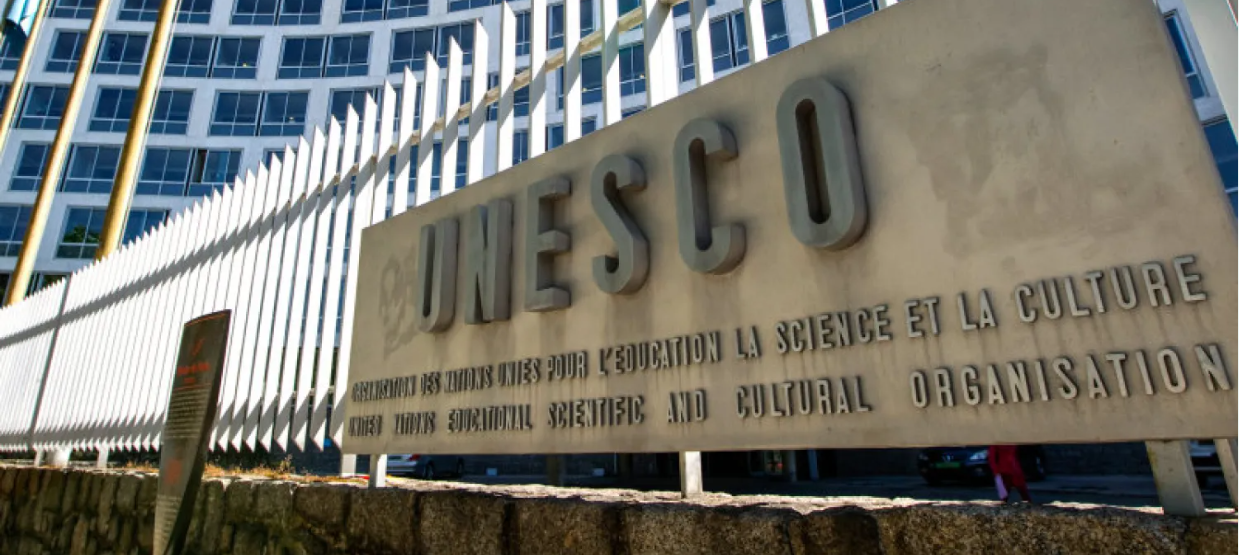
UNESCO (United Nations Educational, Scientific and Cultural Organization) is a specialized agency of the United Nations, established in 1945, with the objective of promoting world peace, sustainable development, and human rights through international cooperation in education, sciences, culture, and communication.
-
Headquarters: Paris, France
-
Membership: 194 member states and 12 associate members
-
Governance: General Conference, Executive Board, and a Director-General (chief administrator)
-
Programme Areas: Education, Natural Sciences, Social & Human Sciences, Culture, and Communication & Information
Key Contributions and Programmes:
-
Education and Literacy: Promotes universal access to quality education and lifelong learning.
-
Cultural Heritage: Protects both tangible and intangible cultural heritage and designates World Heritage Sites.
-
Media and Communication:
-
Promotes the “free flow of ideas by word and image” to counter wartime propaganda.
-
Started journalist training in the 1950s.
-
Established the International Commission for the Study of Communication Problems, which produced the MacBride Report (1980).
-
Launched the International Programme for the Development of Communication (IPDC) for media development in the Global South.
-
Endorsed the Windhoek Declaration (1993) leading to the celebration of World Press Freedom Day (3 May).
-
Since 1997, awards the UNESCO/Guillermo Cano World Press Freedom Prize.
-
Environmental Initiatives:
-
In 1968, UNESCO organized the first intergovernmental conference on environment and development, leading to the launch of the Man and the Biosphere Programme, a pioneering initiative in sustainable development.
Key UNESCO Initiatives
1. World Heritage Convention (1972)
-
Links nature conservation with cultural heritage preservation.
-
Defines criteria for inclusion in the World Heritage List.
-
Globally: 1,154 sites in 167 countries.
-
India: 40 World Heritage Sites
-
30 Cultural, 7 Natural, 1 Mixed
-
Notable: Dholavira (Gujarat), Ramappa Temple (Telangana), Khangchendzonga National Park (Sikkim)
Links nature conservation with cultural heritage preservation.
Defines criteria for inclusion in the World Heritage List.
Globally: 1,154 sites in 167 countries.
India: 40 World Heritage Sites
-
30 Cultural, 7 Natural, 1 Mixed
-
Notable: Dholavira (Gujarat), Ramappa Temple (Telangana), Khangchendzonga National Park (Sikkim)
2. Man and the Biosphere (MAB) Programme
-
Aims to improve human-environment relations.
-
Promotes sustainable development.
-
701 biosphere reserves in 124 countries (21 transboundary).
-
India: 18 reserves, 12 recognized internationally.
Aims to improve human-environment relations.
Promotes sustainable development.
701 biosphere reserves in 124 countries (21 transboundary).
India: 18 reserves, 12 recognized internationally.
3. International Geoscience and Global Geoparks Programme (IGGP)
-
Focuses on sustainable development through Earth heritage management.
-
177 Global Geoparks in 46 countries.
Focuses on sustainable development through Earth heritage management.
177 Global Geoparks in 46 countries.
4. International Hydrological Programme (IHP)
-
UN's only intergovernmental water research and management initiative.
UN's only intergovernmental water research and management initiative.
5. World Water Assessment Programme (WWAP)
-
Assesses freshwater availability and management.
-
Publishes the World Water Development Report (WWDR).
Assesses freshwater availability and management.
Publishes the World Water Development Report (WWDR).
6. International Basic Sciences Programme (IBSP)
-
Strengthens intergovernmental cooperation and capacity in basic sciences.
Strengthens intergovernmental cooperation and capacity in basic sciences.
📄 Important Reports by UNESCO
-
UNESCO Science Report
-
Published every 5 years (on 10 November).
-
Tracks global STI (Science, Tech & Innovation) governance.
-
Global Education Monitoring (GEM) Report
-
Assesses global progress toward SDG 4 (Quality Education).
-
MacBride Report (1980) – “Many Voices, One World”
-
Highlights media inequalities; proposed a New World Information and Communication Order (NWICO).
-
State of the Education Report for India
-
2019: Focus on children with disabilities (CWDs).
-
2021: Based on PLFS & UDISE data; aligns with NEP & SDG 4 (Target 4c – Qualified Teachers).
UNESCO Science Report
-
Published every 5 years (on 10 November).
-
Tracks global STI (Science, Tech & Innovation) governance.
Global Education Monitoring (GEM) Report
-
Assesses global progress toward SDG 4 (Quality Education).
MacBride Report (1980) – “Many Voices, One World”
-
Highlights media inequalities; proposed a New World Information and Communication Order (NWICO).
State of the Education Report for India
-
2019: Focus on children with disabilities (CWDs).
-
2021: Based on PLFS & UDISE data; aligns with NEP & SDG 4 (Target 4c – Qualified Teachers).
UNESCO and India
-
Member since 1946.
-
Indian National Commission for Cooperation with UNESCO (INCCU) coordinates India’s engagement.
-
UNESCO Offices in India:
-
New Delhi Cluster Office: Covers 11 South & Central Asian nations.
-
MGIEP (Mahatma Gandhi Institute): Focuses on peace and sustainable education.
-
India elected to UNESCO's ICH Committee (2022–2026).
-
Previous ICH recognitions include Durga Puja (Kolkata).
Member since 1946.
Indian National Commission for Cooperation with UNESCO (INCCU) coordinates India’s engagement.
UNESCO Offices in India:
-
New Delhi Cluster Office: Covers 11 South & Central Asian nations.
-
MGIEP (Mahatma Gandhi Institute): Focuses on peace and sustainable education.
India elected to UNESCO's ICH Committee (2022–2026).
Previous ICH recognitions include Durga Puja (Kolkata).