
U.S. Stocks and Tax Implications in India
Legal Framework for Investing in U.S. Stocks from India
-
Liberalised Remittance Scheme (LRS) introduced in 2004.
-
Initially $25000 , Current remittance limit: $2,50,000 per financial year (for residents, including minors).
-
Permissible uses: Education, travel, investments including U.S. equities.
-
If remittance exceeds ₹10 lakh, Tax Collected at Source (TCS) applies:
-
TCS rates vary depending on the nature of remittance.
-
Taxation on U.S. Dividends
-
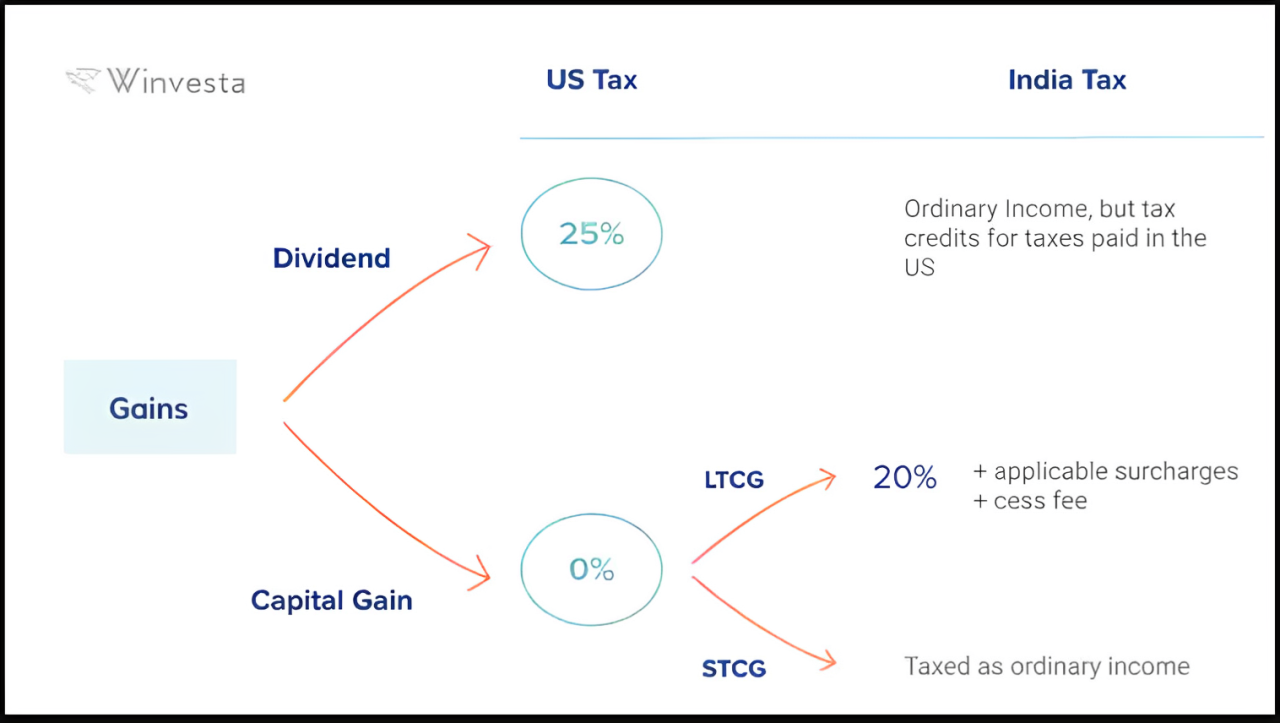
Dividend from U.S. stocks:
-
Treated as foreign income.
-
Subject to 25% withholding tax in the U.S..
-
Remaining 75% taxed in India as per slab rates.
-
-
Double Taxation Avoidance Agreement (DTAA):
-
India-U.S. DTAA allows foreign tax credit for tax already paid in U.S.
-
To claim benefit: File Form 67 before Indian ITR filing.
-
Challenges in claiming:
-
Different financial years (U.S.: Jan–Dec vs India: Apr–Mar).
-
Exchange rate differences.
-
Timing and documentation mismatches.
-
-
Capital Gains Tax on U.S. Stocks
-
No capital gains tax in U.S. for Indian NRAs (Non-Resident Aliens).
- But India taxes all capital gains from U.S. equities:
| Holding Period | Tax Type | Rate |
|---|---|---|
| > 24 months | LTCG | 20% + surcharge + cess |
| ≤ 24 months | STCG | Taxed as per income slab |
-
Governed under the Black Money (Undisclosed Foreign Income and Assets) and Imposition of Tax Act, 2015.
-
Mandatory to disclose all foreign assets (stocks, bank accounts, etc.) under Schedule FA in ITR.
-
Penalties for non-disclosure:
-
₹10 lakh per year per asset.
-
Imprisonment up to 7 years in extreme cases.
-
-
Even if:
-
Stock is not sold (no gains/losses),
-
Value is negligible (even $1),
-
Dividend is minimal,
-
Still must be declared.
-