
Tribal body opposes ST status for six Assam communities
Context
The Coordination Committee of Tribal Organisations of Assam (CCTOA) has opposed the recommendation to grant Scheduled Tribe (ST) status to six Assam communities:
Chutia
Koch-Rajbongshi
Matak
Moran
Tai Ahom
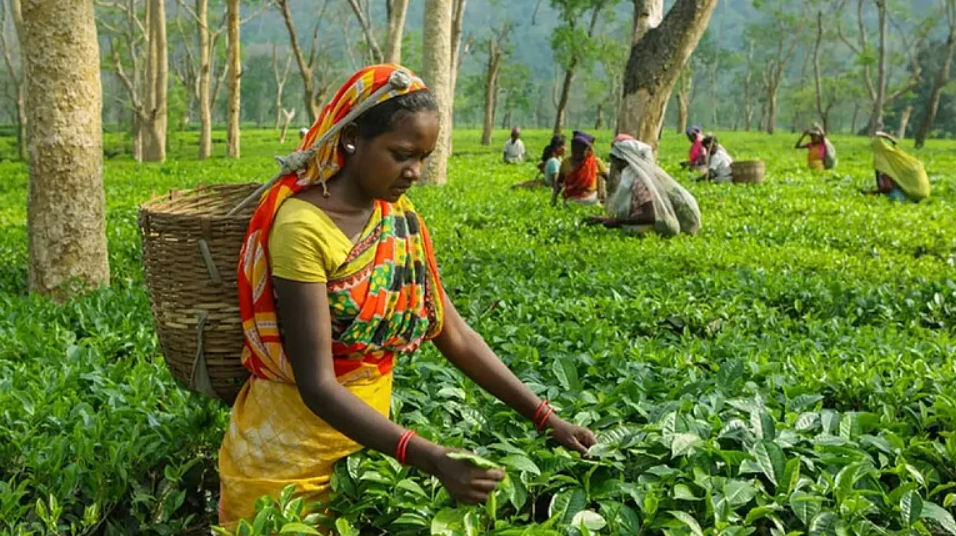
Tea Tribes (Adivasis)
The opposition is directed against the report of a Group of Ministers (GoM) submitted to the Assam Legislative Assembly in November 2025.
What did the Group of Ministers recommend?
Grant ST status to the six communities
Create three sub-categories:
ST (Plain)
ST (Hill)
ST (Valley)
This proposal aims to accommodate the communities without formally displacing existing ST groups.
Why is CCTOA opposing the move?
1. Constitutional and conceptual objection
CCTOA argues that ST status is not based on caste, unlike Scheduled Castes (SCs).
According to the Lokur Committee (1965), Scheduled Tribes are identified using the following indicators:
Primitive traits
Distinctive culture
Geographical isolation
Shyness of contact with the wider society
Social and economic backwardness
CCTOA claims that the six communities do not uniformly satisfy these criteria.
2. Historical committee recommendations
In 1993, the Assam Institute of Research for the Tribals and Scheduled Castes recommended OBC status, not ST status, for these communities.
Subsequently, the National Commission for Backward Classes notified them as Other Backward Classes (OBCs).
CCTOA’s argument:
Once a community is officially classified as OBC, reclassification as ST for political reasons violates constitutional logic and administrative consistency.
3. Tea Tribes specific objection
CCTOA cites:
The Lokur Committee
The August 1947 Joint Report of the Excluded and Partially Excluded Areas and North-East Frontier Tribal Areas Sub-Committee
Both reports explicitly advised against granting ST status to tea plantation workers, as they were migrant labour communities without tribal characteristics indigenous to Assam.
4. Impact on political representation
CCTOA fears:
Dilution of political reservation for existing STs in:
Panchayats
Autonomous councils
State Assembly
Lok Sabha
Reduction in access to Central reservation quotas for current ST communities
Hence, the move is seen as zero-sum, not inclusive.
Constitutional dimension
Article 342: President specifies STs in consultation with the Governor; Parliament has the power to modify the list.
Courts have consistently held that ST identification is not purely socio-economic, but anthropological and historical.
Why this issue is sensitive in Assam?
Assam has high ethnic diversity with limited reserved political space.
Any expansion of the ST list directly affects:
Electoral constituencies
Autonomous council powers
Resource-sharing mechanisms
Thus, tribal organisations see this as an existential political issue, not merely a welfare question.
Prelims Practice MCQ
Q. According to the criteria laid down by the Lokur Committee (1965), Scheduled Tribes are identified primarily on the basis of:
Primitive traits
Distinctive culture
Position in the Hindu caste hierarchy
Geographical isolation
Select the correct answer using the code below:
(a) 1, 2 and 3 only
(b) 2, 3 and 4 only
(c) 1, 2 and 4 only
(d) 1, 2, 3 and 4
Answer: (c)
Explanation:
ST identification is not based on caste hierarchy (that applies to SCs).
Primitive traits, distinctive culture, and geographical isolation are core Lokur Committee criteria.