
The Indian Ocean as cradle of a new blue economy
India’s historic role in ocean diplomacy
During UNCLOS (1970s–1980s), India aligned with small island developing states, supporting the idea that seabed areas beyond national jurisdiction are the “common heritage of mankind.”
Jawaharlal Nehru (1950s) emphasised the ocean’s centrality to India’s security and prosperity.
India has historically balanced development, equity, and environmental stewardship.
Contemporary ocean pressures
Climate change: warming, acidification, rising sea levels.
IUU fishing, coral degradation, and ecosystem collapse.
The Indian Ocean, home to one-third of humanity, is among the world’s most climate-vulnerable basins.
India’s Blue Ocean Strategy — three pillars
a. Stewardship
Indian Ocean as a shared and cooperative space.
Focus on ecosystem restoration, biodiversity protection, sustainable fisheries.
b. Resilience
Proposal for a Regional Resilience and Ocean Innovation Hub:
strengthens ocean observation
early warning systems
technology transfer to SIDS and African coastal states
c. Inclusive growth
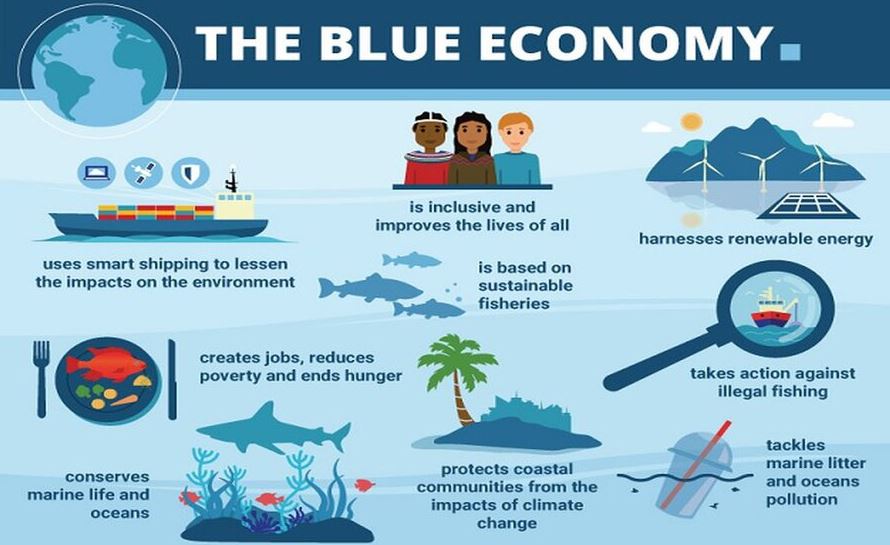
Green shipping, offshore renewable energy, sustainable aquaculture, marine biotechnology.
Requires coordinated regional action and investment.
Turning point in ocean finance
At the Blue Economy and Finance Forum (Monaco, June 2025):
€25 billion pipeline + €8.7 billion new commitments
Finance in Common Ocean Coalition → $7.5 billion annually
Development Bank of Latin America → doubling target to $2.5 billion (by 2030)
At COP30 (Belém):
One Ocean Partnership launched → mobilise $20 billion by 2030
India could establish an Indian Ocean Blue Fund, attracting contributions from development banks, philanthropy, and private sector.
Security through sustainability
Ocean insecurity arises from ecological collapse and climate stress.
IUU fishing, coral loss, coastal vulnerability → socio-economic instability.
India’s SAGAR doctrine (2015): zone of peace, stability and prosperity.
Indian Navy + Coast Guard can advance regional collaboration on:
maritime domain awareness
disaster response
ecosystem monitoring
Narrative of cooperation
India’s approach: cooperative, consultative, outcome-oriented (Jaishankar).
Guiding idea: “From the Indian Ocean, for the World.”
India’s historic responsibility (2026 as a pivotal year)
1972 Stockholm warning by Indira Gandhi on balancing environment and development.
Global landmarks relevant to oceans:
UNOC3 (Nice)
COP30 (Belém)
G20 Johannesburg
Entry into force of BBNJ Agreement
India preparing to ratify the BBNJ Agreement, enabling leadership on:
green shipping corridors
blue bonds
marine technology transfer
well-governed ocean-based carbon removal
Opportunity for India as future chair of the Indian Ocean Rim Association.
The Indian Ocean can become the cradle of a new blue economy balancing prosperity, sustainability, resilience, and justice.
Global Landmarks Relevant to Oceans
1. UNOC3 – Third United Nations Ocean Conference (Nice, France)
A major global conference focused on achieving SDG-14 (Life Below Water).
Emphasis on:
protecting marine ecosystems
reducing marine pollution
scaling up ocean finance
strengthening marine science and technology cooperation
Countries showcased commitments toward sustainable blue economies.
Helps set the global agenda for ocean governance leading into 2026.
2. COP30 (Belém, Brazil)
A climate conference where the One Ocean Partnership was launched.
Recognised oceans as central to climate stability and community resilience.
Committed to mobilising USD 20 billion for ocean-related action by 2030.
Strengthened the linkage between climate mitigation/adaptation and marine ecosystems.
3. G20 Summit (Johannesburg)
Highlighted the role of terrestrial and marine ecosystems in climate resilience and sustainable development.
Included discussions on:
scaling up climate finance
supporting developing countries for oceans and coastal adaptation
advancing nature-based solutions
Reinforced global political momentum for the blue economy.
4. Entry into Force of the BBNJ Agreement (High Seas Treaty)
The Biodiversity Beyond National Jurisdiction (BBNJ) Agreement aims to conserve and sustainably use marine biodiversity in areas beyond national jurisdiction (i.e., the high seas).
Key elements:
Marine Genetic Resources (MGRs) sharing
Area-Based Management Tools (ABMTs) and Marine Protected Areas
Environmental Impact Assessments (EIAs)
Capacity building and technology transfer
Its entry into force marks a landmark moment in international ocean governance, shaping new global norms.
Prelims Practice MCQs
Q. With reference to global ocean governance, which of the following statements is/are correct?
The BBNJ Agreement deals with conservation and sustainable use of marine biodiversity in areas beyond national jurisdiction.
The principle of “common heritage of mankind” originates from the UNCLOS regime.
India opposed this principle during UNCLOS negotiations.
Select the correct answer:
A. 1 only
B. 1 and 2 only
C. 2 and 3 only
D. 1, 2 and 3
Answer: B
Explanation:
Statement 1: Correct.
Statement 2: Correct; applied especially to seabed resources beyond national jurisdiction.
Statement 3: Incorrect; India supported it alongside small island states.
Q. Which of the following global events is directly linked with the launch of the One Ocean Partnership?
A. UNOC3 (Nice)
B. COP30 (Belém)
C. G20 Johannesburg
D. BBNJ Agreement entry into force
Answer: B