
THAAD (Terminal High Altitude Area Defense)
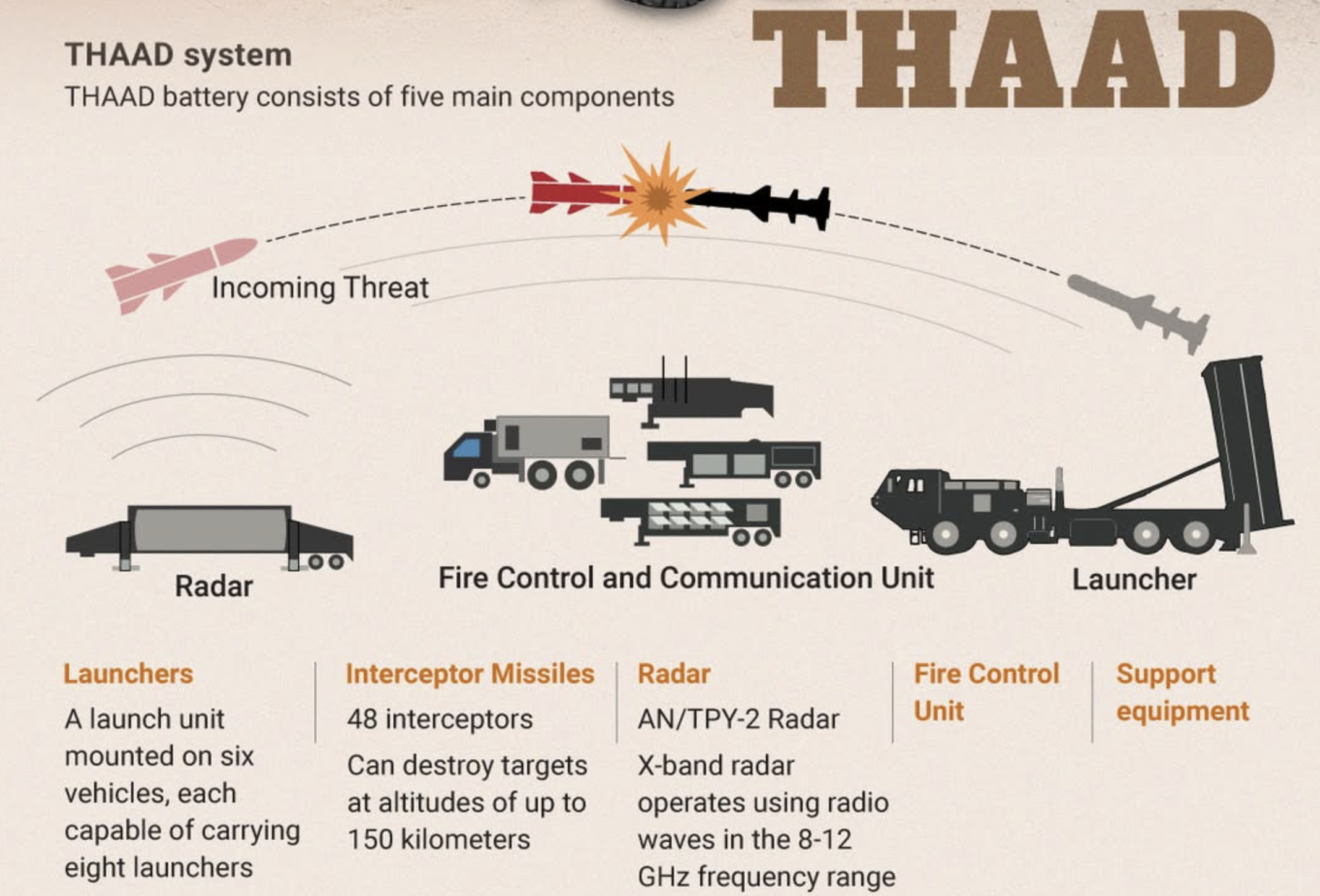
What is THAAD?
THAAD (Terminal High Altitude Area Defense) is an advanced ballistic missile defence system developed by the United States.
It is designed to intercept and destroy ballistic missiles during the terminal phase of their flight.
It can destroy targets inside and outside the Earth’s atmosphere.
It mainly counters short-range, medium-range, and limited intermediate-range ballistic missiles.
Key feature: Hit-to-kill technology
THAAD uses “hit-to-kill” kinetic interception.
Instead of explosives, the interceptor missile directly collides with the incoming missile.
Destruction occurs due to kinetic energy generated by the high-speed impact.
Advantages:
Higher precision
Reduced collateral damage
Less debris compared to explosive interception
Interception capability
Effective interception range: 150–200 km
Intercepts missiles at high altitude before they descend toward targets
Designed to protect population centres, military bases, and critical infrastructure
Components of THAAD system
The THAAD system is part of the Ballistic Missile Defence System (BMDS) architecture and includes:
Interceptor missiles
Destroy incoming ballistic missiles using kinetic impact.
Truck-mounted launchers
Mobile launch platforms carrying interceptor missiles.
AN/TPY-2 radar
High-power radar used for detection, tracking, and discrimination of missile threats.
Fire control and communication system
Coordinates targeting and engagement.
Logistics and support equipment
THAAD battery composition
A standard THAAD battery includes:
About 90 personnel
6 launchers
48 interceptor missiles
Each launcher carries 8 interceptors
Integration with layered missile defence
THAAD operates as part of a multi-layered missile defence network.
It can integrate with:
Patriot air defence system (PAC-3)
Aegis Ballistic Missile Defence system
This layered architecture helps intercept missiles at multiple stages of flight.
Deployment and mobility
THAAD is highly mobile and rapidly deployable.
The first operational deployment occurred in Guam in 2013.
It can be quickly positioned in regions facing ballistic missile threats.
International users
Countries that have acquired THAAD include:
United Arab Emirates (first foreign buyer in 2011)
Saudi Arabia
Role in the West Asia conflict
The U.S. deployed additional THAAD batteries in West Asia during the war involving Iran, Israel, and the U.S..
THAAD helps intercept ballistic missiles launched by hostile actors before they reach targets.
Radar vulnerability
Reports indicate that an AN/TPY-2 radar used for missile tracking was destroyed at Muwaffaq Salti Air Base in Jordan.
The radar, worth about $300 million, is crucial for guiding missile defence systems across the region.
Strategic importance
Ballistic missiles travel extremely fast and at high altitudes, leaving little reaction time.
Systems like THAAD enable early interception far from populated areas.
It is a critical part of the U.S. layered missile defence strategy.
Prelims practice MCQs
Q. With reference to the Terminal High Altitude Area Defense (THAAD) system, consider the following statements:
It is a ballistic missile defence system developed by the United States.
It destroys incoming missiles using explosive warheads.
It intercepts missiles during the terminal phase of their flight.
Which of the statements given above is/are correct?
A. 1 and 3 only
B. 2 only
C. 1 and 2 only
D. 1, 2 and 3
Answer: A
Explanation:
Statement 1: Correct — THAAD is an advanced ballistic missile defence system developed by the United States.
Statement 2: Incorrect — It uses hit-to-kill technology, relying on kinetic impact, not explosive warheads.
Statement 3: Correct — It intercepts missiles during the terminal phase of their trajectory.
Q. The term “hit-to-kill technology” used in missile defence refers to:
A. Destroying a missile using nuclear warheads
B. Destroying a missile through direct collision using kinetic energy
C. Jamming enemy radar systems
D. Disabling missiles through electronic warfare
Answer: B
Explanation:
“Hit-to-kill” technology destroys incoming missiles by directly colliding with them at high speed, using kinetic energy rather than explosives.