
Tamil Nadu’s ₹1 Crore Initiative for Conservation of Four Lesser-known Endangered Species
Context
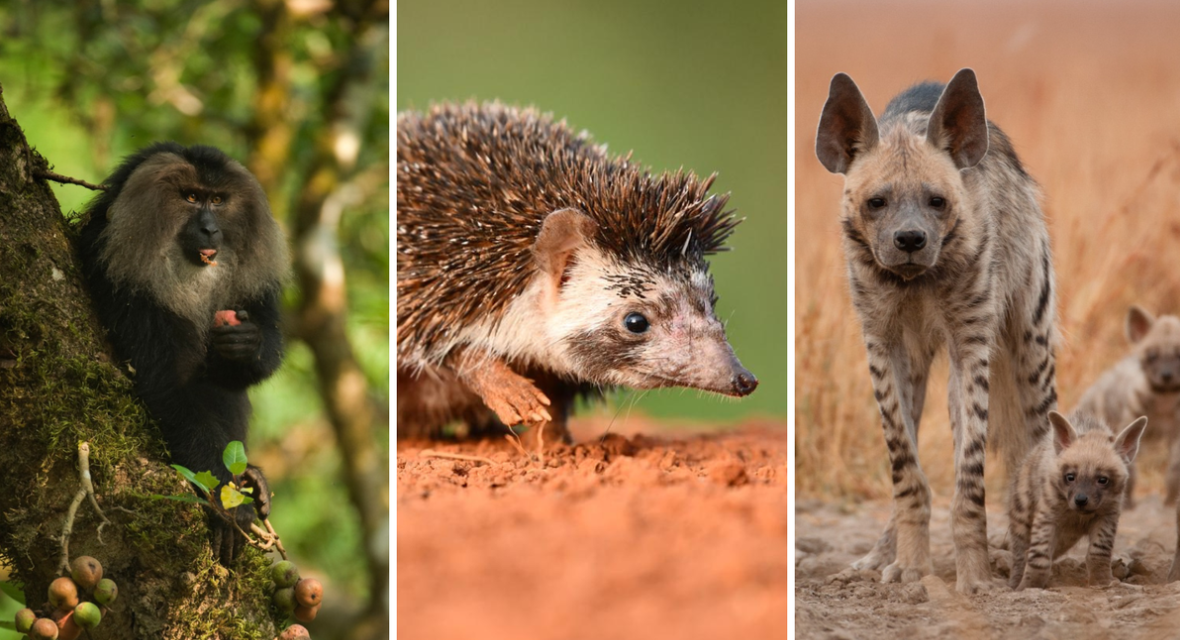
Tamil Nadu Govt sanctioned ₹1 crore for conservation of four lesser-known endangered species:
Lion-tailed macaque
Madras hedgehog
Striped hyena
Hump-headed mahseer
Objectives
To expand conservation beyond flagship species (elephants, tigers).
Focus on ecologically critical but understudied species that maintain food chain balance and ecosystem health.
Strengthen long-term biodiversity planning in line with Tamil Nadu Biodiversity Strategy 2025 and India’s National Biodiversity Action Plan (NBAP).
Species & Focus Areas
Species | Status | Key Habitat & Ecological Role |
Lion-tailed macaque (Macaca silenus)
| Endangered (IUCN) | Endemic to Western Ghats; canopy-dependent frugivore aiding seed dispersal; threatened by habitat fragmentation. |
Madras hedgehog (Paraechinus nudiventris)
| Least Concern (IUCN) | First discovered in 1851. Found in semi-arid scrublands of Tamil Nadu, Andhra Pradesh, and Kerala; nocturnal insectivore, indicator of dryland ecosystem health. Schedule II WLPA act (amended 2022) The hedgehog curls up into a ball when it feels a threat.
|
Striped hyena (Hyaena hyaena)
| Near Threatened (IUCN) | Scavenger vital for nutrient recycling; population decline due to poisoning, habitat loss in Mudumalai & adjoining areas. lives in the Sigur plateau |
Hump-headed mahseer (Tor remadevii)
| Critically Endangered (IUCN) | Large Freshwater fish native to Cauvery & Moyar rivers; impacted by dams, overfishing, and invasive species. Endemic to the Kaveri River basin in India. It is a narrow endemic species, meaning it lives only in the Kaveri River basin, which spans parts of Karnataka, Kerala, and Tamil Nadu Also known as the tiger of the Cauvery |


Planned Conservation Interventions
Lion-tailed macaque: Installation of canopy bridges to reconnect forest patches; population monitoring; anti-fragmentation measures.
Madras hedgehog: Habitat mapping, population assessment, community sensitisation in rural areas.
Striped hyena: Camera-trap surveys, carcass management, public awareness to reduce persecution.
Hump-headed mahseer: In situ breeding, restocking programmes in Moyar River, and ecological flow studies.
Capacity building: Training for forest frontline staff, awareness drives, and long-term ecological research.
Recent Conservation Milestones in Tamil Nadu
India’s first Dugong Conservation Reserve – Palk Bay (2022).
Kadavur Slender Loris Sanctuary – Karur District (2022).
Project Nilgiri Tahr – Launched 2023, for restoration of Tamil Nadu’s State Animal.
Significance
Strengthens State-level biodiversity governance and aligns with SDG-15 (Life on Land).
Sets a model for other states to focus on non-charismatic species crucial to ecosystem stability.
Enhances baseline ecological data, essential for IUCN status reassessment and national reporting to the Convention on Biological Diversity (CBD).
Pratice MCQ :
With reference to Tamil Nadu’s biodiversity conservation initiatives, consider the following:
Project Nilgiri Tahr was launched in 2023.
The Dugong Conservation Reserve is located in the Palk Bay region.
The hump-headed mahseer is a marine species found along the east coast.
Which of the above statements are correct?
a) 1 and 2 only
b) 2 and 3 only
c) 1 and 3 only
d) 1, 2 and 3
Answer: a) 1 and 2 only,
hump-headed mahseer is NOT a marine species