
Sungudi sari
Introduction
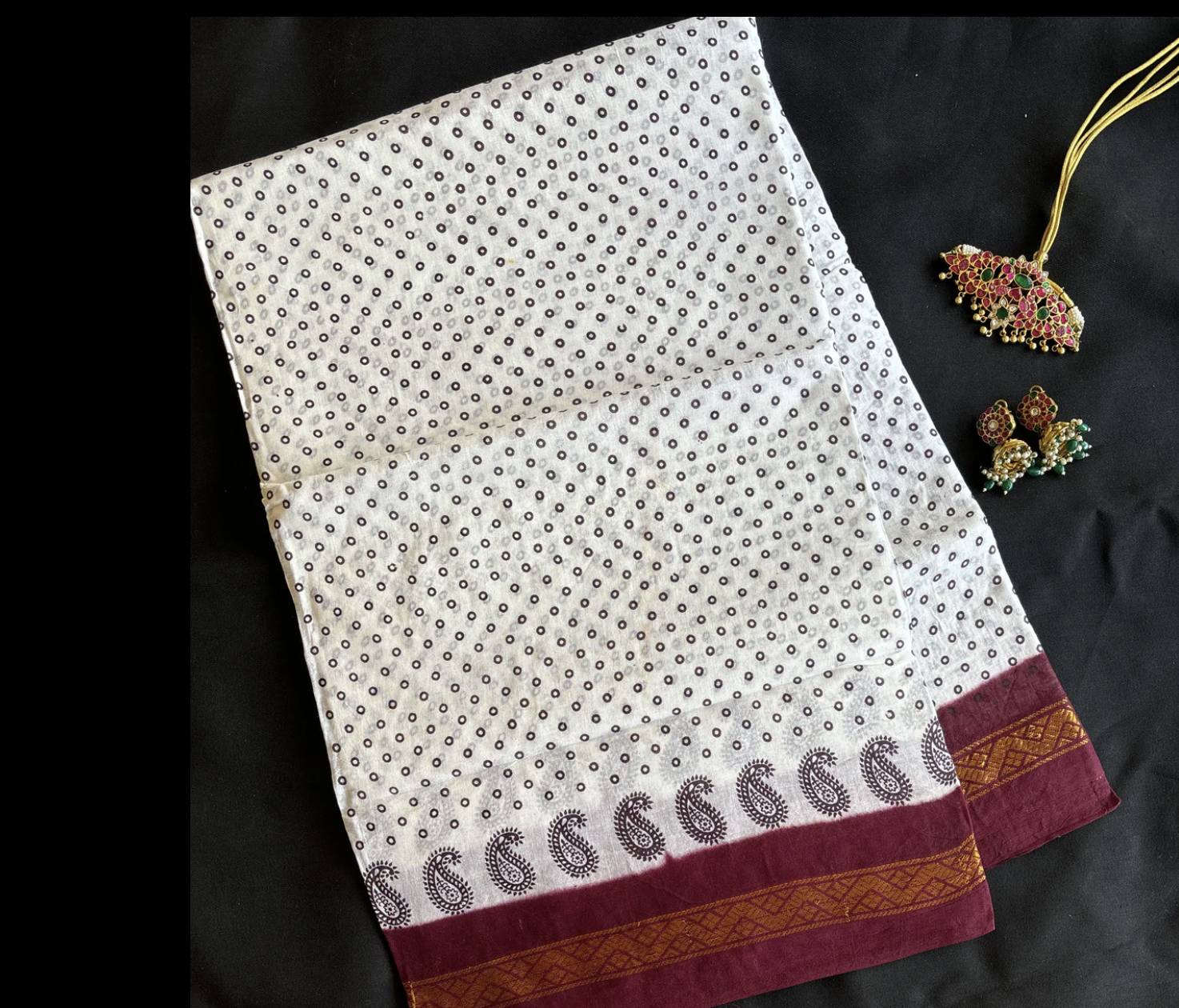
Sungudi sari is a traditional handloom cotton sari associated with Madurai, Tamil Nadu.
Known for its distinctive tie-and-dye (bandhani-style) white dot patterns.
Awarded Geographical Indication (GI) tag on December 12, 2005.
Cultural legacy of the Saurashtrian community who migrated from Gujarat to Madurai in the 17th century.
Historical background
Origin linked to migration of Saurashtrian weavers from Gujarat.
Folklore associates its design inspiration with the star-studded sky along the Vaigai river.
Represents cultural assimilation: Gujarati textile techniques adapted to Tamil socio-cultural context.
Production process
Base cloth woven (usually fine cotton with zari border).
Fabric is hand-knotted meticulously to create patterns.
Dyed in vibrant shades.
Knots are untied after dyeing.
Final wash removes excess dye.
Starched and sun-dried.
Key features:
May contain over 15,000 tiny white dots.
Takes more than 15 days to complete one sari.
Entirely labour-intensive and handcrafted.
Distinctive characteristics
Lightweight and breathable cotton fabric.
Small circular white dot motifs.
Bright colours with contrast zari borders.
Affordable to premium range: ₹500 to ₹20,000 depending on thread count and craftsmanship.
Economic and cultural significance
Cultural heritage
Reflects syncretic traditions (Gujarati weaving + Tamil aesthetics).
Part of Tamil Nadu’s textile identity.
Example of India’s living handloom traditions.
Economic importance
Supports handloom weavers in Madurai region.
Falls under MSME and cottage industry sector.
Potential for export and global fashion integration.
Challenges
Competition from power loom and machine-printed imitations.
Declining interest among younger generations in traditional weaving.
Limited global branding and market linkage.
Income instability for artisans.
Way forward
Strengthen GI enforcement to prevent duplication.
Promote through:
International fashion shows.
E-commerce platforms.
Government schemes like National Handloom Development Programme.
Encourage design innovation while retaining authenticity.
Integrate with “Vocal for Local” and One District One Product initiatives.
Prelims Practice MCQs
Q. With reference to the Sungudi sari, consider the following statements:
It is traditionally associated with Madurai in Tamil Nadu.
It is produced using a tie-and-dye technique involving hand-knotting.
It received Geographical Indication (GI) status in 2005.
Which of the statements given above are correct?
(a) 1 and 2 only
(b) 2 and 3 only
(c) 1 and 3 only
(d) 1, 2 and 3
Answer: (d) 1, 2 and 3
Explanation:
Statement 1 is correct. Sungudi sari is closely associated with Madurai.
Statement 2 is correct. It involves a labour-intensive tie-and-dye technique with thousands of hand-tied knots.
Statement 3 is correct. It was granted GI status on December 12, 2005.
Q. The Sungudi sari tradition in Tamil Nadu is historically linked to which of the following communities?
(a) Marwaris
(b) Saurashtrians
(c) Chettiars
(d) Parsis
Answer: (b) Saurashtrians
Explanation:
The Saurashtrian community migrated from Gujarat to Madurai in the 17th century and perfected the Sungudi tie-and-dye technique in the region.
Q. Which of the following features distinguish a Sungudi sari?
Fine cotton fabric
Large block-printed motifs
Numerous small white dots created through knotting
Zari borders in many designs
Select the correct answer:
(a) 1 and 3 only
(b) 1, 3 and 4 only
(c) 2 and 4 only
(d) 1, 2, 3 and 4
Answer: (b) 1, 3 and 4 only
Explanation:
Statement 1 is correct. Sungudi saris are typically made of breathable cotton fabric.
Statement 2 is incorrect. The patterns are not primarily block-printed; they are created through tie-and-dye knotting.
Statement 3 is correct. Thousands of tiny white dots are formed by tying and dyeing.
Statement 4 is correct. Many Sungudi saris feature zari borders.