
Snow Leopards: The World’s Least Genetically Diverse Big Cat
Introduction
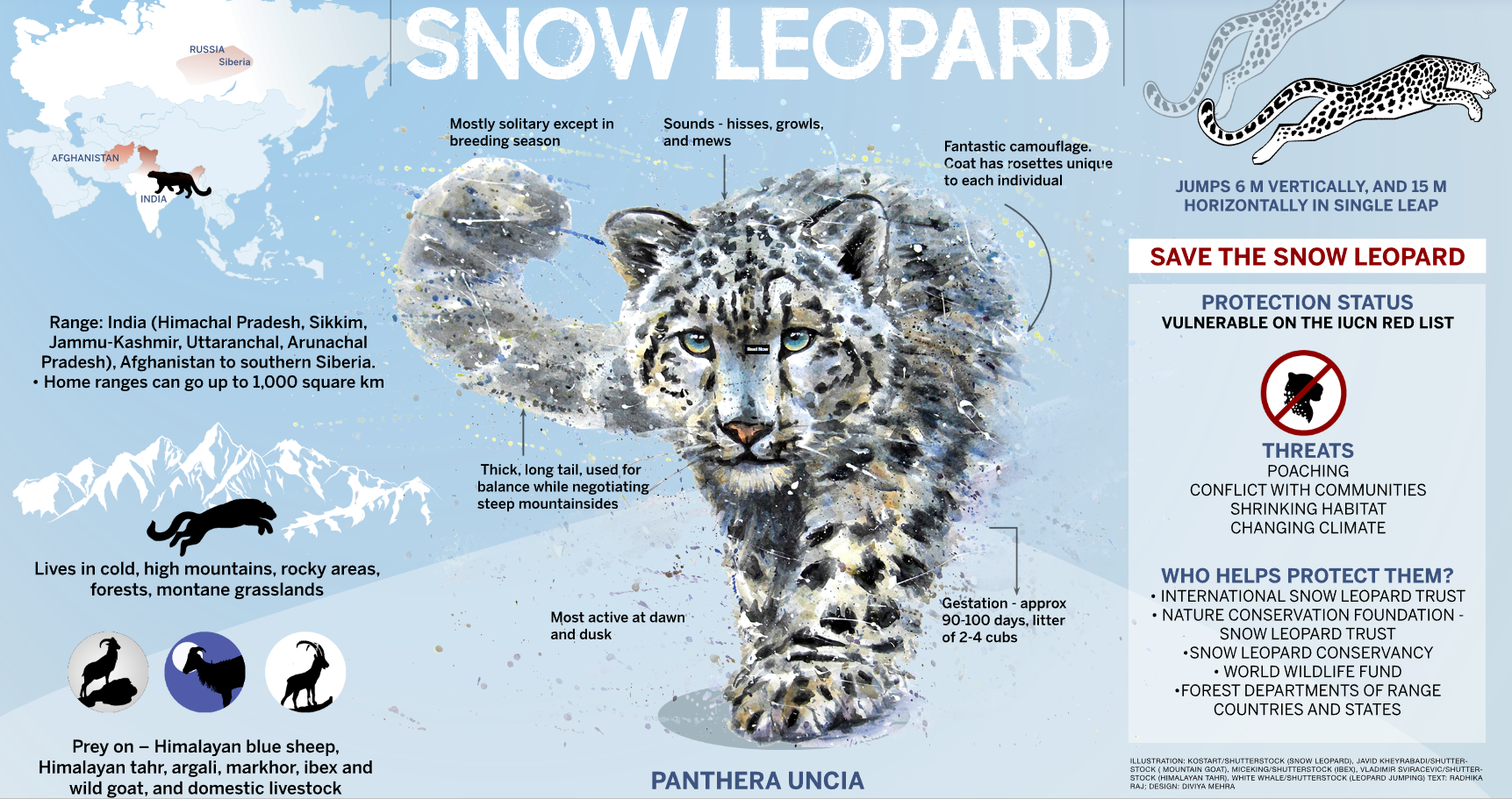
The snow leopard (Panthera uncia), often called the “ghost of the mountains,” inhabits the rugged terrains of 12 Asian countries, including India. Despite being a symbol of resilience in harsh alpine ecosystems, a new study by Stanford University (PNAS, October 2025) reveals that snow leopards possess the lowest genetic diversity among all big cats, even lower than cheetahs traditionally known for their genetic uniformity.
Key Findings of the Study
Sample Size: 37 snow leopards analyzed using whole-genome sequencing data
Main Conclusion:
The low genetic diversity stems from a persistently small population size throughout evolutionary history not from recent inbreeding.
Genetic Implications
Low Heterozygosity:
Every snow leopard sample showed lower heterozygosity than any other big cat, including the cheetah.
→ Indicates minimal genetic variability across the species.Purging of Harmful Mutations:
Over generations, harmful mutations have been effectively “purged.”
Individuals with deleterious traits likely died before reproducing.
Result: Despite low diversity, populations remain relatively healthy.
Inbreeding Coefficient:
Higher than in most big cats, yet not the cause of low diversity.
Inbreeding may have historically facilitated purging of bad mutations.
Future Risk:
Limited adaptability to climate change, disease, and anthropogenic pressures due to restricted gene pool.
Conservation and Ecological Importance
Population Estimates: 4,500 – 7,500 globally
Habitat Range: 12 countries across Central and South Asia
Role in Ecosystem: Apex predator maintaining mountain ecosystem balance; habitats act as major carbon sinks and water sources for nearly 2 billion people in Asia.
Status and Threats
IUCN Red List: Vulnerable (downlisted from Endangered in 2017)
Major Threats:
Climate change altering snowline and prey distribution
Habitat fragmentation and infrastructure projects
Declining prey base (mountain ungulates like Siberian ibex)
Retaliatory killings and poaching
Borderland infrastructure in fragile ecosystems
Snow Leopard in India
Estimated Wild Population (2024 Survey): 718 individuals
Ladakh – 477
Uttarakhand – 124
Himachal Pradesh – 51
Arunachal Pradesh – 36
Sikkim – 21
Jammu & Kashmir – 9
India’s Share: 10–15% of global population
Significance: Third-highest snow leopard population after China and Mongolia
Conservation Initiatives:
Project Snow Leopard (2009): Central scheme integrating local communities in conservation.
Snow Leopard Trust (NCF Mysore): Working for 27 years with local participation.
Habitat Connectivity: Evidence of corridor continuity (75 km in Pakistan; ~1,000 km in Mongolia).
Research Challenges
Sample Collection: Difficult due to remote, high-altitude terrain and bureaucratic hurdles.
Permitting and Funding: Often misaligned, slowing genetic studies.
Need for India: Larger, systematic sampling across Himalayas to map genetic diversity regionally.