
Self-Respect Movement – 100 Years Retrospective
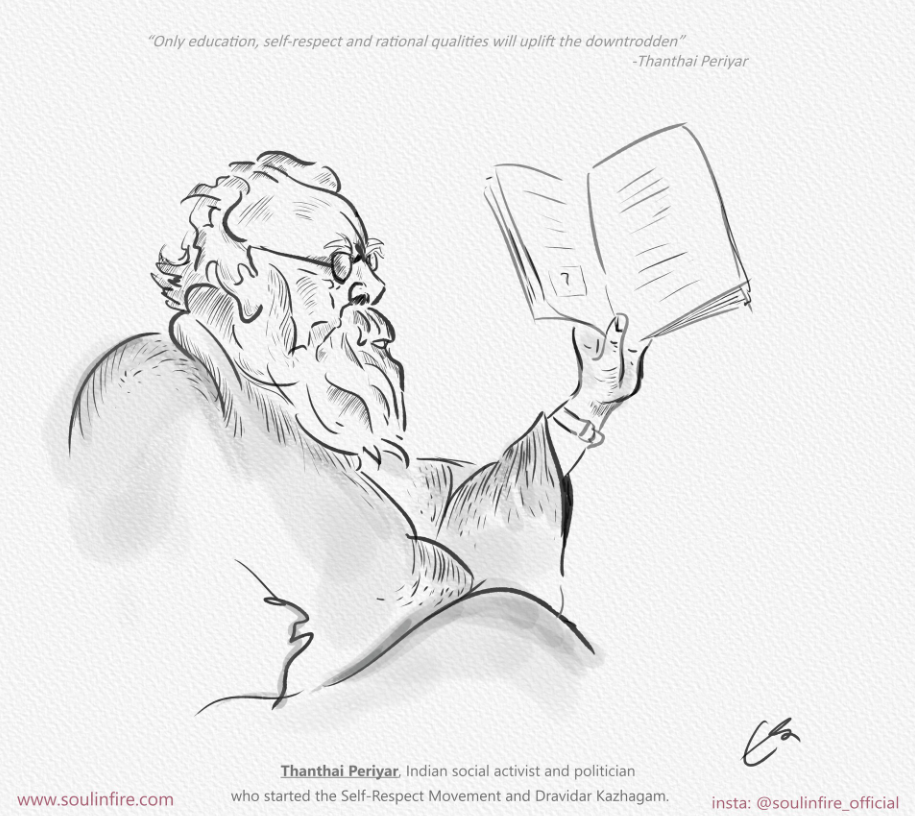
Background & Origins
-
Founded: 1925 by Periyar E.V. Ramasamy after leaving the Indian National Congress.
-
Context:
-
Early 20th century South India – dominance of Brahmins in politics, education, and media.
(South Indian Liberal Federation) Justice Party (1916) – first attempt at non-Brahmin assertion, but confined largely to elite non-Brahmins.
-
Periyar’s ideological break: believed English education and government jobs alone would not dismantle caste oppression.
-
-
Trigger: Launch of Tamil weekly Kudi Arasu (Republic) – became the voice and vehicle of the Self-Respect Movement.
Ideological Core
-
Rejection of caste hierarchy and Brahmin dominance.
-
Rationalist critique of religion, superstition, and patriarchy.
-
Vision of egalitarian society based on reason, equality, and self-respect.
-
movement was not a single event but a “process” of rebellion and defiance, questioning sacred traditions and empowering ignored communities.
Role of Kudi Arasu
-
Radical strand of the Dravidian movement.
-
Advocacy journalism challenging upper-caste dominance in media.
-
Mobilised masses through Tamil language, simple communication, and sharp social critique.
-
Provided an alternative to Congress nationalism, portraying the Congress as tied to Hinduism and caste hierarchy.
Radical Social Reforms
-
Self-Respect Marriages – no Brahmin priests, rejection of religious rituals, emphasis on equality.
-
Women’s Liberation – supported widow remarriage, right to divorce, right to property, and even abortion rights.
-
Caste Reforms – promoted inter-caste marriages, temple-entry, rejection of caste names.
-
Education & Rationalism – stressed on scientific temper and eradication of superstitions.
Contribution & Legacy
-
Justice Party → Self-Respect Movement → Dravidar Kazhagam (DK) → DMK/AIADMK – laid the foundation of Tamil Nadu’s Dravidian political discourse.
-
Shifted politics from elite negotiation to mass mobilisation.
-
Created cultural icons, slogans, and practices that persist in Tamil Nadu’s socio-political landscape.
-
Periyar instilled self-pride among non-Brahmin masses, uniting them beyond caste into a rationalist social reform movement.
Principles of the Self-Respect Movement (1929 Conference)
At the First Self-Respect Conference (1929), Periyar speaking with
M.K.Reddy articulated the foundational principles:
-
Equality of Human Beings
-
No kind of inequality among people.
-
Rejection of caste hierarchy, untouchability, and hereditary privilege.
-
-
Economic Justice
-
No difference such as rich and poor in economic life.
-
Aim of equitable distribution of resources, though not strictly socialist at the time.
-
-
Gender Equality
-
Men and women to be treated as equals in every respect.
-
No differences in education, marriage, property rights, or social freedom.
-
-
Eradication of Social Divisions
-
Attachments to caste, religion, varna, and even narrow nationalism to be eliminated.
-
Movement envisioned a universal fraternity transcending sectarian identities.
-
-
Rationalism and Freedom of Thought
-
Every human being should act according to reason, understanding, desire, and perspective.
-
Complete rejection of superstition, priestly dominance, and blind faith.
-
-
Freedom from Slavery of Any Kind
-
No individual should be subject to social, political, religious, or economic slavery.
-
True self-respect = autonomy in thought and action.
-