
Section 79 of the Information Technology Act, 2000
Fake Verified X Account Demonstration in Karnataka HC
Why in news : In an ongoing case in the Karnataka High Court, the Union Government demonstrated how social media accounts can be easily misused by creating a fake verified X (formerly Twitter) account in the name of a non-existent body — the "Supreme Court of Karnataka". The account, verified by the platform, was shown in court by Solicitor-General Tushar Mehta to highlight the potential for misinformation and impersonation.
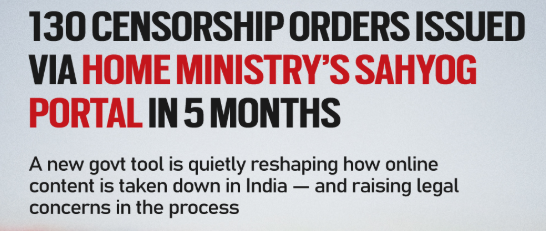
This demonstration was presented during the hearing of a petition filed by X Corp., which is challenging the blocking orders issued under Section 79 of the Information Technology Act, 2000. X Corp. also objected to the Centre’s ‘Sahyog’ portal, alleging it facilitates pre-approved censorship and circumvents the safeguards laid down by the Supreme Court in previous judgments related to free speech and intermediary responsibility.
Important Acts & Provisions:
-
Information Technology Act, 2000
-
Section 79: Provides “safe harbour” to intermediaries (like X), shielding them from liability for third-party content unless they fail to act on government orders to block or remove content.
-
Central issue in the case revolves around whether blocking orders bypass procedural safeguards mandated under this section.
-
-
Supreme Court Judgment:
-
Shreya Singhal v. Union of India (2015): Held that intermediaries must only remove content upon receiving actual knowledge through a court order or notification by an appropriate government agency, thus placing limits on arbitrary blocking.
-
Relevant Scheme/Platform:
-
Sahyog Portal:
Origin:
SAHYOG follows an October 2023 Office Memorandum from the Ministry of Electronics and Information Technology (MeitY) authorizing government agencies to block content under Section 79 of the IT Act, 2000.-
Legal Provision Used – Section 79(3)(b), IT Act:
-
Grants “safe harbour” protection to intermediaries.
-
But if platforms are notified by the government of unlawful content and fail to remove it, they lose immunity.
-
-
X’s Objection:
-
Argues that SAHYOG bypasses Section 69A of the IT Act, which:
-
Allows blocking only on specific grounds: national security, public order, etc.
-
Includes procedural safeguards: written orders, designated officer, and review mechanism.
-
-
SAHYOG allows multiple agencies, including state police, to issue takedown requests without procedural checks.
-
-
Case Reference:
In Shabana vs Govt of NCT of Delhi, Delhi HC had asked for a real-time coordination mechanism, which led to the development of SAHYOG.
UPSC Syllabus (GS Paper II & III):
-
GS II: Issues related to governance, transparency, and accountability in social media regulation.
-
GS III: Role of IT Act in cyber regulation, misuse of digital platforms, ethical use of AI and algorithms in content moderation.