
Sea cucumber poaching case in Lakshadweep
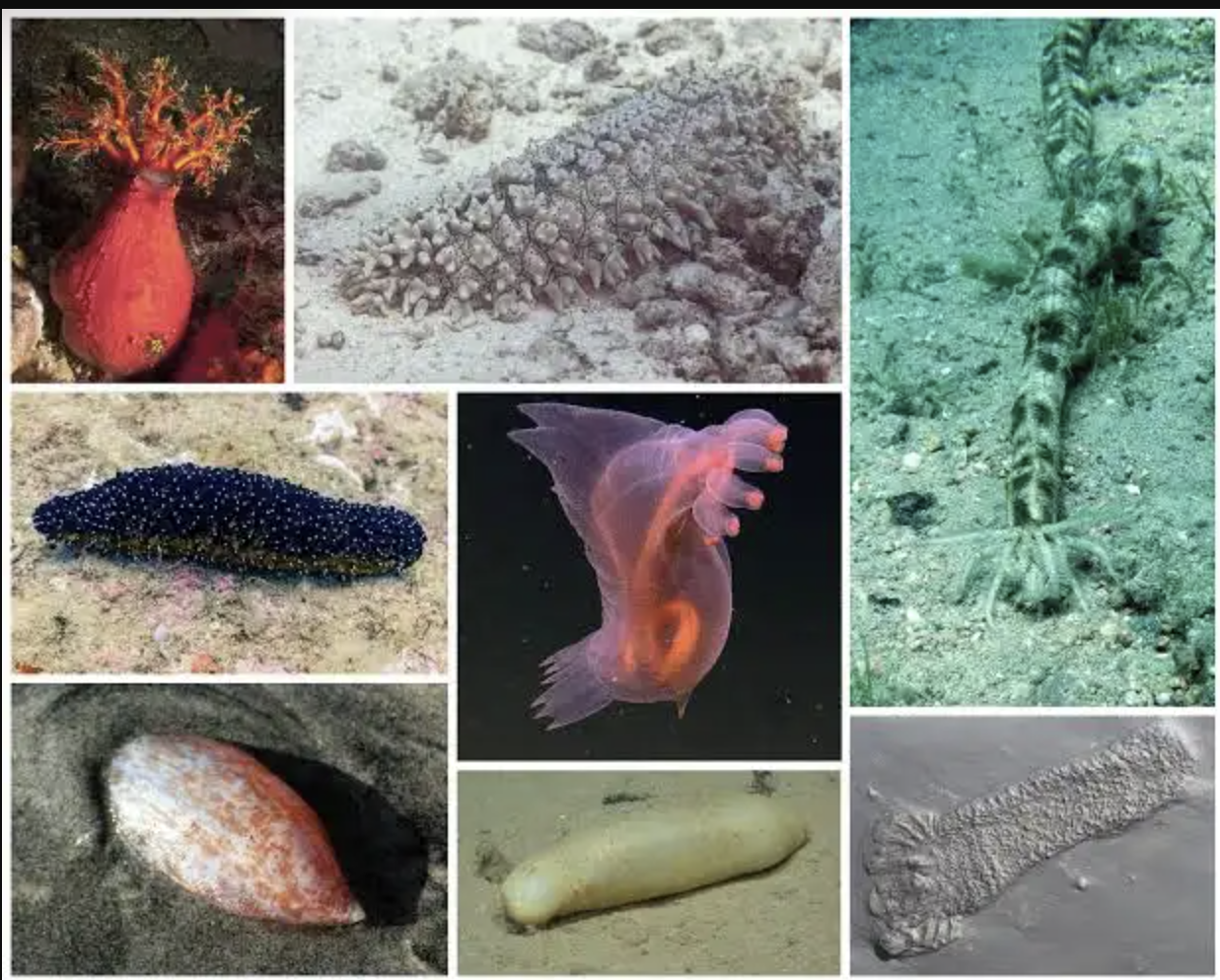
Context
The Directorate of Enforcement (ED) filed prosecution complaints before the Special Court for PMLA cases in Kavaratti (Lakshadweep) against four individuals for illegal activities related to sea cucumber poaching and trade.
The ED filed the case under the Prevention of Money Laundering Act (PMLA), 2002 because the illegal wildlife trade generated illicit money.
Why sea cucumbers are important
Ecological role
Sea cucumbers (class Holothuroidea) play a major role in marine ecosystems:
Clean the seabed by consuming organic matter.
Recycle nutrients in coral reef ecosystems.
Improve oxygen flow in sediments, similar to earthworms in soil.
Loss of sea cucumbers can damage coral reef health, especially in regions like Lakshadweep.
Why they are poached
Sea cucumbers are heavily targeted because:
Considered a luxury seafood delicacy (especially in East Asia).
Used in traditional medicine.
Dried product called “Beche-de-mer” or trepang fetches very high prices in the black market.
Lakshadweep is particularly vulnerable due to its rich coral reef ecosystem.
Legal protection in India
Under the Wildlife (Protection) Act, 1972:
Sea cucumbers are listed in Schedule I.
This is the highest level of protection, similar to tigers and elephants.
Activities prohibited:
Hunting
Possession
Transport
Trade
Violation can lead to imprisonment and fines.
Lakshadweep
Lakshadweep has extensive coral reefs and lagoons.
Sea cucumber populations are important for reef ecosystem stability.
The region has seen repeated smuggling attempts due to high international demand.
Sea cucumbers
About
Sea cucumbers are marine invertebrates that live on the seafloor (benthic zone).
They are generally found in tropical and temperate oceans worldwide, with high diversity in the Asia–Pacific region.
They are named after their elongated body resembling a cucumber.
They belong to the taxonomic class Holothuroidea.
Taxonomic classification
Kingdom: Animalia
Phylum: Echinodermata
Class: Holothuroidea
Other organisms under Echinodermata include:
Sea stars (starfish)
Sea urchins
Sand dollars
Brittle stars
Species diversity
Around 1,250–1,786 species of sea cucumbers are known globally.
The Asia–Pacific region hosts the largest number of species.
Physical characteristics
Soft-bodied marine animals with leathery skin.
Elongated cylindrical body.
Possess a reduced calcified endoskeleton made of microscopic plates called ossicles (sclerites).
Usually have one branched gonad.
Some deep-sea species lack a skeleton completely.
Habitat
Benthic organisms – live on the ocean floor.
Found from shallow coastal waters to deep sea environments.
Ecological importance
Sea cucumbers are important detritivores in marine ecosystems.
Functions:
Consume organic matter and detritus from sediments.
Recycle nutrients in the ocean ecosystem.
Improve sediment quality and support coral reef health.
Act like “earthworms of the sea”, cleaning the seabed.
Economic importance
Many species are harvested for food.
Common commercial names:
Trepang
Bêche-de-mer
Namako
Balate
They are considered a luxury seafood delicacy in Asian cuisines and are also used in traditional medicine, which drives illegal trade.
Legal protection in India
Under the Wildlife (Protection) Act, 1972:
Sea cucumbers are listed in Schedule I.
This is the highest level of protection, similar to tigers and elephants.
Activities prohibited:
Hunting
Possession
Transport
Trade
Violation can lead to imprisonment and fines.
Threats
Illegal poaching and international smuggling
Overexploitation due to high market demand
Habitat degradation (coral reef damage)
Prelims pointers
Sea cucumbers belong to the class Holothuroidea under Echinodermata.
In India they are protected under Schedule I of the Wildlife (Protection) Act, 1972.
Illegal trade product: Beche-de-mer.
ED can investigate wildlife crimes when money laundering is involved under PMLA, 2002.
Prelims practice MCQs
Q. Sea cucumbers belong to which of the following taxonomic groups?
A. Mollusca
B. Arthropoda
C. Echinodermata
D. Cnidaria
Answer: C
Explanation:
Sea cucumbers belong to the phylum Echinodermata and class Holothuroidea. Other members of this phylum include sea stars, sea urchins and sand dollars.
Q. With reference to sea cucumbers, consider the following statements:
They are benthic organisms that live mainly on the ocean floor.
They function as detritivores in marine ecosystems.
They belong to the phylum Mollusca.
Which of the statements given above are correct?
A. 1 and 2 only
B. 2 and 3 only
C. 1 and 3 only
D. 1, 2 and 3
Answer: A
Explanation:
Statements 1 and 2 are correct: Sea cucumbers live on the seafloor and act as detritivores, recycling nutrients.
Statement 3 is incorrect: They belong to Echinodermata, not Mollusca.
Q. Which of the following organisms are classified under the same phylum as sea cucumbers?
Sea stars
Sea urchins
Sand dollars
Jellyfish
Select the correct answer using the code below:
A. 1, 2 and 3 only
B. 1 and 2 only
C. 2, 3 and 4 only
D. 1, 2, 3 and 4
Answer: A
Explanation:
Sea stars, sea urchins and sand dollars belong to the phylum Echinodermata like sea cucumbers. Jellyfish belong to phylum Cnidaria.