
SC Notice on President and Governors’ Powers in Bill Assent Process
Context :
The Supreme Court has issued notices to all States and the Union Government on a Presidential Reference filed by President Droupadi Murmu under Article 143 of the Constitution. A five-judge Constitution Bench, led by Chief Justice B.R. Gavai, will examine the constitutional questions related to the powers of the President and Governors in giving assent to State legislation, particularly under Articles 200 and 201.
Key Constitutional Provisions Involved:
-
Article 143: Empowers the President to seek the opinion of the Supreme Court on questions of law or fact of public importance.
-
Article 200: Deals with the Governor's powers to assent, withhold, or reserve a Bill passed by the State Legislature for the President.
-
Article 201: Deals with the President’s powers to assent or withhold assent to a Bill reserved by the Governor.
Article 143: Empowers the President to seek the opinion of the Supreme Court on questions of law or fact of public importance.
Article 200: Deals with the Governor's powers to assent, withhold, or reserve a Bill passed by the State Legislature for the President.
Article 201: Deals with the President’s powers to assent or withhold assent to a Bill reserved by the Governor.
Core Issue in the Reference:
The Presidential Reference seeks clarity on:
-
Whether the courts can impose timelines on the President or Governors to act on Bills.
-
Whether the manner of exercising powers under Articles 200 and 201 can be prescribed by judicial orders, despite the absence of explicit time limits in the Constitution.
Whether the courts can impose timelines on the President or Governors to act on Bills.
Whether the manner of exercising powers under Articles 200 and 201 can be prescribed by judicial orders, despite the absence of explicit time limits in the Constitution.
Backdrop of the Case:
This move follows an April 8, 2024 judgment by the Supreme Court in a case concerning the Tamil Nadu Governor’s delay in assenting to 10 re-passed State Bills. The SC had termed such inaction as unconstitutional, reinforcing that Governors must act within a reasonable time and not obstruct the legislative process.
Article 143 of the Indian Constitution: Presidential Reference
About:
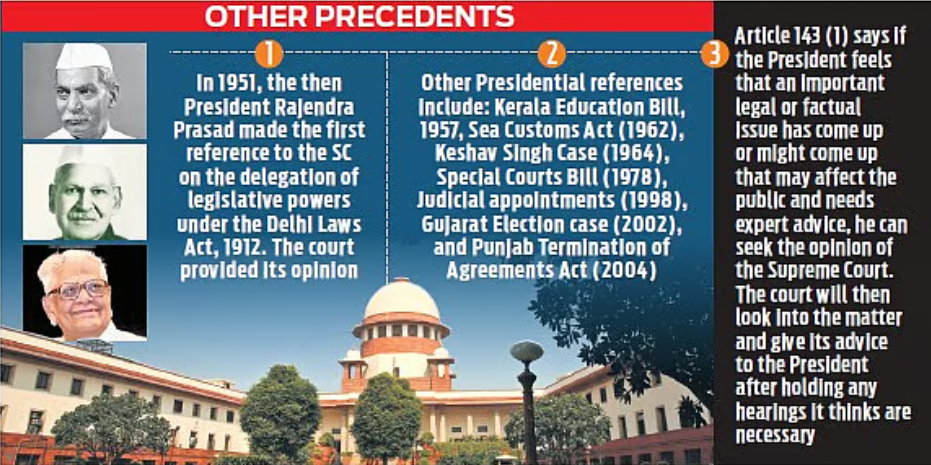
Article 143 empowers the President of India to seek the advisory opinion of the Supreme Court on any question of law or fact of public importance, either arising or likely to arise. This establishes the advisory jurisdiction of the SC, which is exclusive to the President and exercised on the aid and advice of the Council of Ministers.
Types of References under Article 143:
-
Article 143(1):
Allows the President to refer any question of law or fact of public importance.-
The SC may choose to respond or decline.
-
Example: In 1993, the SC refused to give an opinion on the Ram Janmabhoomi-Babri Masjid issue.
-
-
Article 143(2):
Applies to pre-Constitution agreements, treaties, and covenants, where the SC is obligated to respond.
Nature of the Opinion:
-
The Supreme Court’s opinion is advisory, not binding.
-
However, it carries high constitutional authority and ensures clarity in governance and constitutional interpretation.
Bench Requirement:
-
Article 145(3): A minimum of five judges (Constitution Bench) must hear the Presidential Reference.
Historical Context:
-
Inspired by Section 213 of the Government of India Act, 1935.
-
Globally, Canada allows advisory opinions by its Supreme Court; the U.S. Supreme Court does not, upholding a strict separation of powers.
Presidential References Made So Far:
-
There have been 15 Presidential References to the Supreme Court of India under Article 143. These include several landmark constitutional issues that have shaped Indian jurisprudence.
Landmark Presidential References:
-
Delhi Laws Act Case (1951):
Defined the scope and limits of delegated legislation. -
Kerala Education Bill (1958):
Harmonised Fundamental Rights with Directive Principles of State Policy. -
Berubari Case (1960):
Held that cession of Indian territory (to another country) requires a constitutional amendment. -
Keshav Singh Case (1965):
Addressed conflict between legislative privileges and judicial review. -
Presidential Election Case (1974):
Clarified that Presidential elections can proceed despite vacancies in State Assemblies. -
Special Courts Bill Case (1979):
Examined the validity of setting up special courts to try certain political leaders. -
Cauvery Water Dispute Reference (1991):
The SC held that Article 143 cannot be used to overturn judicial decisions. -
Rama Janmabhoomi Case (1993):
SC declined to answer the reference on whether a temple existed before the mosque. -
Third Judges Case (1998):
Established the Collegium system for judicial appointments. -
Gujarat Assembly Dissolution (2002):
Validated the President’s recommendation to dissolve the Gujarat Assembly.
(Note: Additional references exist, but the above are most prominent among the 15 made till date.)
Current Reference (2024): Key Constitutional Issues
-
Whether courts can impose timelines on the President or Governors for assent to Bills under Articles 200 and 201.
-
Whether judicial orders can prescribe the manner of exercising discretionary powers, even if the Constitution is silent.
-
Involves interpretation of Article 142 (SC's power to do complete justice).
-
Follows SC's April 8, 2024 judgment that held the Tamil Nadu Governor’s delay in assenting to Bills as illegal.
Significance of the Presidential Reference System:
-
Clarifies constitutional roles of the President and Governors.
-
Reinforces separation of powers and federalism.
-
Ensures procedural certainty in intergovernmental interactions.
-
Promotes cooperative federalism through legal interpretation.
-
Allows peaceful, authoritative resolution of executive-judiciary tensions.
Challenges:
-
Non-binding nature reduces enforceability.
-
Risks politicization, especially in controversial matters.
-
No clear threshold for what constitutes "public importance".
-
Can cause institutional strain if used to review settled rulings.
-
No timeline prescribed for SC to deliver its opinion, leading to potential delays.
Conclusion:
The ongoing 16th Presidential Reference under Article 143 is a critical constitutional moment. It aims to clarify the boundaries of judicial review, the limits of executive discretion, and the interplay between Articles 142, 200, and 201. The outcome could significantly impact the balance of power, federal structure, and legislative processes in India.