
Satellites, long-range radars to power next-gen airspace shield
Mission Sudarshan Chakra
Concept & Purpose
-
Mentioned by PM Modi in Independence Day speech (2025).
-
A comprehensive air and missile defence shield for India.
Aims at providing complete security for strategic and civilian areas, such as hospitals and railway stations
-
Aims to neutralise all aerial threats:
-
Kamikaze drones
-
Ballistic missiles (incl. MIRVs)
-
Cruise missiles
-
Armed drones, aircraft
-
Background
-
Triggered after Pakistan’s Operation Sindoor (≈1000 projectiles fired at India).
-
Some missiles intercepted, others deflected by jamming enemy C2 networks.
-
Inspiration from Israel’s Iron Dome (neutralised 498/500 Iranian missiles in 2025).
-
Need arises due to Pakistan’s Ababeel MRBM (2200 km, MIRV warheads).
Structure
-
Integrates:
-
Satellites (surveillance inputs)
-
Long-range radars
-
Airborne early warning systems (AEW&C)
-
UAVs
-
Interceptor missiles (short, medium, long range)
-
-
Centralised control centres:
-
Receive multi-source inputs
-
Decide whether to deflect or intercept incoming threats.
-
Relation with Project Kusha
-
Project Kusha (DRDO) → Extended-range interceptors for IAF & Navy (by 2030).
-
Sudarshan Chakra → Bigger, overarching security architecture (by 2035).
Operational Aspects
-
Defensive Role: Protect India’s large landmass & civilian population.
-
Offensive Role: Precision strike capability with missiles like:
-
Pralay (short-range ballistic)
-
Nirbhay (cruise missile)
-
Long-range naval missiles for ship/land targets.
-
-
Strategy: Retaliation with massive capability bypassing enemy defences.
Challenges
-
Need for:
-
Multiple interceptors of varying range/warhead weights.
-
Study of Chinese missile systems (Pakistan’s arsenal largely Chinese/Turkish).
-
Mission Sudarshan Chakra = India’s integrated air and missile defence shield, combining satellites, radars, UAVs, AEW&C, and interceptors, with both defensive and offensive roles. It is India’s answer to Pakistan’s and China’s missile threats, aiming for full coverage by 2035.
India currently has three S-400 missile systems developed by Russia
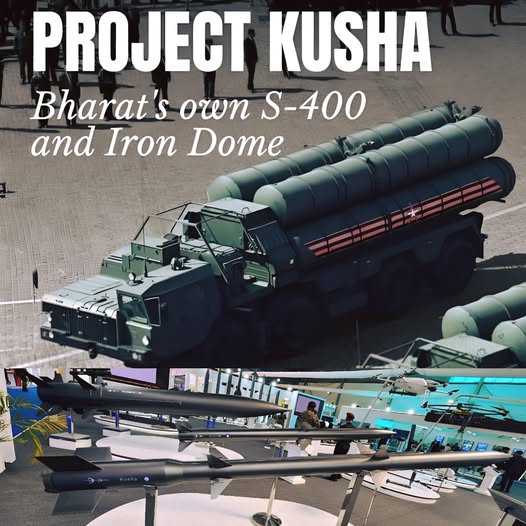
Project Kusha (ERADS / XRSAM / PGLRSAM)
Introduction
-
Project Kusha, officially called the Extended Range Air Defence System (ERADS), is a long-range surface-to-air missile (LRSAM) programme under DRDO.
-
It is being designed for both the Indian Air Force (lead agency) and the Indian Navy.
-
Objective: To fill the gap between existing missile systems — MR-SAM (80 km) and S-400 Triumf (400 km) — providing an indigenous area-defence system.
The main aim of the project is to develop a long-range surface-to-air missile (LR-SAM) system, often referred to as “Desi S-400”.
- The mobile LR-SAM will feature long-range surveillance and fire control radars.
Development Timeline
-
Cleared for development: By Cabinet Committee on Security (CCS) in May 2022.
-
Acceptance of Necessity (AoN): Granted by the Ministry of Defence (MoD) in September 2023.
-
Procurement plan: 5 squadrons for the IAF at a cost of ₹21,700 crore (~US$2.6 billion).
-
Phased induction: Expected 2028–2030.
System Features
-
Interceptor Variants: Three types of missiles for layered defence (short, medium, and long range).
-
Range: To bridge the gap between 80 km (MR-SAM) and 400 km (S-400). Likely effective range: 150–350 km.
-
Mobility: Fully mobile, can be deployed across varied terrains.
-
Target capability: Designed to intercept and destroy:
-
Fighter jets
-
Bombers
-
Unmanned Aerial Vehicles (UAVs)
-
Cruise missiles
-
Potentially, some ballistic missile threats
-
Strategic Role
-
Supplements India’s multi-layered air defence architecture, alongside:
-
Barak-8 (MR-SAM) – Indo-Israeli
-
S-400 Triumf – Russian
-
Indian Ballistic Missile Defence (BMD) system – DRDO
-
-
Enhances area-defence capability and self-reliance (Atmanirbhar Bharat) in advanced defence technology.
Significance
-
Bridges operational gap between MR-SAM and S-400.
-
Reduces dependence on foreign suppliers (Israel, Russia).
-
Strengthens India’s Air Defence Command (ADC) under planning.
-
Boosts deterrence against adversaries with strong air and missile assets (China, Pakistan).
Challenges Ahead
-
Technological complexity: Multi-stage propulsion, radar integration, seeker tech.
-
Timely delivery: Induction expected by 2030, but delays possible.
-
Integration: With IAF’s Integrated Air Command and Control System (IACCS).
Conclusion
Project Kusha represents India’s push for a self-reliant, multi-layered air defence shield. By 2030, its induction will complete India’s indigenous capability to counter threats from fighters, UAVs, and cruise/ballistic missiles—bridging gaps left by existing imported systems.