
Satellite tagging of Olive Ridley turtles
Context
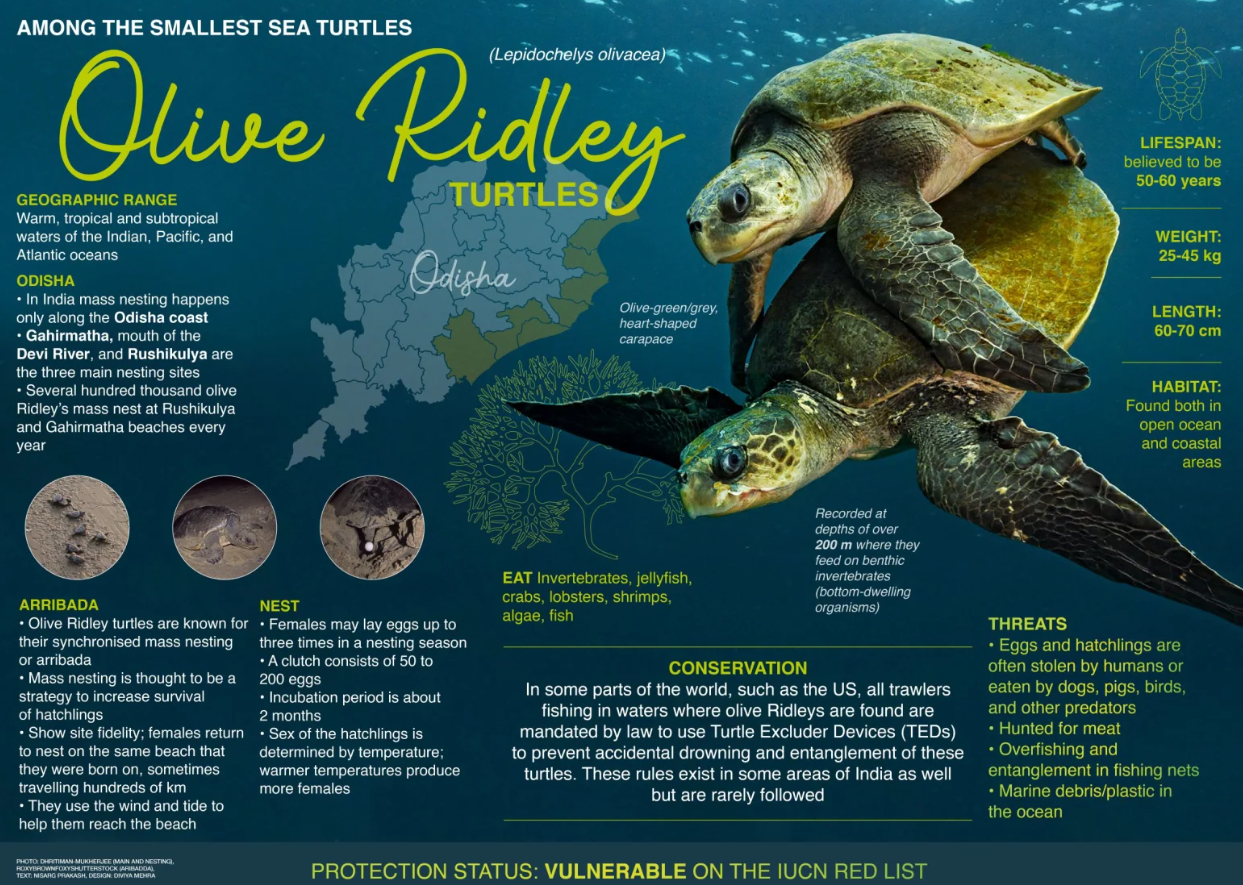
Two Olive Ridley sea turtles nesting on Chennai’s city beach were satellite-tagged and released in a first-of-its-kind initiative in Tamil Nadu.
The initiative marks the use of radio telemetry to strengthen marine conservation on the east coast.
Study details
Duration: 2025–2027 (two years).
Implementing agencies: Wildlife Institute of India and Advanced Institute for Wildlife Conservation.
Geographical focus
Vulnerable and key nesting sites along:
Chennai coast
Cauvery delta
Wider Tamil Nadu coastline
Technology used
Satellite tags:
Track near-shore movements during nesting season (November–April).
Transmit location data every hour for continuous monitoring.
Flipper tags:
Enable long-term identification of individuals.
Help study nest-site fidelity and migration patterns over years.
Scientific and conservation objectives
Map migratory routes and foraging grounds.
Understand nesting behaviour and near-shore movement ecology.
Study interactions with fishing activities to reduce bycatch and injuries.
Provide evidence-based inputs for future conservation and fisheries policies.
Prelims Practice MCQs
Q. Satellite tagging of Olive Ridley turtles primarily helps in understanding which of the following?
Migratory routes
Foraging grounds
Nesting behaviour
Genetic diversity
Select the correct answer using the code below:
(a) 1, 2 and 3 only
(b) 1 and 4 only
(c) 2 and 4 only
(d) 1, 2, 3 and 4
Answer: (a)
Explanation: The study focuses on movement ecology, foraging, and nesting behaviour. Genetic diversity requires molecular studies, not telemetry.
Q. In the context of wildlife conservation, flipper tags are used mainly to:
(a) Transmit real-time satellite data
(b) Mark individuals for long-term identification
(c) Monitor physiological parameters
(d) Track underwater diving depth
Answer: (b)
Explanation: Flipper tags are physical identifiers used for long-term monitoring of individuals, nest-site fidelity, and migration.