
Sammakka–Saralamma Jatara
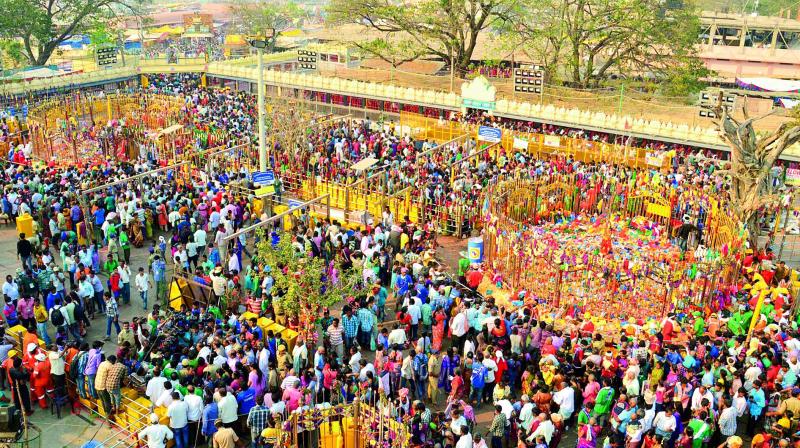
Context
Sammakka-Saralamma Jatara is one of the world’s largest indigenous spiritual gatherings.
It is the world's largest tribal festival,second only to the main Kumbh Mela in scale.
Held at Medaram in Mulugu district, Telangana.
Conducted biennially, following the full moon in the Hindu month of Magh.
Located deep inside the forests of Dandakaranya, near the Godavari River.
Community and belief system
Primarily associated with the Koya tribe.
Belief system: Animism infused with Hindu elements.
Worship is familial, not cosmological:
Sammakka (mother)
Pagididda Raju (husband)
Saralamma (daughter)
Govinda Raju (son-in-law)
Divinities are believed to reside among the people only for three days during the Jatara.
Historical background
Legend traces origins to a forest-found girl (Sammakka), later married into a ruling family.
Conflict with Kakatiya dynasty rulers over taxation.
Massacre of the ruling family; Sammakka disappears into the forest, leaving bangles and kumkum.
The Jatara commemorates sacrifice, resistance and survival of the tribal community.
Ritual landscape and practices
Sacred core contains four gadde (platforms) dedicated to the family members.
Two sacred trees:
Peddegi (Pterocarpus marsupium) – Sammakka
Tuniki (Diospyros melanoxylon) – Saralamma
Offerings:
Jaggery (tonnes offered; central ritual element)
Animals (chicken, goat, lamb)
Worship involves circling, not idol-based darshan.
Sacrificed animals are consumed as prasadam.
Clan memory and oral tradition
Each Koya clan carries a dalgudda / padige (triangular flag).
Features:
Creation myths (earth and sky from an egg)
Clan genealogies and kings
Sacred animals, trees and objects
Narrated by arthi kalakarlu (storytellers); group leader called thalapathi.
Represents oral historiography and indigenous knowledge systems.
Cultural change and continuity
Increasing participation of non-tribal communities.
Shifts observed:
Coconut offerings despite non-native origin
Replacement of traditional mahua liquor with bottled liquor
Emergence of printed images of mainstream Hindu goddesses
Critique:
Seen by scholars as cultural homogenisation and erosion of indigenous practices.
Prelims Prcatice MCQs
Q. The Sammakka–Saralamma Jatara is best described as:
(a) A Shaivite pilgrimage centred on temple worship
(b) A Vaishnavite festival associated with agricultural harvest
(c) An indigenous tribal festival rooted in animist beliefs
(d) A Buddhist monastic congregation
Correct answer: (c)
Explanation:
The Sammakka-Saralamma Jatara is one of the world’s largest indigenous gatherings, primarily rooted in animist belief systems of the Koya tribe, though it has later absorbed some Hindu elements.