
“Saha Guidelines” and Mental health
Context: The Supreme Court’s judgment in ‘Sukdeb Saha vs The State Of Andhra Pradesh’, acknowledges mental health to be an integral part of the right to life
Case: Sukdeb Saha vs State of Andhra Pradesh .
-
Death by suicide of a 17-year-old NEET aspirant in Visakhapatnam hostel.
-
Father’s plea for CBI probe was initially rejected by the High Court but accepted by the Supreme Court.
-
Outcome: CBI inquiry ordered + recognition of mental health as an integral part of Article 21 (Right to Life).
Key Constitutional Significance
-
Expands Article 21: Right to life includes psychological integrity and mental health.
-
Converts mental health from statutory right (Mental Healthcare Act, 2017) → fundamental right.
-
Establishes a normative benchmark for citizens to claim safeguards.
Structural Victimisation & Criminological Angle
-
Student suicides = structural victimisation caused by:
-
Neglect of mental health policies.
-
Exploitative coaching culture.
-
Institutional indifference.
-
-
Extends victimology lens: students as victims of systems and institutions, not just personal failures.
-
Links to Johan Galtung’s theory of structural violence → harm caused by systemic neglect = as blameworthy as direct violence.
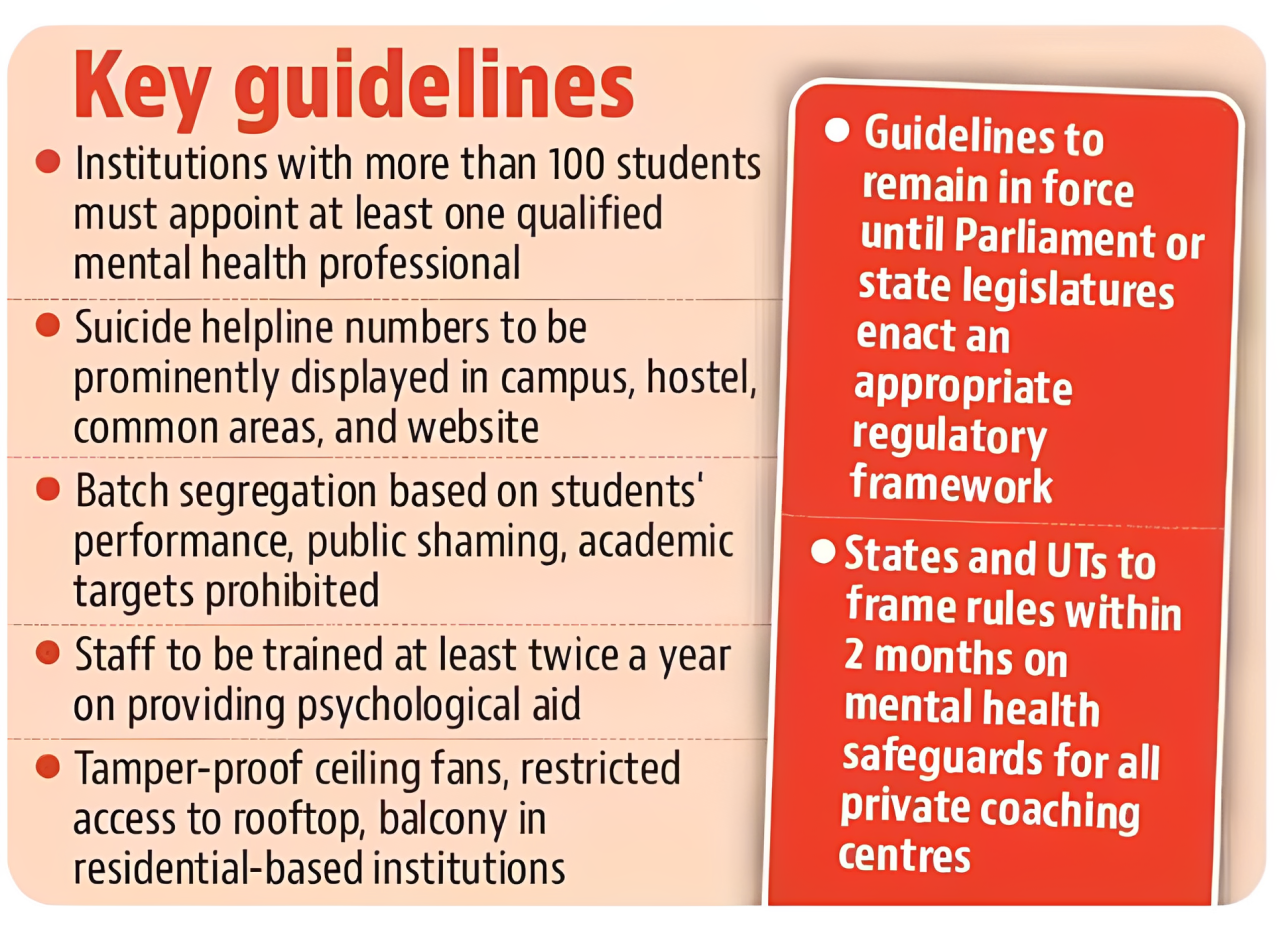
The “Saha Guidelines” (Binding Interim Orders)
-
Applicable to schools, colleges, hostels, and coaching centres.
1. Institutional Policy Framework
-
Mandatory Mental Health Policy in all schools, colleges, coaching centres, and hostels.
-
Must align with national programmes: UMMEED, MANODARPAN, National Suicide Prevention Strategy.
2. Counsellor Requirement
-
At least one qualified mental health counsellor per institution with 100+ students.
-
Larger institutions must scale counsellor strength proportionately.
3. Safe Learning Environment
-
Prohibition of harmful practices:
-
Batch segregation based on academic performance.
-
Public shaming of students.
-
Imposition of unrealistic academic targets.
-
4. Access to Helplines
-
Helpline numbers (e.g., Tele-MANAS, local helplines) to be displayed prominently in campuses and hostels.
5. Staff Training
-
All staff (teachers, wardens, administrators) to undergo biannual mental health training.
-
Training includes crisis response, identification of warning signs, and first-line support.
6. Inclusivity & Non-Discrimination
-
Institutions must adopt inclusive practices.
-
Special protections for SC/ST/OBC/EWS, LGBTQ+ community, and persons with disabilities.
7. Confidential Redressal Mechanisms
-
Confidential reporting systems for sexual assault, ragging, and identity-based discrimination.
-
Institutions must ensure immediate psychosocial support for affected students.
8. Reducing Exam-Centric Stress
-
Shift away from exam-only focus.
-
Promote interest-based career counselling and encourage extracurricular activities.
-
Mandates:
-
Development of support systems for student mental health.
-
States/UTs to notify rules within 2 months.
-
Creation of district-level monitoring committees.
-
-
Until Parliament enacts a code, these guidelines have legislative force.
Challenges Ahead
-
Implementation bottlenecks: Will schools, universities, and states invest in mental health care?
-
Cultural stigma around mental illness still persists.
-
Risk of judgment being reduced to symbolic without resource commitment.
Implications
-
Legal: Elevates mental health as part of fundamental rights jurisprudence.
-
Criminological: Expands accountability of state and institutions as structural perpetrators.
-
Social: Demands recognition of students’ mental well-being as central to governance and education reforms.
Conclusion
-
The Sukdeb Saha verdict is a landmark blending law, criminology, and victimology.
-
It confronts an uncomfortable truth: neglect and structural pressures can be as deadly as direct violence.
-
Success of this judgment depends on institutional compliance, budgetary support, and cultural change.
-
By affirming that “the right to life includes a healthy mind”, the Court has amplified the voice of a silenced generation.
Article 21 landmark judgments
| Case Name | Year | Principle / Key Ruling under Article 21 |
|---|---|---|
| A.K. Gopalan v. State of Madras | 1951 | Narrow view: Article 21 protection is only against executive action. Legislature could deprive by enacting law. |
| Maneka Gandhi v. Union of India | 1978 | Expanded scope of Article 21: Right to life = dignified existence; personal liberty is of widest amplitude; freedom of speech has no geographical barriers. |
| Sunil Batra v. Delhi Administration | 1978 | Recognised prisoners’ right to dignity; prisoners are not mere chattels of the State. |
| Hussainara Khatoon v. State of Bihar | 1979 | Free legal aid and speedy trial are fundamental rights of the accused under Article 21. |
| Olga Tellis v. Bombay Municipal Corporation | 1985 | Right to livelihood is integral to right to life; eviction without just and fair procedure violates Article 21. |
| NALSA v. Union of India (Transgender Rights Case) | 2014 | Recognised transgender persons’ rights; entitled to all fundamental rights including life and personal liberty. |
| Puttaswamy v. Union of India | 2017 | Declared Right to Privacy as a fundamental right under Article 21. |
| Common Cause v. Union of India | 2018 | Recognised Right to die with dignity (passive euthanasia) as part of Article 21. |
| Navtej Singh Johar v. Union of India | 2018 | Decriminalised homosexuality; affirmed privacy, dignity, and sexual orientation as protected under Articles 14, 15, 19, and 21. |
| Sukdeb Saha v. State of Andhra Pradesh | 2025 | Court held mental health is a fundamental right under Article 21. Introduced Saha Guidelines: binding interim measures for schools, colleges, hostels, and coaching institutes to provide support systems, States/UTs to notify rules within two months, and district-level monitoring committees. Elevated psychological well-being to constitutional protection. |