
Rwanda–DR Congo Peace Agreement
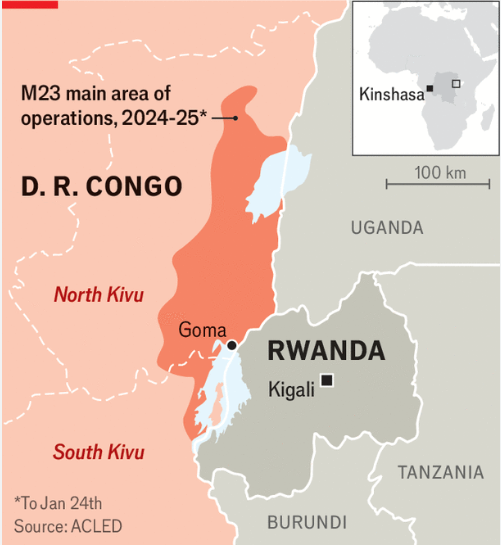
Context : Rwanda and the Democratic Republic of Congo (DRC) signed a peace agreement in Washington to end ongoing conflict that has killed thousands. The U.S. President Donald Trump hailed the deal as a milestone, boasting that it would also help the U.S. secure mineral rights from Congo.
-
Purpose: To end fighting in eastern DRC, primarily involving the M23 rebel group (linked to Rwanda) and FDLR (Hutu militia linked to the 1994 Rwandan genocide).
📍 Location
Goma
-
Location: Eastern Democratic Republic of Congo (DRC), on the border with Rwanda, near Lake Kivu.
-
Significance:
-
Capital of North Kivu province.
-
A strategic and mineral-rich city.
-
Has frequently been at the center of conflict due to its proximity to rebel-controlled zones and Rwanda.
-
In 2022–23, M23 rebels captured key areas near Goma, threatening regional stability.
-
👥 Groups
M23 (March 23 Movement)
-
Type: Armed rebel group.
-
Ethnic Base: Primarily Tutsi (an ethnic group also present in Rwanda and Uganda).
-
Origin: Emerged in 2012 as a breakaway faction from the Congolese army, claiming the DRC government failed to implement a peace deal signed on March 23, 2009—hence the name.
-
Support Allegations:
-
Allegedly backed by Rwanda and Uganda, though both deny it.
-
Accused of committing human rights violations.
-
-
Goal: Initially claimed to fight for Tutsi rights in the DRC, but later expanded into a powerful militia seeking political and territorial control.
Ethnic Background: Tutsis
-
Region: Primarily found in Rwanda, Burundi, and eastern DRC.
-
Historical Context:
-
Tutsis were victims of the 1994 Rwandan genocide, where over 800,000 Tutsis and moderate Hutus were killed by Hutu extremists.
-
Some Tutsi groups, especially refugees in DRC, have remained vulnerable to Hutu militant groups like the FDLR.
-