
Red Sea Cable Cuts and Impact on Indian Networks
Context
-
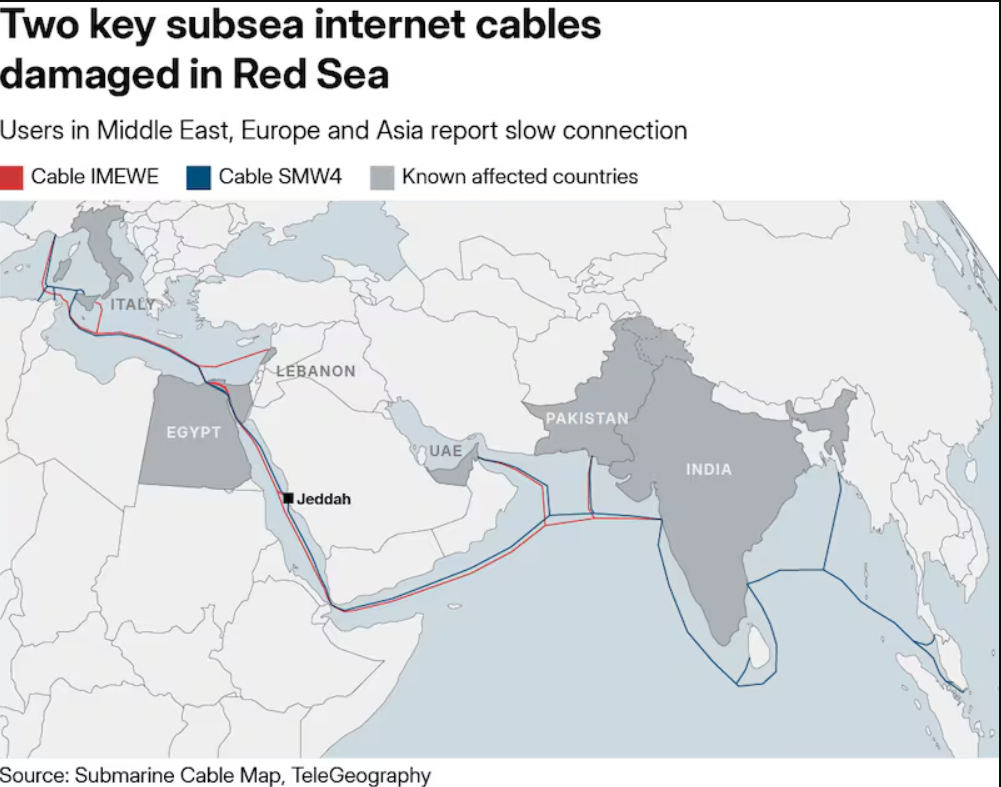
Recently, subsea cables SEA-ME-WE 4 and IMEWE running through the Red Sea were damaged, disrupting India’s internet connectivity with Europe.
-
Major Indian telecom operators affected: Bharti Airtel Ltd., Reliance Jio Infocomm Ltd., Tata Communications Ltd.
-
This is the second such disruption, following cuts in 2024 during the Red Sea crisis linked to Houthi attacks.
Importance of Subsea Cables
-
Backbone of global internet infrastructure – carry more than 95% of international internet traffic.
-
India has over a dozen subsea cable systems landing at Mumbai and Chennai, connecting it to Europe, West Asia, Southeast Asia, and the US.
-
Disruptions highlight strategic vulnerability as India increasingly relies on digital economy and global connectivity.

Technical Impact
-
Latency (time for a data packet to travel a round trip):
-
Earlier Europe–Mumbai latency: 110–150 ms
-
After cuts: 190–300 ms
-
-
Though no widespread outages, rerouting through alternative cables leads to higher delays and reduced efficiency.
Geopolitical and Security Dimensions
-
Red Sea route is critical for both maritime trade and data cables.
-
Houthi attacks in the Yemen conflict have raised risks to both energy security and digital infrastructure.
-
Underlines the need for cable route diversification, redundancy, and cyber-physical protection of subsea infrastructure.
Implications for India
-
Economic Impact: Slower connectivity hampers IT services, BPO, and financial transactions with Europe.
-
Strategic Concerns: Reliance on chokepoints (Suez-Red Sea) exposes vulnerabilities in India’s digital infrastructure.
-
Digital India Goals: With India aiming to be a global digital hub, stable undersea connectivity is essential.
-
Security Concerns: Highlights the overlap of geopolitical conflicts and cyber-physical infrastructure risks.
Way Forward
-
Strengthen redundancy: Invest in alternate cable routes (via Africa, Arctic, Pacific).
-
Domestic Infrastructure: Enhance satellite-based internet and data center capacity.
-
International Cooperation: Collaborate with Europe, West Asia, Quad partners for cable security and resilience.
-
National Policy: DoT and National Security Council Secretariat (NSCS) may develop a Submarine Cable Security Framework.