
Quantum Random Number Generator with Blockchain Integration
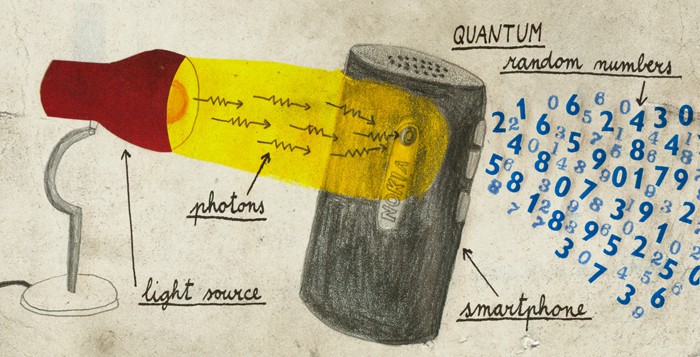
Context & Relevance:
-
Ensuring data privacy and encryption is critical in a digital age.
-
Random numbers are essential for generating secure encryption keys.
-
Traditional methods may appear random but are often predictable or hackable.
Key Concepts:
1. Randomness & Encryption:
-
Encryption transforms data into unreadable form (ciphertext) using a secret key.
-
If the key is predictable, encryption can be broken.
-
Therefore, true randomness in key generation is crucial for cybersecurity.
2. Existing Randomness Sources (Example: Lava Lamps):
-
Cloudflare uses images of lava lamps to create random seeds.
-
Lava lamp images produce visually random patterns.
-
However:
-
Movements are based on thermodynamics, hence theoretically predictable.
-
Algorithms using these seeds are deterministic (can be replicated if seed is known).
-
These are called pseudorandom number generators (PRNGs).
-
Quantum Mechanics: A Source of True Randomness
-
Quantum phenomena are inherently unpredictable.
-
Particles behave randomly at microscopic levels.
-
Hence, quantum random number generators (QRNGs) can provide true randomness.
What’s New in the Study?
-
The new method combines:
-
Quantum physics to generate random numbers.
-
Blockchain to store, certify, and trace the process.
-
Unique Features:
-
Traceable & tamper-proof: Thanks to blockchain, every random number generated can be independently verified.
-
Any change in one step will affect all subsequent records, making tampering impossible.
-
First system of its kind combining true quantum randomness with blockchain’s transparency.
Expert View:
-
Highlights how blockchain ensures immutability and auditability.
-
Explains the flaws in pseudorandom systems and why quantum randomness is superior.
Quantum Randomness & CURBy: A Breakthrough in Random Number Generation
-
Quantum mechanics is inherently probabilistic: outcomes at the atomic level (like a photon’s polarisation) cannot be predicted deterministically.
Each photon has an oscillating electromagnetic field. The direction in which the field oscillates is called the photon’s polarisation.
According to the laws of quantum mechanics, the polarisation of a photon can be both horizontal and vertical (or left and right) until it is measured — just like a coin tossed in the air is both ‘heads’ and ‘tails’ until it lands. It is only at the time of measurement that the polarisation becomes one of the two, and this choice is random.
-
A photon’s polarisation remains in a superposed state (e.g., both horizontal and vertical) until measured — measurement yields truly random results.
Recent Development :
-
Researchers: Gautam A. Kavuri and team (University of Colorado Boulder & NIST)
-
Innovation: Developed a method to generate and publicly broadcast quantum-derived random numbers.
-
Result: Launch of CU Randomness Beacon (CURBy) - a public service to broadcast certified random numbers.
How It Works:
-
Photon Pair Generation:
-
Method: Spontaneous Parametric Down-Conversion (SPDC) at NIST
-
A non-linear crystal splits high-energy photons into entangled photon pairs.
-
Entangled photons exhibit correlated polarisation states, even when far apart.
-
-
Randomness Measurement:
-
Each photon sent to a separate lab.
-
Polarisation is measured independently ~15 million times per minute.
-
Each measurement yields random polarisation data (basis of randomness).
-
-
Data Processing:
-
At CU Boulder, data converted to a bit string (0s and 1s).
-
Bit string is initially biased (unequal distribution of 0s/1s).
-
Processed using a Randomness Extractor — uses external seed from DRAND to produce a uniform 512-bit unbiased random string.
DRAND is run by a confederation of many independent parties around the world, including Cloudflare, Ethereum Foundation, and the Swiss Federal Technology Institute of Lausanne in Switzerland.
-
-
Public Verification:
-
System incorporates blockchain cryptographic protocols for transparency and traceability.
-
Each step is auditable and certifiable by independent observers.
-
Why Random Number Generators (RNGs) Need Trust?
-
RNGs are used in encryption/decryption and cryptographic security.
-
Verification challenge: No easy way to prove randomness or detect tampering.
Solution: Blockchain Integration
-
Each step in the random number generation process is recorded using a hash (fingerprint).
-
Blockchain properties:
-
Immutable: Hash changes if even a small part of data is changed.
-
Linked steps: Changing one fingerprint disrupts the entire chain, making tampering detectable.
-
The ‘Twine’ Protocol
-
Developed by researchers to create a traceable cryptographic contract.
-
Three parties involved:
-
NIST – Supplies raw bit string (initial data).
-
CUB – Executes randomness extractor.
-
DRAND – Provides independent seed.
-
-
Each step is hashed and linked in blockchain, allowing transparency & verification.
Advantages:
-
Tamper detection built-in.
-
Decentralised trust: No single party controls entire process.
-
Verifiability: Any party or user can trace integrity using hash records.
Challenges:
-
Scalability:
-
Current prototype: 7,434 random numbers in 40 days.
-
Not viable for commercial-scale operations yet.
-
-
Infrastructure needs:
-
Requires advanced quantum-optical hardware for entangled photon manipulation.
-
High-cost, complex setup.
-
-
Commercial Deployment: May take several more years for widespread application.
Future :
-
Expanding to include more independent parties to decentralise further.
-
Potential use in critical cryptographic applications (e.g., defense, finance, AI models, etc.).