
Public Accounts Committee Pulls Up Government Over SANKALP Scheme
Context
The Public Accounts Committee (PAC), chaired by K. C. Venugopal, criticised the Union Government for the slow and inefficient implementation of the Skill Acquisition and Knowledge Awareness for Livelihood Promotion (SANKALP) scheme.
The observations were based on a report of the Comptroller and Auditor General of India (CAG), which flagged financial and physical progress shortfalls.
About SANKALP Scheme
Full Form: Skill Acquisition and Knowledge Awareness for Livelihood Promotion
Ministry: Ministry of Skill Development and Entrepreneurship
Approval: October 2017 by the Cabinet Committee on Economic Affairs
Launch: 2018
Original Completion: March 2023 (extended to March 2024)
Total Outlay: ₹4,455 crore
Type: Centrally Sponsored Scheme (CSS)
Financing Pattern
World Bank Loan – ₹3,300 crore
State Government Leverage – ₹660 crore
Industry Contribution – ₹495 crore
Objectives
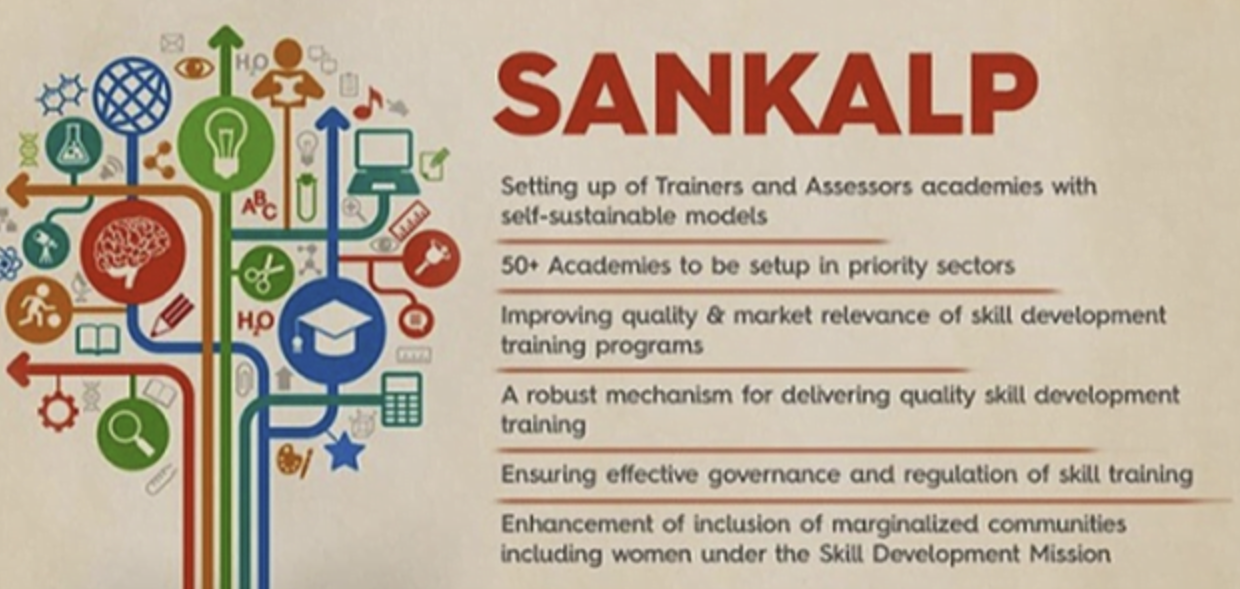
Strengthen short-term skill training
Improve institutional frameworks
Enhance industry linkage
Promote inclusion of marginalised communities
Key Components
(A) Institutional Strengthening
Capacity building of State Skill Development Missions (SSDMs)
District Skill Committees
(B) Skill India Portal
Centralised digital platform
Tracks skill training data and outcomes
(C) Mahatma Gandhi National Fellowship (MGNF)
Designed to strengthen district-level planning
Young professionals deployed in districts
Focus: Data-driven skill planning
Key Findings of CAG
Only 44% of budgeted provision disbursed (2017–18 to 2023–24)
Weak adherence to implementation guidelines
Sluggish execution across components
Absence of strong monitoring mechanism
World Bank Loan Utilisation
First tranche agreed: $250 million
Disbursed: ₹1,606.15 crore (86%)
Utilised by Ministry: ₹850.71 crore (as of December 2023)
CAG attributed delays partly to “non-preparedness” within the Ministry before the loan period commenced.
Constitutional and Governance Dimensions
1. Role of Public Accounts Committee
Examines CAG reports
Ensures parliamentary control over public expenditure
Strengthens financial accountability
2. Role of CAG
Constitutional authority under Article 148
Audits receipts and expenditure of Government of India
Reports submitted to President/Governor and laid before Parliament/State Legislature
3. Issues Highlighted
Under-utilisation of funds
Weak monitoring and due diligence
Implementation deficit in flagship skill programme
SANKALP vs STRIVE vs PMKVY
Feature | SANKALP Scheme | STRIVE Scheme | Pradhan Mantri Kaushal Vikas Yojana |
Full Form | Skill Acquisition and Knowledge Awareness for Livelihood Promotion | Skills Strengthening for Industrial Value Enhancement | Pradhan Mantri Kaushal Vikas Yojana |
Ministry | Ministry of Skill Development and Entrepreneurship (MSDE) | MSDE | MSDE |
Launch Year | 2018 | 2019 | 2015 |
Type | Centrally Sponsored Scheme (CSS) | Central Sector Scheme | Central Sector Scheme |
World Bank Assistance | Yes ($250 million) | Yes (~$125 million) | No |
Total Outlay | ₹4,455 crore | ~₹2,200+ crore (approx.) | Varies by phase (PMKVY 1.0, 2.0, 3.0, 4.0) |
Primary Focus | Institutional strengthening & short-term skill training | Strengthening ITIs & apprenticeship ecosystem | Short-term training & certification of youth |
Target Level | National, State & District institutions | Industrial Training Institutes (ITIs) | Individual youth (15–45 years) |
Industry Linkage | Strengthened via district planning | Strong emphasis on apprenticeship | Placement-linked training |
Special Features | Gender Action Plan, Skill India Portal, MGNF | Performance-based funding to ITIs | Recognition of Prior Learning (RPL) |
Nature of Reform | Systemic & governance reform | Institutional reform (ITI ecosystem) | Mass skill certification programme |
Prelims Practice MCQs
Q. With reference to the Skill Acquisition and Knowledge Awareness for Livelihood Promotion (SANKALP) scheme, consider the following statements:
It is implemented by the Ministry of Skill Development and Entrepreneurship.
It is fully funded by the Government of India without external assistance.
It aims to strengthen short-term skill training and industry linkage.
Which of the statements given above is/are correct?
A. 1 only
B. 1 and 3 only
C. 2 and 3 only
D. 1, 2 and 3
Answer: B
Explanation:
Statement 1 is correct — It is under the Ministry of Skill Development and Entrepreneurship.
Statement 2 is incorrect — It is partly financed by a World Bank loan.
Statement 3 is correct — It aims at strengthening short-term skill training and industry linkage.
Q. Consider the following features of the SANKALP Scheme:
Promotion of decentralized planning in skill development
Gender Action Plan to increase women’s participation
Direct cash transfers to trainees under DBT
Which of the above are part of SANKALP?
A. 1 and 2 only
B. 2 and 3 only
C. 1 and 3 only
D. 1, 2 and 3
Answer: A
Explanation:
Statement 1 is correct — SANKALP promotes decentralized planning.
Statement 2 is correct — It includes a Gender Action Plan.
Statement 3 is incorrect — It is not primarily a DBT-based cash transfer scheme.