
Proton accelerator facility proposed in Visakhapatnam
Why in news
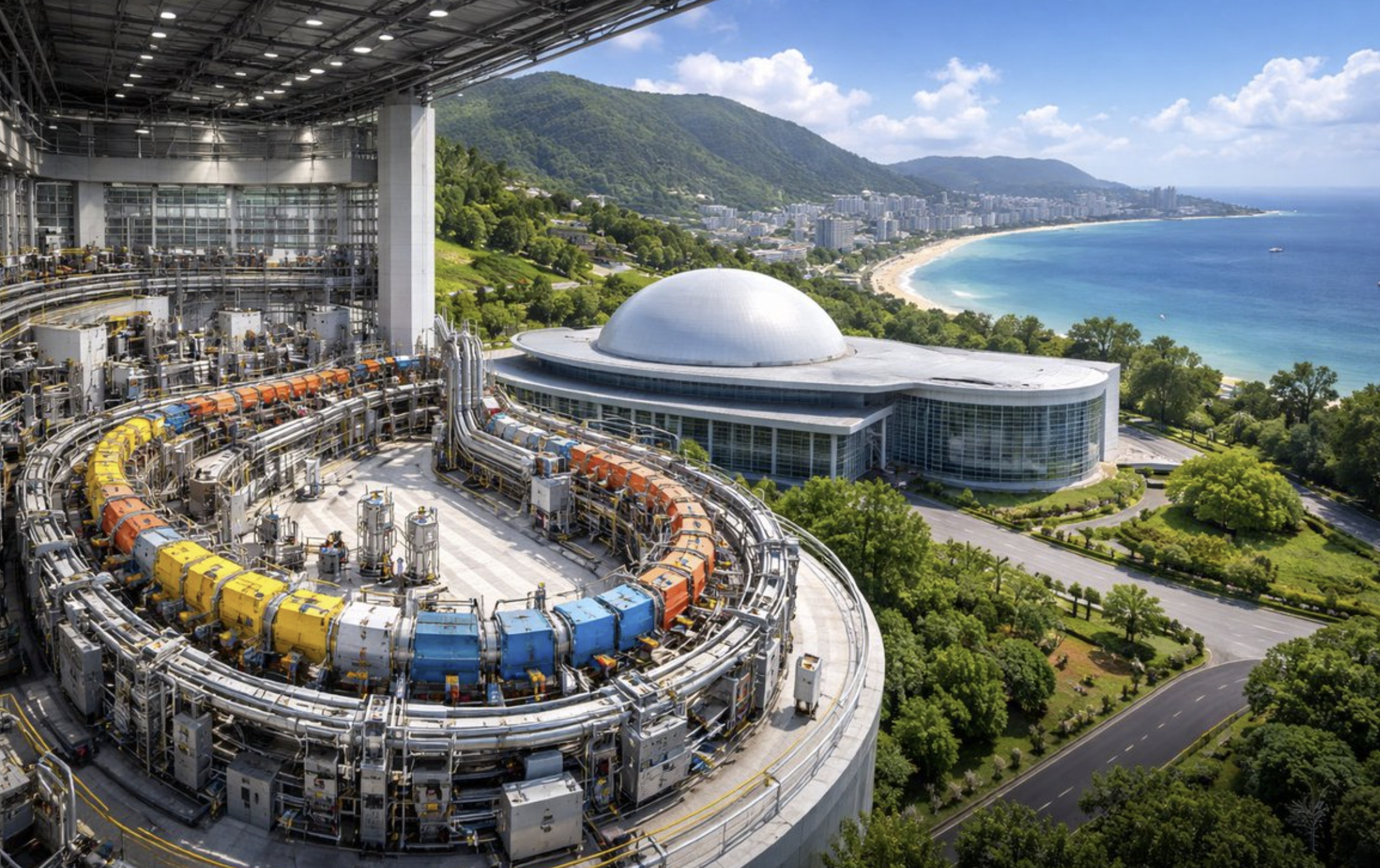
A high-energy proton accelerator facility is proposed to be set up in Visakhapatnam, Andhra Pradesh.
It will support India’s accelerator-driven systems (ADS) programme aimed at utilising the country’s vast thorium reserves for nuclear energy.
Institution involved
The project is being developed by Raja Ramanna Centre for Advanced Technology (RRCAT) in Indore, under the Department of Atomic Energy (DAE).
RRCAT was established in 1984 and specialises in:
Particle accelerators
Laser technologies
Applications in space, defence, communications and medicine.
What is a proton accelerator
A particle accelerator that speeds up protons to extremely high energies using electromagnetic fields.
When these high-energy protons strike a heavy metal target, they produce neutrons through a process called spallation.
Role in India’s nuclear programme
The accelerator will support Accelerator-Driven Systems (ADS).
Process involved:
High-energy protons hit a heavy target (lead/bismuth).
Spallation reaction releases a large number of neutrons.
These neutrons help convert thorium-232 into uranium-233, which can be used as nuclear fuel.
Accelerator-driven systems (ADS) are innovative nuclear reactors that combine a particle accelerator with a subcritical core to safely transmute long-lived radioactive waste into shorter-lived fission products. By driving fission with an external neutron source rather than a self-sustaining chain reaction, ADS provides superior safety and the potential to burn thorium fuel | ||
Strategic importance for India
India has one of the world’s largest thorium reserves, especially along the Kerala–Tamil Nadu coastal sands.
Thorium utilisation is central to India’s three-stage nuclear power programme.
ADS technology can:
Improve fuel efficiency
Reduce long-lived nuclear waste
Enhance nuclear safety.
Why Visakhapatnam was chosen
Strong scientific and technological ecosystem.
Proximity to the sea provides large quantities of cooling water, essential for high-energy accelerator facilities.
Other applications of accelerator technology
Facilities at RRCAT are already used for:
Electron beam sterilisation of medical devices
Materials research
Industrial processing
Advanced scientific experiments.
Prelims Pointers
RRCAT – located in Indore, under DAE.
Accelerator-Driven System (ADS) – uses particle accelerators to generate neutrons for nuclear reactions.
Important for thorium-based nuclear energy.
Thorium cycle produces Uranium-233 as fuel.
Prelims Practice MCQ
Q. With reference to Accelerator-Driven Systems (ADS), consider the following statements:
They use particle accelerators to produce neutrons through spallation reactions.
They help convert thorium-232 into uranium-233.
They are primarily designed for uranium enrichment.
Which of the statements given above is/are correct?
A. 1 and 2 only
B. 2 and 3 only
C. 1 only
D. 1, 2 and 3
Answer: A
Explanation:
Statement 1: Correct — ADS uses high-energy proton beams to produce neutrons through spallation.
Statement 2: Correct — Neutrons convert thorium-232 → uranium-233 fuel.
Statement 3: Incorrect — ADS is not used for uranium enrichment.