
Prime Minister Dhan-Dhaanya Krishi Yojana (PMDDKY)
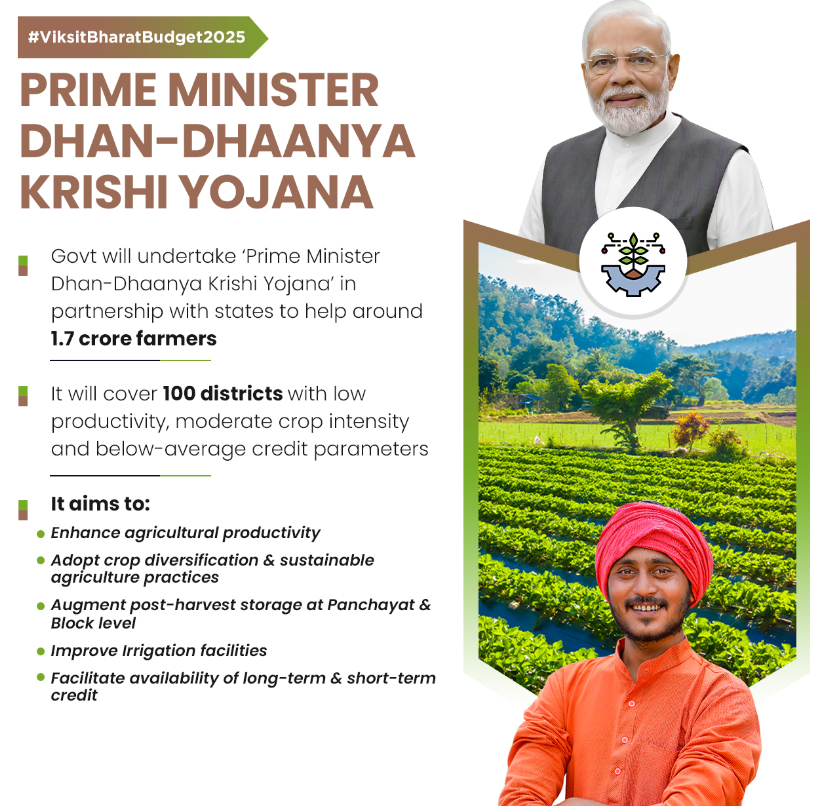
Prime Minister Dhan-Dhaanya Krishi Yojana (PMDDKY)
Why in news :
The Union Cabinet approved the PM Dhan-Dhaanya Krishi Yojana (PMDDKY), announced in the Union Budget 2025–26, to boost agricultural productivity and promote sustainable farming practices across India.
Key Features of PMDDKY:
-
Objective:
Enhance productivity, promote sustainable agricultural practices, and increase resilience in low-performing agricultural districts. -
Budgetary Allocation:
₹24,000 crore per year for 6 years, starting 2025–26. -
Target Beneficiaries:
Estimated to benefit 1.7 crore farmers. -
Scheme Convergence:
Merges 36 existing schemes from 11 Ministries/Departments, leveraging central, State, and private sector resources. -
Implementation Model:
Based on the Aspirational Districts Programme, focusing on convergence, competition, and collaboration.

District Selection Criteria:
-
100 districts identified initially.
-
Criteria include:
-
Low productivity
-
Low cropping intensity
-
Low credit disbursement
-
-
At least one district from each State/UT, based on Net Cropped Area and operational holdings.
Planning and Monitoring Mechanism:
-
Three-tier committees at:
-
District level (District Dhan Dhaanya Samiti – includes progressive farmers)
-
State level
-
National level
-
-
Each district will prepare a District Agriculture and Allied Activities Plan aligned with:
-
Crop diversification
-
Water and soil conservation
-
Natural and organic farming
-
Self-sufficiency in agriculture
-
-
Monthly monitoring of progress.
Components Covered:
-
Strengthening post-harvest storage at panchayat/block level
-
Improving irrigation infrastructure
-
Facilitating short-term and long-term agricultural credit
-
Promotion of natural and organic farming
-
Encouragement of allied sectors and value-added agriculture
Expert Opinion:
-
Concerns Raised:
-
Use of low credit disbursement as a selection criterion could be counterproductive.
-
Suggested using annual net agricultural income per hectare for better district targeting.
-
Emphasized that a resilient system should reduce dependence on credit while improving farmer incomes.
-
UPSC Syllabus:
-
GS Paper III: Agriculture, Government schemes, cropping patterns, irrigation, rural development, sustainable farming.
-
GS Paper II: Governance, convergence of schemes, Centre-State cooperation.
-
Essay Paper: Sustainable development, inclusive agriculture, doubling farmers' income.
-
Prelims: Scheme objectives, budgetary allocation, implementing ministries, and district selection parameters.