
Presidential Reference and Revisiting Supreme Court Judgments
Context:
-
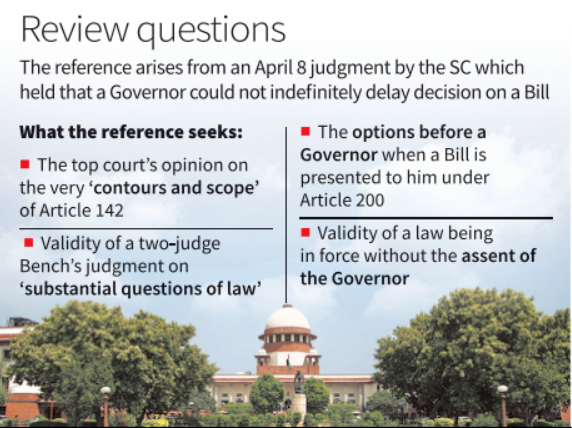
On July 22, 2025, the Supreme Court began examining a Presidential Reference under Article 143, following its April 8 ruling on delays by Governors and the President in assenting to Bills passed by State legislatures.
What is a Presidential Reference?
-
Constitutional Provision:
-
Article 143(1): Allows the President of India to seek the advisory opinion of the Supreme Court on any question of law or fact of public importance.
-
-
Nature: Purely advisory and not binding.
-
Scope: The Court must confine itself strictly to the questions referred.
Issue Behind the Current Reference:
-
Originates from Tamil Nadu vs. Governor R.N. Ravi:
-
Challenge to the delay in assent to 10 re-passed State Bills.
-
SC April 8 ruling: Declared such prolonged inaction illegal.
-
Imposed judicially enforceable timelines on both Governors and the President.
-
-
The Reference seeks clarity on:
-
Whether constitutional authorities (President/Governors) can be judicially compelled to act within specific timeframes on State legislation.
-
Is the Court Bound to Answer a Presidential Reference?
-
No – Article 143(1) uses the term “may”, giving the Court discretion to:
-
Accept, decline, or partially respond to a Reference.
-
-
Precedents:
-
Special Courts Bill (1978): Court upheld discretion.
-
Ayodhya Reference (1993): Declined due to ongoing civil case and violation of secularism.
-
Are Advisory Opinions Binding?
-
Technically Not Binding:
-
As per St. Xavier’s College v. State of Gujarat (1974).
-
Article 141 (binding precedent) does not apply to Article 143 opinions.
-
-
However:
-
Some cases, like R.K. Garg v. Union of India (1981), have treated advisory opinions as binding.
-
Thus, advisory opinions hold strong persuasive authority but no binding legal force.
-
Can Presidential Reference Overturn a Judgment?
-
No – Article 143 cannot be used as a tool to:
-
Review or reverse a settled judgment delivered under Article 141 (binding precedents).
-
-
Only valid options: Review Petition or Curative Petition.
However...
-
The Court may refine, elaborate, or clarify the legal principles of a previous judgment without overruling it.
-
Example:
-
Natural Resources Allocation (2012): Clarified law post-2G ruling.
-
Presidential Reference on Collegium (1998):
-
Modified the functioning of the collegium system without overturning the 1993 judgment - Supreme Court Advocates-on-Record Association versus Union of India (1993)
-
-
-
| Component | Key Points |
|---|---|
| Article 143 | Presidential Reference – advisory opinion mechanism |
| Nature of Advisory Opinion | Not binding, but persuasive |
| April 8 Ruling | Judicially enforceable timelines on constitutional authorities for Bill assent |
| Scope of Review | Reference cannot overrule, only refine/elaborate existing rulings |
| Binding Force | Only judgments under Article 141 are binding, not advisory opinions |