
Political parties aren’t workplaces, POSH Act can’t apply: Supreme Court
Context:
-
A petition sought to bring women political workers within the ambit of the POSH Act, 2013.
-
The Act currently applies to women in workplaces, providing mechanisms against sexual harassment.
Supreme Court’s View
-
Bench: Headed by Chief Justice of India B.R. Gavai.
-
Observation: Accepting the plea would “open a Pandora’s box.”
-
Dismissal: Petition was rejected, Court did not agree to extend POSH to politics.
Petitioner’s Argument
-
Core Points:
-
No rational basis to exclude women in politics when other professions are covered.
-
Definitions of ‘workplace’ and ‘employer’ in POSH should be expanded to include political parties and the political domain.
-
Political parties function like structured organisations, hence comparable to workplaces.
-
SC Questioned whether political parties can be interpreted as “employers” under POSH.
Legal & Constitutional Angle
-
POSH Act, 2013:
-
Provides protection for women in workplaces from sexual harassment.
-
Key definitions:
-
Workplace: Covers offices, organizations, institutions (public & private).
-
Employer: Person responsible for management/supervision in a workplace.
-
-
-
Gap Identified: Political workers, campaigners, and party functionaries often work in environments that function like workplaces but remain outside the Act’s scope.
Significance
-
Exclusion of Women in Politics: Leaves a gap in protection for women politicians, workers, and party functionaries.
-
Judicial Caution: Court refrained from expanding statutory definitions, leaving it to the legislature.
-
Policy Debate: Raises question whether political parties should be explicitly brought under workplace protection laws.
The Sexual Harassment of Women at Workplace (Prevention, Prohibition and Redressal) Act, 2013
Objective:
The Act aims to prevent and address incidents of sexual harassment of women at their place of work and provide a mechanism for redressal of complaints related to such harassment.
Key Provisions:
Definition of Sexual Harassment: The Act provides a clear definition of sexual harassment, encompassing unwelcome acts or behaviour that are sexually colored, creating a hostile or intimidating work environment.
Applicability: The Act applies to all workplaces, including government, private, and non-governmental organizations, as well as any organization, institution, undertaking, or establishment.
Internal Committee (IC): The Act mandates every workplace employing more than ten persons to constitute an Internal Complaints Committee. This committee is responsible for addressing complaints of sexual harassment and ensuring a safe working environment.
Local Committee (LC): In cases where the workplace does not have an IC (e.g., in organizations with less than ten employees or in certain specific circumstances), the district officer shall constitute a Local Committee to receive and redress complaints. In GNCTD District Magistrate is nominated as District Officer for constitution of Local Committee at District Level in GNCTD.
Complaint Procedure: The Act lays down a specific procedure for making complaints, conducting inquiries, and resolving cases of sexual harassment. It ensures confidentiality and timely resolution of complaints.
Protection against Retaliation: The Act prohibits retaliation or adverse actions against the complainant for filing a complaint in good faith.
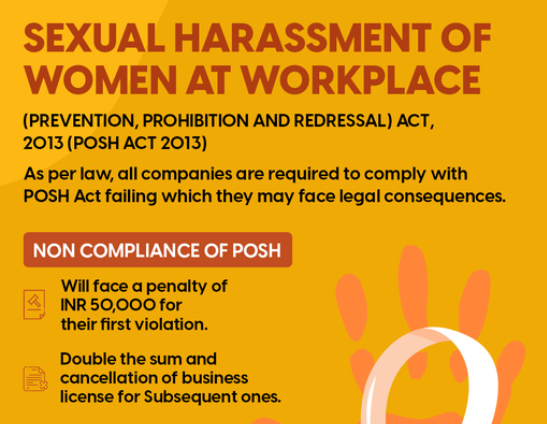
Penalties: If found guilty, the Act provides for penalties, which may include a monetary fine or termination of employment, depending on the severity of the offense.
Act is not Gender Neutral: The POSH Act protects only women and is not a gender-neutral statute and protects only women. Therefore, the safeguards under the POSH Act are not applicable to ‘men victims’.
The complaint procedure under the "Sexual Harassment of Women at Workplace (Prevention, Prohibition, and Redressal) Act, 2013" involves the following steps:
Filing the Complaint:
The aggrieved woman or any person authorized on her behalf can file a written complaint of sexual harassment.
The complaint should be filed with the Internal Committee (IC) if the organization has more than ten employees. If the organization has less than ten employees or for any other valid reason, the complaint can be filed with the Local Committee (LC) constituted by the district officer.
Timeframe for Filing:
The complaint should be filed within three months from the date of the incident of sexual harassment or within three months of the last incident, in case of a series of incidents.
Composition of the Committee:
The IC or LC, as applicable, must have a majority of women members.
One of the members should be from a women's rights organization or NGO.
Inquiry Process:
The committee shall conduct an inquiry into the complaint in a fair and impartial manner.
The complainant, as well as the accused, shall have the right to present their case and provide evidence during the inquiry.
Timeframe for Completion:
The committee is required to complete the inquiry within 90 days from the date of receipt of the complaint. However, if there are valid reasons, the time limit may be extended for an additional period, not exceeding 90 days.
Confidentiality:
The Act mandates that the proceedings of the inquiry and the identity of the parties involved should be kept confidential.
Report and Action:
After completing the inquiry, the committee shall prepare a report of its findings and recommendations.
If the committee finds the accused guilty of sexual harassment, it shall recommend appropriate actions and penalties to the employer.
Employer's Action:
The employer is obligated to implement the recommendations of the committee within 60 days.
The employer must provide appropriate relief to the aggrieved woman, which may include monetary compensation, counseling, or any other action to ensure a safe working environment.
Appeal:
If either party is dissatisfied with the decision of the IC/LC or the action taken by the employer, they may appeal to the appropriate authority.
The Department of WCD has already reconstituted the Internal Committee at Headquarter level. A detail of the same is attached herewith.