
PM Modi inaugurates Mahi Banswara nuclear project
Mahi-Banswara Nuclear Power Project (Rajasthan)
Location: Near Napla village, Banswara district, Rajasthan.
Capacity: 4 units × 700 MWe Pressurised Heavy Water Reactors (PHWRs).
Cost: Approx. ₹42,000 crore (part of projects worth ₹1.22 lakh crore inaugurated on 25 Sept 2025).
Developer: Anushakti Vidhyut Nigam Ltd (Ashvini) – a JV of NPCIL (51%) and NTPC (49%).
Approved by AERB; foundation stone laid by PM Narendra Modi.
Part of Fleet Mode Initiative
India’s strategy: construct 10 identical 700 MWe PHWRs under uniform design and procurement.
Expected benefits:
Lower costs through economies of scale.
Faster construction timelines.
Standardisation → operational expertise and easier regulatory approvals.
Other Reactors under Fleet Mode
Kaiga units 5 & 6 (Karnataka).
Gorakhpur units 3 & 4 (Haryana).
Chutka units 1 & 2 (Madhya Pradesh).
Rajasthan units 7 & 8 (ongoing).
Kakrapar units 3 & 4 (Gujarat) – already operational.
India’s Nuclear Power Programme (as of April 2025)
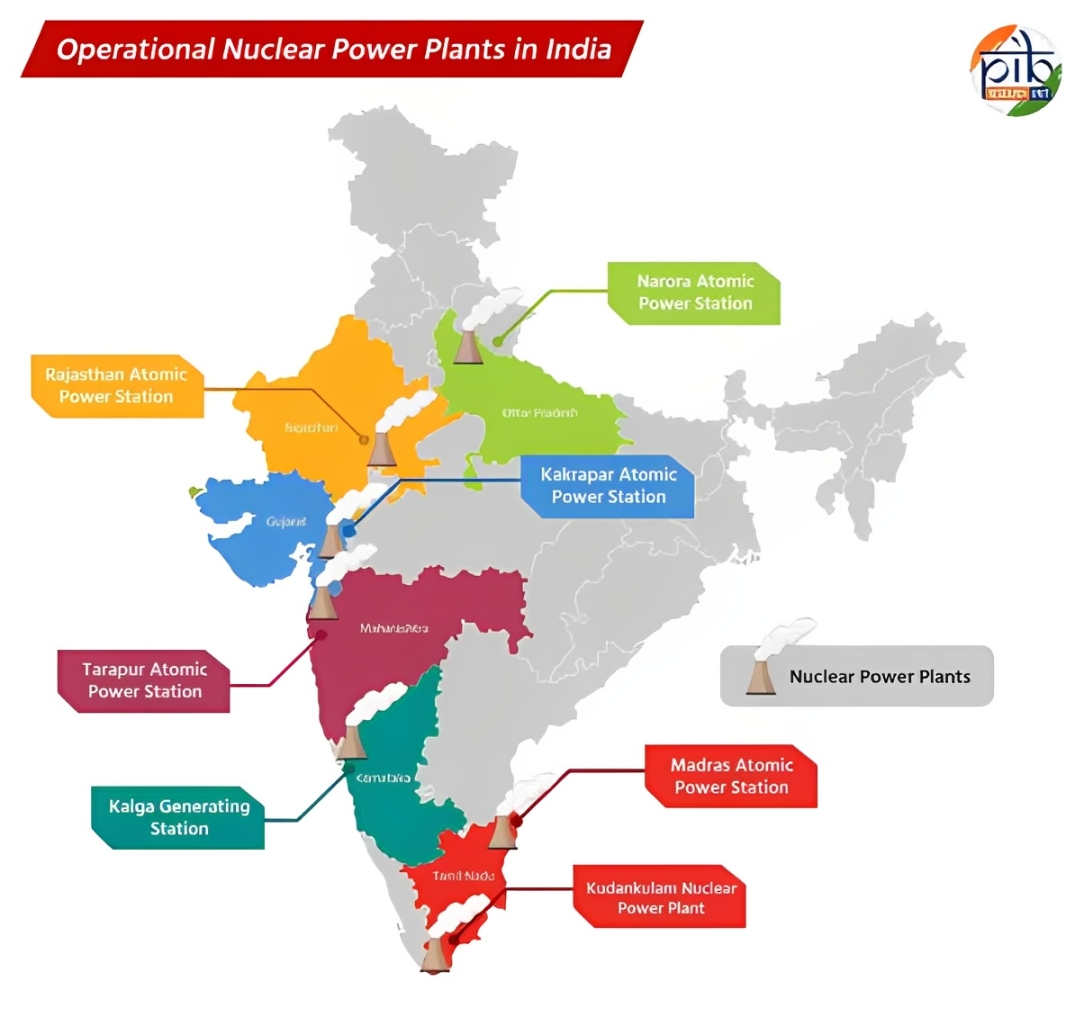
25 operational reactors across 8 nuclear power plants, total capacity: 8,880 MW.
Nuclear energy contributes ~3% of India’s electricity, with plans for massive scale-up to meet energy security and clean energy goals.
Major Nuclear Power Plants
Tarapur Atomic Power Station (TAPS), Maharashtra – India’s first, commissioned in 1969.
(Note: Apsara was India's and Asia's first nuclear reactor, becoming operational on August 4, 1956, at the Bhabha Atomic Research Centre (BARC) in Trombay.)Kudankulam (KKNPP), Tamil Nadu – India’s largest nuclear plant.
Rajasthan Atomic Power Station (Rawatbhata) – First to use CANDU reactor.(Canada Deuterium Uranium)
(The CANDU reactor type was chosen for its use of natural uranium fuel, which allowed India to avoid dependency on foreign suppliers for enriched uranium. )
Madras Atomic Power Station (Kalpakkam), Tamil Nadu.
Kakrapar Atomic Power Station, Gujarat.
Kaiga Atomic Power Station, Karnataka.
Narora Atomic Power Station, Uttar Pradesh.
The Union Budget 2025-26 outlines a significant push towards nuclear energy as part of India's long-term energy transition strategy. The government has set an ambitious target of 100 GW nuclear power capacity by 2047
Small Modular Reactors (SMRs) and R&D Initiatives
A key highlight of the Union Budget 2025-26 is the launch of a Nuclear Energy Mission, which is focused on research and development (R&D) of Small Modular Reactors (SMRs). The government has allocated ₹20,000 crore for this initiative, aiming to develop at least five indigenously designed and operational SMRs by 2033.
Nuclear Energy Mission for Viksit Bharat
To facilitate the implementation of the Nuclear Energy Mission, amendments to the Atomic Energy Act and Civil Liability for Nuclear Damage Act will be taken up by the parliament. These amendments are expected to encourage private sector investments in nuclear power projects.
India’s Push for Bharat Small Reactors (BSRs) & Small Modular Reactors (SMRs)
India aims to achieve 500 GW of non-fossil fuel capacity by 2030 and net-zero by 2070.
Nuclear energy is central to ensuring low-carbon, reliable base-load power.
Government strategy: Expand nuclear through Bharat Small Reactors (BSRs) and Small Modular Reactors (SMRs) with private sector participation.
Bharat Small Reactors (BSRs) are India's specific program to deploy smaller nuclear power units, designed to be "small" in capacity but not necessarily "modular" or factory-built like traditional Small Modular Reactors (SMRs).
While the BSRs will leverage India's Pressurized Heavy Water Reactor (PHWR) technology and will be smaller than conventional large plants, they are intended to be built on-site rather than prefabricated, a key characteristic of SMRs
Bharat Small Reactors (BSRs)
Type: 220 MW Pressurised Heavy Water Reactors (PHWRs) (proven safety, Indian expertise).
Upgrades: Reduced land footprint → suitable near industries (steel, aluminium, metals).
Role:
Captive power plants → help industries decarbonise.
Localised, flexible supply with lower infrastructure needs.
Implementation Model:
Private sector: provide land, cooling water, capital.
NPCIL: handles design, QA, O&M.
All within existing legal framework (Atomic Energy Act, 1962).
Bharat Small Modular Reactors (SMRs)
Definition: Advanced nuclear reactors with <30 MWe to 300+ MWe capacity.
Advantages:
Factory-built, modular → lower costs, faster construction.
Flexible deployment → on-grid, off-grid, remote locations.
Can repurpose retiring coal power plants.
Suitability for India:
Complements renewables → stabilises grid.
Reduces land constraints.
Builds on India’s PHWR expertise.
Future Nuclear Technologies (by BARC & DAE)
High-Temperature Gas-Cooled Reactors (HTGRs) → hydrogen co-generation.
Molten Salt Reactors (MSRs) → utilise India’s abundant thorium reserves.
R&D thrust: strengthen civil nuclear programme + climate commitments.