
Philippines Coral Larvae Cryobank Initiative
Context
The Philippines has launched Southeast Asia’s first coral larvae cryobank to preserve and restore coral reefs in the face of climate change and habitat degradation.
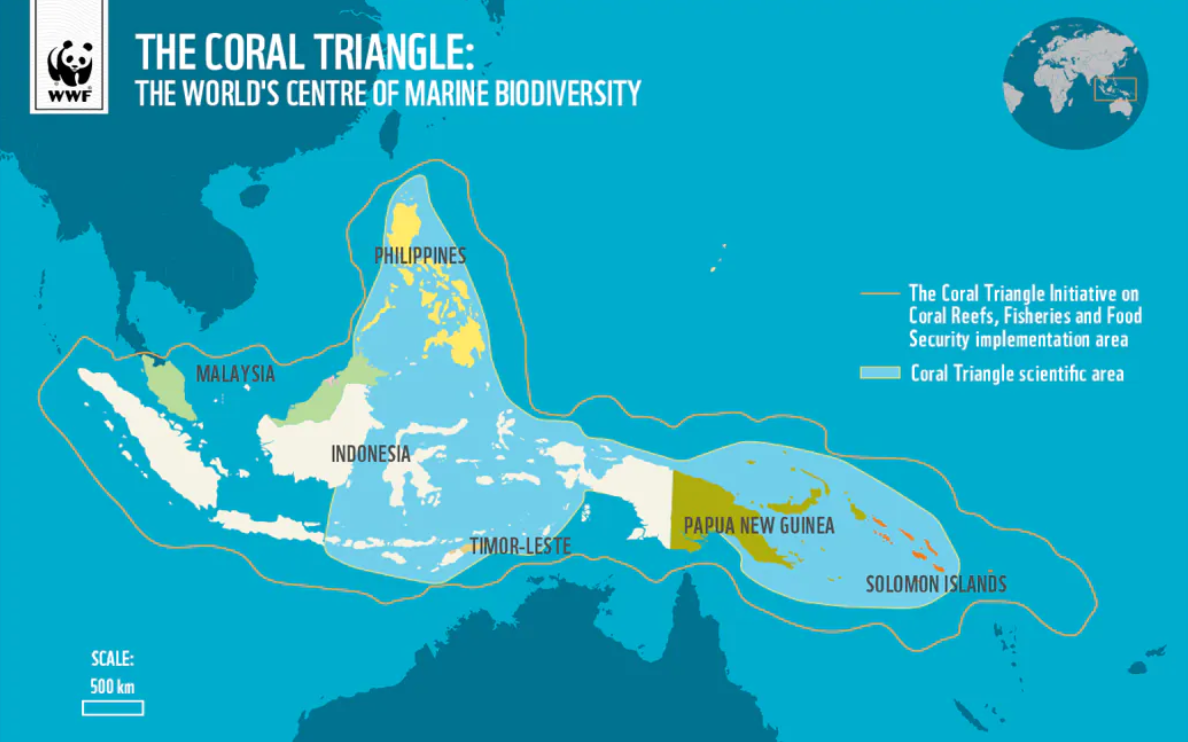
It is part of a regional initiative within the Coral Triangle, the most biodiverse marine ecosystem on Earth.
About the Coral Triangle
Known as the “Amazon of the Seas”, covering 5.7 million sq. km across:
Indonesia, Malaysia, Papua New Guinea, the Philippines, Solomon Islands, and Timor-Leste.Biodiversity:
75% of world’s coral species
33% of reef fish species
Six of seven marine turtle species
Vast mangrove forests
Supports 120 million people through fisheries and coastal livelihoods.
Threats to Coral Reefs
Climate Change: Rising ocean temperatures → coral bleaching.
Pollution: Air, water, and soil contamination.
Destructive fishing and habitat loss.
According to Status of Coral Reefs of the World 2020:
14% coral loss (2009–2018)
If warming exceeds 1.5°C, 70–90% of corals may vanish by 2050.
The Cryobank Initiative
Lead Institution: University of the Philippines Marine Science Institute.
Supported by:
Coral Research & Development Accelerator Platform
Marine Environment and Resources Foundation, Inc.
Partners: Institutions in Taiwan, Indonesia, Malaysia, Thailand, and the Philippines.
Technology: Cryopreservation of Coral Larvae
Coral larvae (tiny free-swimming “seeds”) are frozen at –196°C using liquid nitrogen.
Method:
Vitrification – rapid freezing after treatment with cryoprotective solutions prevents ice crystal formation.
Laser thawing – ultra-fast warming prevents re-crystallisation damage.
Larvae are then rehydrated in seawater and checked for vitality.
This preserves genetic diversity and can revive reefs decades later.
Significance
Acts as a “genetic insurance policy” for corals.
Protects marine biodiversity and ecosystem services.
Supports SDG-14 (Life Below Water).
Provides a scientific model for climate resilience and restoration-based conservation.
Reinforces regional cooperation under the Coral Triangle Initiative.
Challenges
Technical: Coral larvae are lipid-rich, cold-sensitive, and contain algae that complicate preservation.
Community awareness: Local dependence on tourism and fishing often ignores long-term reef health.
Climate lag: Even if emissions fall, oceans will take decades to stabilise, keeping reefs vulnerable.
The Coral Triangle: The Amazon of the Seas
Overview
The Coral Triangle is a 6 million km² marine area covering parts or all of six countries:
Indonesia, Malaysia, Papua New Guinea, the Philippines, Solomon Islands, and Timor-Leste.It represents the global epicentre of marine biodiversity, hosting the highest coral and reef fish diversity on Earth.
Geographically, it spans two biogeographic regions:
Indonesian–Philippines Region
Far Southwestern Pacific Region


Economic and Social Importance
Supports over 120 million people, providing food, income, and livelihood security through fisheries and tourism.
Nature-based tourism industry valued at over USD 12 billion annually.
Tuna spawning and nursery grounds supply a multi-billion dollar global tuna industry.
Local economies rely heavily on marine and coastal ecosystem services such as reefs, mangroves, and seagrasses.
Why the Region is Called the ‘Coral Triangle’
Defined by marine zones with ≥500 species of reef-building corals, forming a roughly triangular geographic area.
Neighbouring countries like Australia and Fiji have high coral diversity but fall short of the 500-species benchmark.
Scientific delineation criteria include:
Species richness and habitat diversity (corals, reef fishes, foraminifera, fungid corals, stomatopods).
Oceanographic parameters, especially currents supporting larval dispersal and gene flow.