
Orange Oakleaf
Context
Madhya Pradesh is set to declare the Orange Oakleaf (Kallima inachus) as its state butterfly.
MP will become the first state in central India (not whole india) to notify a state butterfly.
Butterfly distribution
The Orange Oakleaf butterfly flies in the Himalayas at low elevations, from Jammu and Kashmir to Garhwal and Kumaon, and across West Bengal, Sikkim, Arunachal Pradesh and other northeastern states.
It is also found in central and peninsular India, including Madhya Pradesh, Jharkhand, Chhattisgarh and Odisha.
It flies along the central Indian highlands to Pachmarhi and Amarkantak in the Satpura Mountain Range in Madhya Pradesh.
In MP:
Found mainly in Satpura National Park.
Other states with state butterflies
Goa, Karnataka, Sikkim, J&K, Arunachal Pradesh, Tamil Nadu, Tripura, Uttarakhand, Maharashtra, Sikkim, Kerala.
Arunachal Pradesh
Kaiser-i-Hind (Teinopalpus imperialis)
Rare, high-altitude species; indicator of pristine forest ecosystems.
Legally protected; often discussed in wildlife trade debates.
Goa
Malabar tree-nymph (Idea malabarica)
Slow-flying forest butterfly; often called “paper butterfly”.
Western Ghats endemic.
Jammu and Kashmir
Blue pansy (Junonia orithya)
Widespread species; known for striking blue eyespots.
Karnataka
Sahyadri birdwing (Troides minos)
One of the largest butterflies in India; Western Ghats endemic.
Strong conservation value due to habitat loss issues.
Kerala
Malabar banded peacock (Papilio buddha)
Large swallowtail; Western Ghats endemic.
Noted for blue-green iridescence.
Maharashtra
Blue mormon (Papilio polymnestor)
India’s second-largest swallowtail.
Common in Western Ghats; important for butterfly tourism and citizen science.
Manipur
Manipur jungle queen (Stichophthalma sparta)
Rare, shade-loving forest butterfly.
Significant for conservation of Eastern Himalayan forest tracts.
Sikkim
Blue duke
Found in eastern Himalayas; sensitive to forest degradation.
Known for seasonal forms and striking deep-blue coloration.
Tamil Nadu
Tamil yeoman (Cirrochroa thais)
Known locally as “Tamil Maravan”.
Widespread in southern forests; culturally symbolic.
Uttarakhand
Common peacock
Himalayan swallowtail species; appears early in summer.
Large, brightly coloured, and often sighted along hill trails.
MP’s existing state symbols
State animal – Swamp deer (Barasingha).
State bird – Paradise flycatcher.
State fish – Mahseer.
MP also brands itself as: tiger state, leopard state, cheetah state, gharial state (due to highest populations).
Conservation relevance of symbolic designation
State symbols help public awareness, policy attention, and fund allocation.
Example:
Swamp deer was near extinction but recovered in Kanha NP and now has a second viable population in Satpura NP.
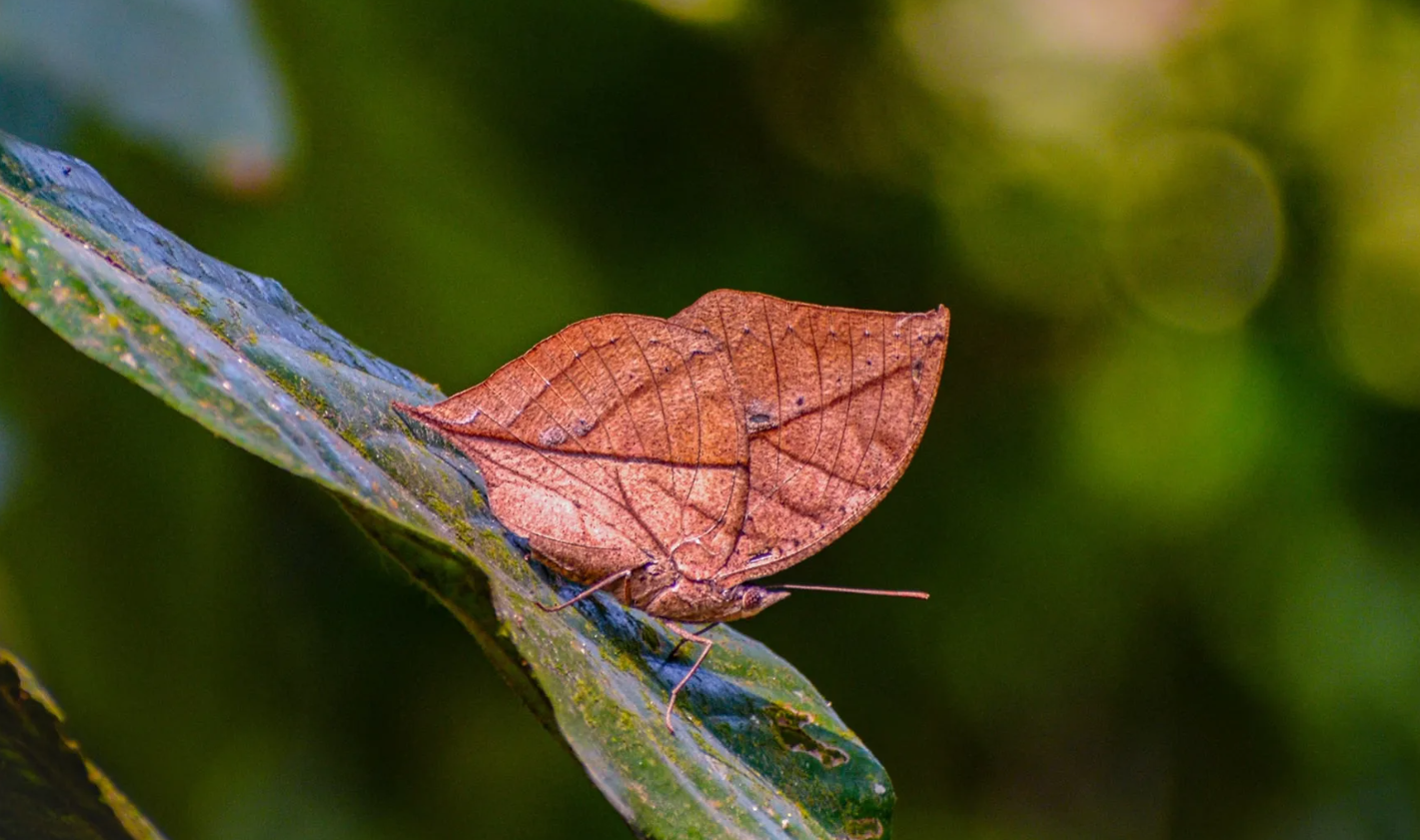
Orange Oakleaf: Key species features
Scientific name: Kallima inachus.
Known as a master of camouflage:
Closed wings → looks like a dry leaf.
Open wings → bright blue and orange coloration.
Recently voted the most beautiful butterfly in a public poll.
Significance of MP adopting a state butterfly
Enhances biodiversity branding and eco-tourism value.
May lead to better monitoring, habitat protection, and research support for lesser-known taxa like insects.
Useful for environmental education and local community engagement.
Prelims Practice MCQs
Q. With reference to the Orange Oakleaf butterfly proposed as the state butterfly of Madhya Pradesh, consider the following statements:
It is mostly found in the arid regions of western India.
It exhibits leaf-mimicking camouflage when resting.
It is commonly found across all major tiger reserves of Madhya Pradesh.
Which of the above statements is/are correct?
A. 1 only
B. 2 only
C. 2 and 3 only
D. 1 and 3 only
Correct answer: B
Explanation:
The species prefers moist forested habitats, not arid western India → Statement 1 is incorrect.
It is known for leaf-mimicking camouflage → Statement 2 is correct.
In MP, it is not common and largely restricted to Satpura National Park, not all tiger reserves → Statement 3 is incorrect.
Q. The Orange Oakleaf butterfly (Kallima inachus) is predominantly associated with which ecological characteristic?
A. Migratory behaviour across the Himalayas
B. Ability to mimic dead leaves through wing patterns
C. Feeding exclusively on bamboo species
D. Nocturnal pollination activity
Correct answer: B
Explanation:
Its signature trait is leaf-like camouflage with closed wings.