
Nuclear Waste Management in India
1. Legal & Regulatory Framework
-
Governed under Atomic Energy Act, 1962 and Atomic Energy (Safe Disposal of Radioactive Wastes) Rules, 1987.
-
Principle: No radioactive waste is released into the environment unless cleared/exempted/excluded by regulation.
-
Oversight: Independent regulatory capability + operational arrangements.
Law/Rule
Purpose
The Atomic Energy Act,
1962
Primary legislation for
all nuclear activities, including waste.
Amendments to AEA
Empower regulatory
oversight and safety enforcement.
Atomic Energy (Safe
Disposal of Radioactive Wastes) Rules, 1987
Specific rules for
classification, handling, treatment, and disposal of radioactive waste
|
Law/Rule |
Purpose |
|
The Atomic Energy Act,
1962 |
Primary legislation for
all nuclear activities, including waste. |
|
Amendments to AEA |
Empower regulatory
oversight and safety enforcement. |
|
Atomic Energy (Safe
Disposal of Radioactive Wastes) Rules, 1987 |
Specific rules for
classification, handling, treatment, and disposal of radioactive waste |
2. Current Practices
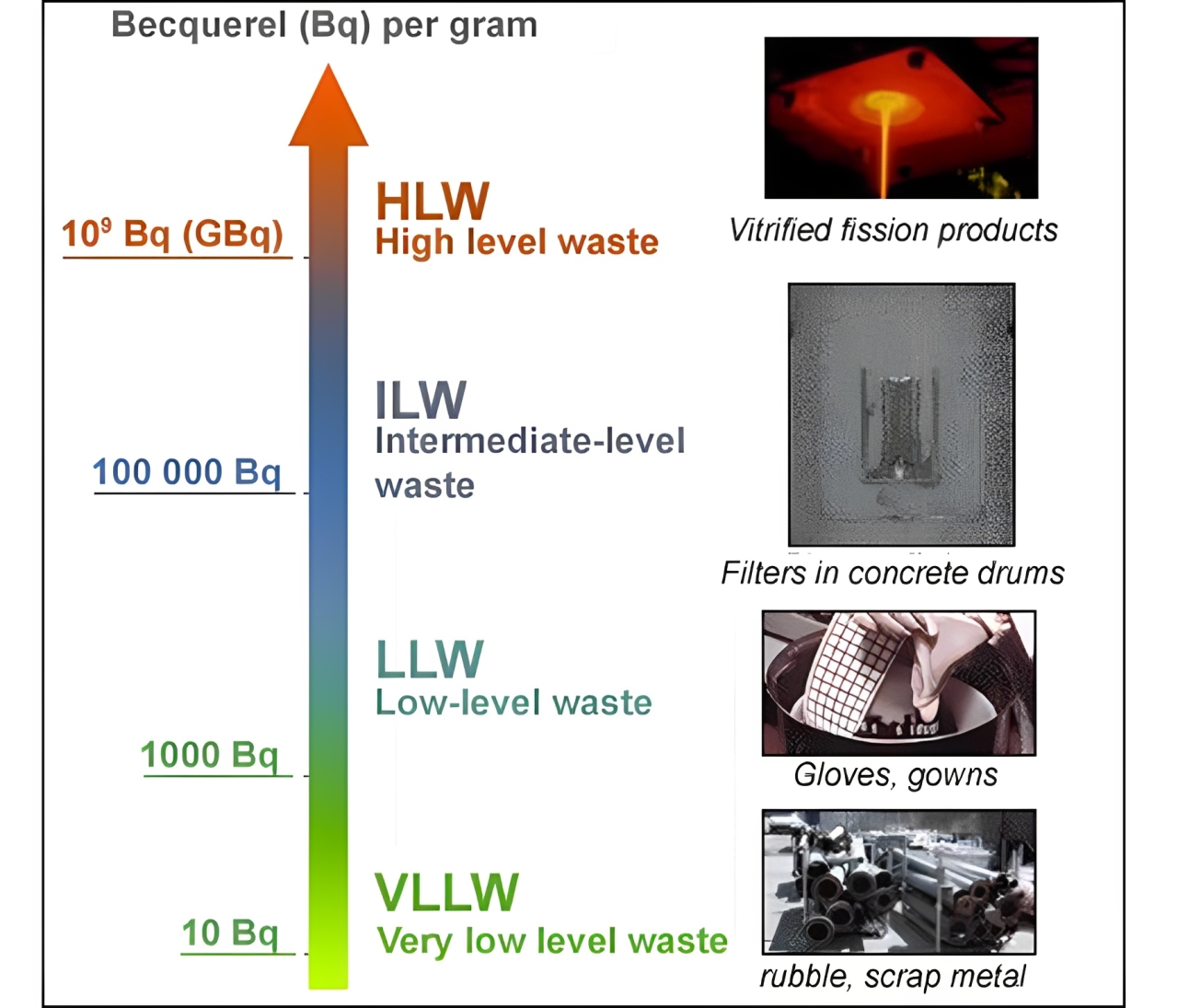
Low Level Waste – protective clothing, filters, mop water → compacted/solidified → disposed in trenches/tile holes.
-
Intermediate Level Waste – reactor components, chemical sludge → solidified in cement/bitumen → stored in engineered structures.
-
High Level Waste – spent fuel reprocessing by-products → Immobilized by vitrification (glass matrix)-vitrified and stored in Solid Storage Surveillance Facilities
SSSF (Tarapur, Kalpakkam)
-
Waste records filed with regulatory authority (quantity, location).
-
Waste volume: ~0.15 cubic meters/year/MW (over lifetime, incl. decommissioning).
On-Site Waste Management Practices
- LLW and ILW are managed at the reactor site during operation and decommissioning.
- Treatment Methods:
- Volume reduction: Evaporation, compaction.
- Immobilization: Encapsulation in cement, bitumen, or glass to prevent leaching.
- Disposal Structures:
- Reinforced concrete trenches
- Tile holes
- Designed for long-term containment.
- Environmental Monitoring:
- Borewells around disposal sites.
- Regular testing of groundwater and soil samples.
- Ensures no leakage of radioactivity.
Practice is at par with IAEA guidelines.
India follows a strict, safety-first philosophy:
❌ No radioactive waste is released into the environment unless it is:
- Cleared (proven safe),
- Exempted, or
- Excluded from regulatory control.
High-Level Waste (HLW) Management: Vitrification & Storage
Vitrification Process
- HLW (liquid waste from reprocessing) is:
- Concentrated.
- Mixed with glass-forming materials (borosilicate).
- Heated to ~1100°C to form a stable, inert glass matrix.
- Poured into stainless steel canisters and sealed.
Glass is highly durable, resistant to water and radiation — prevents leaching for thousands of years.
Interim Storage
- Vitrified waste canisters stored in:
- Solid Storage Surveillance Facility (SSSF) at:
- Tarapur (Maharashtra)
- Kalpakkam (Tamil Nadu)
- Solid Storage Surveillance Facility (SSSF) at:
- Passive cooling and radiation shielding.
- Continuous monitoring for safety.
3. Closed Fuel Cycle Approach
- India follows a closed nuclear fuel cycle:
- Spent fuel is reprocessed to recover plutonium and unused uranium for reuse in reactors (e.g., Fast Breeder Reactors).
- Reduces volume and radiotoxicity of waste.
- i.e, Domestic spent fuel → reprocessed.
- Recovered fissile material reused in future reactors.
- HLW vitrified → interim storage.
-
Ongoing R&D:
-
Partitioning technologies → recovery of long-lived constituents & useful radioisotopes.
-
Incineration of actinides → reduce long-term storage needs.
-
4. Future Outlook (towards 100 GW by 2047)
-
Roadmap prepared post Budget 2025–26.
-
Groundwork required: policy, legal & regulatory reforms, spent fuel reprocessing, waste management.
-
Funding:
-
₹20,000 crore outlay for SMR R&D under Nuclear Energy Mission.
-
Additional financing via extra-budgetary resources + private financing.
-
Recognition of nuclear energy in India’s Climate Finance Taxonomy (Draft) → eligible for climate finance.
-