
Nuclear Laws and the Role of Opposition
Background and Context
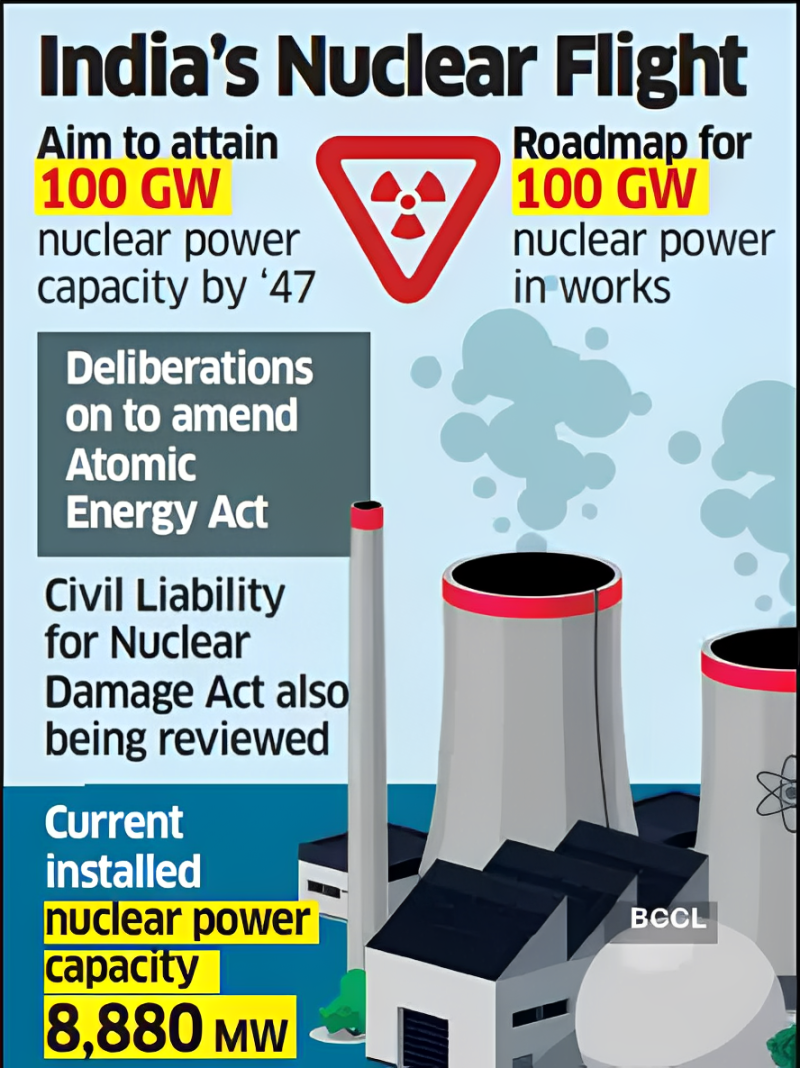
- The government intends to amend two key nuclear legislations:
- Civil Liability for Nuclear Damages Act (CLNDA), 2010
- Atomic Energy Act (AEA), 1962
- These amendments are expected to be introduced in the monsoon session of Parliament.
- The proposed changes aim to:
- Amend CLNDA: Address supplier liability in case of nuclear accidents.
- Amend AEA: Allow private sector participation in nuclear energy.
Historical Debate on Nuclear Liability
- India-U.S. Civil Nuclear Agreement (2008) was a turning point.
- Prior to CLNDA (2010), India had no domestic law on nuclear liability and was not party to international conventions (e.g., Vienna Convention, Paris Convention).
- The UPA government (Congress-led) introduced CLNDA to operationalize the nuclear deal.
- Opposition parties demanded higher compensation and supplier liability, leading to Section 17(b) and Section 46:
- Section 17(b): Allows operator (NPCIL) to recover damages from suppliers in case of equipment defect or negligence.
- Section 46: Grants right of recourse to the operator against suppliers.
- This deviated from international norms (which limit liability to operator only), making Western suppliers hesitant to enter Indian market.
Result: CLNDA rendered "dead on arrival" for foreign suppliers (e.g., Westinghouse, Areva).
Current Proposals and Concerns
- Proposed Amendments:
- Remove or dilute supplier liability (Section 17(b)) → align with Convention on Supplementary Compensation (CSC).
- Open nuclear energy sector to private players via AEA amendment.
- Opposition Objections :
- Amendments dilute accountability of equipment suppliers.
- Compromise public safety and prioritize foreign corporate interests (esp. U.S., France).
- Timing linked to PM Modi’s foreign visits – accused of appeasement.
- Government counters: Needed for energy security, climate goals, and scaling up nuclear capacity.
Energy and Climate Imperatives
- Current Status (2023):
- 24 nuclear reactors; 8.8 GW installed capacity.
- Nuclear contributes ~3% of total power generation.
- Targets:
- 22.48 GW by 2031–32
- 100 GW by 2047 (centenary of Independence)
- Small Modular Reactors (SMRs): Emerging global trend; India exploring partnerships.
- Challenges:
- High capital cost
- Long gestation period
- Public resistance due to safety concerns
- Nuclear waste management remains unresolved
Role of Opposition in Parliamentary Democracy
- Historical Precedents of U-Turns:
- Patents (Amendment) Act, 2005:
- Initially opposed by Opposition.
- Later supported to comply with TRIPS after change in stance.
- Insurance Sector FDI (2015):
- Opposed by Congress-led Opposition.
- Later supported when in government.
- Land Boundary Agreement with Bangladesh (2015):
- Initially stalled.
- Eventually ratified with bipartisan support.
- Patents (Amendment) Act, 2005:
- Key Lesson: On national interest issues, opposition parties have changed stance after deliberation.
"A change of sides should not result in a change of stand."
— Highlights need for principled, consistent opposition.
Need for Inclusive Debate
- Despite NDA’s majority in both Houses, the issue demands:
- Bipartisan consultation
- Expert inputs (scientists, environmentalists, legal experts)
- Public discourse on:
- Safety mechanisms
- Waste disposal
- Liability regime
- Private sector role
- Opposition should lead in initiating a comprehensive debate, not just oppose for political gain.
The Raja Ramanna Committee (1997)
- In 1997, the Government of India constituted a high-level committee chaired by Dr. Raja Ramanna, a renowned nuclear scientist and former Chairman of the Atomic Energy Commission.
- Objective: To review the Atomic Energy Act, 1962, and recommend reforms to modernize India’s nuclear legal and regulatory framework.
- Key Recommendations (Report submitted in 1997):
- Amend the AEA, 1962 to allow greater private sector participation in nuclear energy (non-strategic areas like construction, operation support, and ancillary services).
- Strengthen safety and regulatory mechanisms.
- Prepare India for international nuclear cooperation post-Cold War.
- Consider liability frameworks in line with global practices.
Note: The report did not recommend full privatization of nuclear power generation (core activities like fuel handling, reactor control remain with public sector), but suggested opening up support roles to private players.
Despite the report being examined by the government, no immediate action was taken due to:
- Political sensitivity around national security.
- Lack of international civil nuclear cooperation (India was under nuclear isolation post-1974 and 1998 tests).
- Technological and financial constraints.
During debates on the India-U.S. Civil Nuclear Agreement, the government acknowledged that the Raja Ramanna Committee’s recommendations were under review.
The proposed amendment to the Atomic Energy Act, 1962, to allow private participation, can be seen as a long-delayed implementation of the 1997 Raja Ramanna Committee vision.