
New GDP series (base year 2022–23)
Introduction
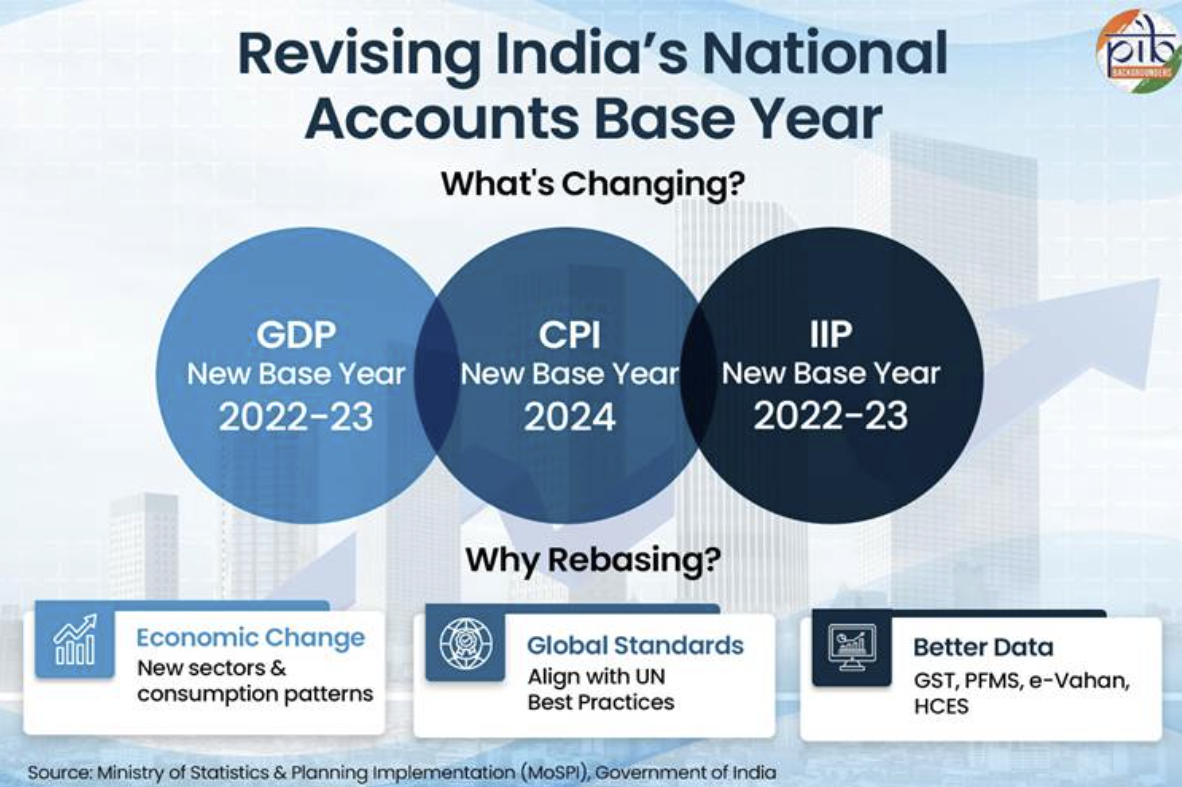
A new GDP series with base year 2022–23 has been released in the public domain.
Released on February 27, 2026 by the Ministry of Statistics and Programme Implementation (MoSPI).
Provides GDP estimates and related aggregates for:
2022–23
2023–24
2024–25
Objective:
To provide a more accurate and realistic picture of the Indian economy
To overcome limitations of the outdated 2011–12 base year
GDP size (current prices, ₹ lakh crore)
2022–23 → 261.18
2023–24 → 289.84
2024–25 → 318.07 (first revised estimate)
These estimates are 3–4% lower than earlier estimates based on the old series
Sectoral composition (GVA, 2024–25)
Primary sector → 21.4%
Secondary sector → 25.8%
Tertiary sector → 52.9%
Key observation:
Tertiary sector dominates the economy
Structural pattern consistent with a service-led economy
Growth trends (Manufacturing sector)
Real GVA growth:
2023–24 → 12.7%
2024–25 → 9.3%
Indicates strong industrial performance (>9%) in both years
Expenditure side (GDP)
Private Final Consumption Expenditure (PFCE) share ≈ 56%
Applies to both:
Current prices
Constant prices
Indicates consumption-driven nature of Indian economy
Major methodological refinements
1. Treatment of multi-activity enterprises
GVA now apportioned across different activities
Based on revenue share data (MGT 7/7A)
Earlier: Entire GVA assigned to single dominant activity
2. Adjustment for non-reporting companies
Use of blown-up factorat:
Industry × size class level
Based on paid-up capital
Captures contribution of:
Active companies that did not file returns
3. Expanded corporate coverage
Inclusion of Limited Liability Partnerships (LLPs)
Data source: Ministry of Corporate Affairs (MCA)
4. Household sector estimation
GVA estimated as:
GVAPW (ASUSE) × number of workers (PLFS)
GVA per worker (GVAPW)
Uses:
Annual Survey of Unincorporated Sector Enterprises (ASUSE)
Periodic Labour Force Survey (PLFS)
Earlier method:
Base year GVA extrapolated using indicators
Improvements in estimation techniques
1. Real GVA estimation
Expanded use of:
Double deflation
Volume extrapolation
Aligns estimates with international standards
2. PFCE estimation
Benchmark estimates for 2022–23 derived using:
Household Consumption Expenditure Survey (HCES 2022–23)
Particularly for:
Widely consumed items
Low income elasticity goods
Challenges in the new GDP series
1. Private corporate sector issues
GVA compiled using MCA database
Problem:
Data available only at enterprise level
Difficult to allocate GVA across States
Affects:
Gross State Value Added (GSVA) estimation
2. Limitations of ASI data
Earlier method:
State-wise GVA allocated using ASI shares
New method:
Uses ASI + GST data
Major issue:
Inadequate ASI frame
Evidence:
MCA companies (manufacturing): 135,802
ASI factories: 67,649
Implication:
ASI-based shares may:
Not reflect reality
Distort State GDP estimates
3. Suggested improvements
Improve ASI sampling frame using:
MCA database
GST database
Conduct:
Properly designed sample surveys of active companies
Goal:
Better State-wise GVA estimation
Household sector issues
Method
GVA = GVAPW (ASUSE) × workers (PLFS)
Problem: Volatility in ASUSE data
Example 1 (Rubber & plastic products)
2021–22 → ₹163,078
2022–23 → ₹255,447
2023–24 → ₹201,930
Example 2 (Bihar manufacturing)
₹89,638 → ₹117,021 → ₹100,101
Indicates:
Unstable annual estimates
Solutions suggested
Use of 3-year moving average (except base year)
Explore:
Rotating panel design in ASUSE
Similar to PLFS (overlapping samples)
Conclusion
Key improvements:
Better methodology
Wider data coverage
Improved estimation techniques
Key requirements ahead:
Strengthen ASI database
Refine ASUSE methodology
Outcome:
More reliable GDP and GSDP estimates
Prelims Practice MCQs
Q. Consider the following statements regarding sectoral composition in the new GDP series (2024–25):
Tertiary sector has the highest share in GVA.
Primary sector contributes more than the secondary sector.
Secondary sector contributes more than one-fourth of total GVA.
Which of the statements given above is/are correct?
(a) 1 and 3 only
(b) 1 only
(c) 2 and 3 only
(d) 1, 2 and 3
Answer: (a) 1 and 3 only
Explanation:
Tertiary = 52.9% → highest (Correct)
Primary = 21.4%, Secondary = 25.8% → Primary is NOT higher (Statement 2 wrong)
Secondary > 25% → Correct
Q. Which of the following methodological changes has been introduced in the new GDP series?
Allocation of entire GVA of enterprises to their major activity
Use of MGT 7/7A data for multi-activity enterprises
Inclusion of LLP data using MCA database
Use of ASUSE and PLFS for household sector estimation
Select the correct answer:
(a) 2, 3 and 4 only
(b) 1 and 2 only
(c) 1, 3 and 4 only
(d) 2 and 4 only
Answer: (a) 2, 3 and 4 only
Explanation:
Statement 1: Old method (wrong)
Statement 2: New improvement (Correct)
Statement 3: LLP coverage added (Correct)
Statement 4: ASUSE + PLFS used (Correct)
Q. With reference to estimation techniques in the new GDP series, consider the following:
Double deflation method is expanded.
Volume extrapolation is used for real GVA estimation.
PFCE estimates rely exclusively on income tax data.
Which of the statements is/are correct?
(a) 1 and 2 only
(b) 2 and 3 only
(c) 1 only
(d) 1, 2 and 3
Answer: (a) 1 and 2 only
Explanation:
Statement 1: Correct → Improved estimation method
Statement 2: Correct
Statement 3: Incorrect → PFCE uses HCES data, not tax data