
Natural Rubber Cultivation in India
1. Origin
-
Natural rubber is a versatile plant-based industrial raw material.
-
Latex, the economic product, is harvested by controlled tapping of the bark.
-
Native : Hevea brasiliensis, native to the Amazon Basin, introduced to Asia and Africa by the British in the late 19th century.
Source: Derived from latex of Hevea brasiliensis (rubber tree)
Composition: Mainly polyisoprene (a polymer) with organic compounds
Climatic Conditions:
Temperature: 20°C to 35°C
Rainfall: Over 200 cm annually
Soil: Loamy or laterite, elevated or sloped terrain
Requires cheap, skilled labour
2. Agro-Climatic Requirements
-
Thrives in a variety of climates and soils.
-
Requires well-distributed rainfall of ~200 cm annually.
3. Rubber Cultivation in India
-
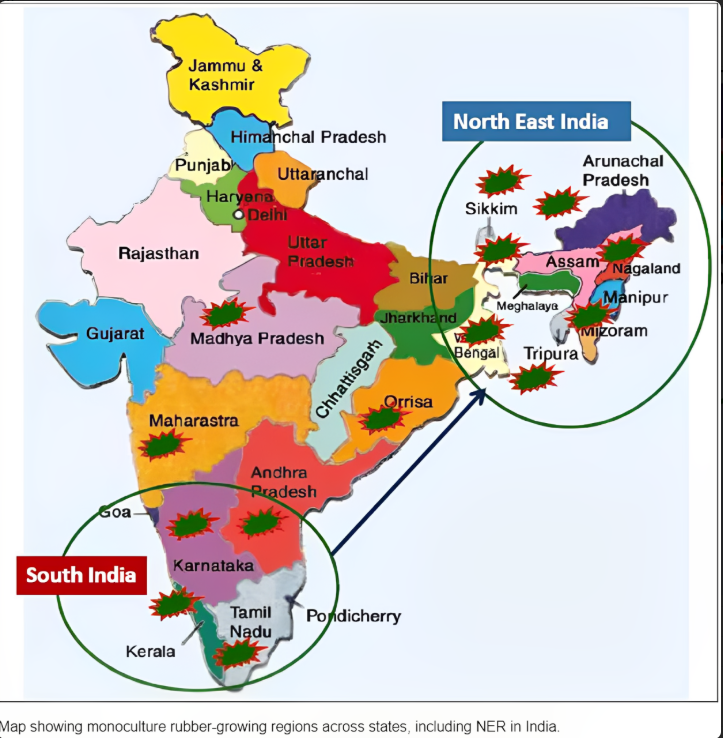
Total area: 8.5 lakh hectares
-
Kerala and Kanyakumari (TN): ~5 lakh hectares
-
Tripura: ~1 lakh hectares
-
Northeast (Tripura, Assam, etc.): >16% of national production
-
Kerala's share: Declined from 90% to 78%
-
Non-traditional areas (Karnataka, Goa, Maharashtra): ~6% share
India’s Rubber Scenario
-
Global Rank:
-
5th largest producer
-
4th largest consumer of natural rubber
-
5th largest consumer of natural + synthetic rubber

-
Major Producing States:
-
Kerala: >90% of domestic production
-
Tripura: ~9%
-
Others: Karnataka, Assam, Tamil Nadu, Meghalaya, Nagaland, Manipur, Goa, A&N Islands
-
3. Trade Data (2022–23)
-
Exports: 3,700 tonnes (to USA, Germany, UAE, UK, Bangladesh)
-
Imports: 5,28,677 tonnes (from Indonesia, Thailand, China, South Korea, Japan)
4. Three Zones of Rubber Cultivation
-
Traditional Region: Kerala and Kanyakumari (Tamil Nadu)
-
Non-Traditional Region: All other Indian states excluding NE and traditional zone
-
Northeast Region: Assam, Tripura, Meghalaya, Nagaland, Manipur, Mizoram, Arunachal Pradesh
-
Potential: 4 lakh hectares
-
Planned cultivation: 2 lakh hectares (due to terrain challenges like landslides)
-
5. Properties and Uses
-
Latex has ~40% rubber content; rest is water and other compounds.
-
Vulcanisation: Adding sulphur transforms rubber into an elastic material with:
-
High tensile strength
-
Greater hardness and abrasion resistance
-
-
Major uses:
-
65% in the automobile industry (tyres and tubes)
-
Engineering applications: Shock absorption, vibration isolation, road surfacing
Rubber Board of India
-
Established under: Rubber Act, 1947
-
Renamed as: The Rubber Board (via Rubber Production and Marketing (Amendment) Act, 1954)
-
Purpose: Overall development of the rubber industry in India
-
Ministry: Functions under the Ministry of Commerce & Industry, Government of India
-
Headquarters: Kottayam, Kerala
-
Composition (as per Section 4(3) of the Act): A Chairman and other appointed members
Government Initiatives for Rubber Sector Development
1. Rubber Plantation Development Scheme
-
Promotes rubber cultivation in traditional and non-traditional regions
-
Target states: Karnataka, Maharashtra, Andhra Pradesh, Goa, Odisha, West Bengal
2. Scheme for Rubber Development in Northeast
-
Focuses on new plantations in the Northeastern states
3. Rubber Production Incentive Scheme (RPIS)
-
Provides financial support and technical assistance for new planting
-
Ensures minimum price of ₹150/kg for rubber
4. NE Mitra Scheme
-
Implemented by Rubber Board with major tyre companies
-
Aims to cultivate 2 lakh hectares of rubber in the Northeast within five years
5. Production Linked Incentive (PLI) Scheme
-
Proposed by All India Rubber Industries Association (AIRIA)
-
Aims to promote rubber goods manufacturing in India
-
Supports India's emergence as an alternative to China in the rubber goods industry