
National Population Register (NPR)
×
![]()
Why in news :
The Centre has not
yet decided whether to update the National Population
Register (NPR) during Census 2027.This
was communicated during a preparatory
meeting of Census Directors held on July
3–4.
About National Population
Register (NPR)
- NPR is a register of usual residents of the
country.
- A “usual
resident” is a person who
has resided in a local area for the past 6
months or intends to reside
there for the next 6 months or more.
Legal Basis:
- Governed by the Citizenship
Act, 1955 and the Citizenship (Registration of Citizens and Issue of
National Identity Cards) Rules, 2003.
Purpose:
- To create a comprehensive
identity database of
every usual resident.
- It is
considered the first step toward the creation of the National Register of
Citizens (NRC).
Origin and Updates:
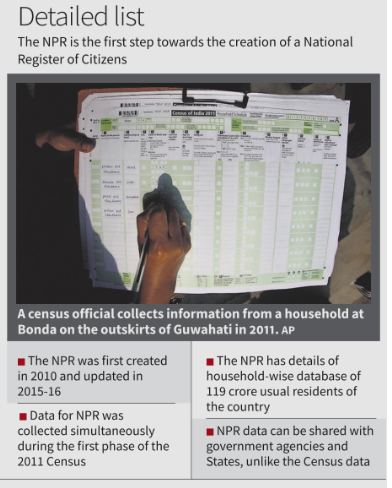
- First created in 2010,
during the House Listing phase of Census 2011.
- Updated in 2015–16 using information
from door-to-door surveys.
- Proposed to be updated again alongside
Census 2021, but delayed due to COVID-19.
Data Collected:
- Includes demographic
details (name, gender, DOB, relationship, marital status,
etc.) and residential information.
- Unlike Census
data (which is anonymized
and aggregated), NPR
data can be shared with Central and State governments and
agencies for planning and security.
Scope:
- Covers all usual
residents, including foreigners
residing in India for more than 6 months.
- As of 2015–16, NPR held records of over 119
crore residents.
Controversy:
- Concerns over privacy, exclusion,
and linkage with NRC have been raised by civil society and
political groups.
- Some States (e.g., West Bengal, Kerala) had
halted NPR work citing concerns over its impact on minorities.
Difference from Census:
|
NPR |
Census |
|
|
Nature |
Individual-specific |
Aggregated
data |
|
Legal Backing |
Citizenship Act, 1955 |
Census Act, 1948 |
|
Purpose |
Identity
database |
Population
statistics |
|
Frequency |
No fixed interval |
Every 10 years |
|
Data
Sharing |
Allowed
with governments |
Not
shared publicly |