
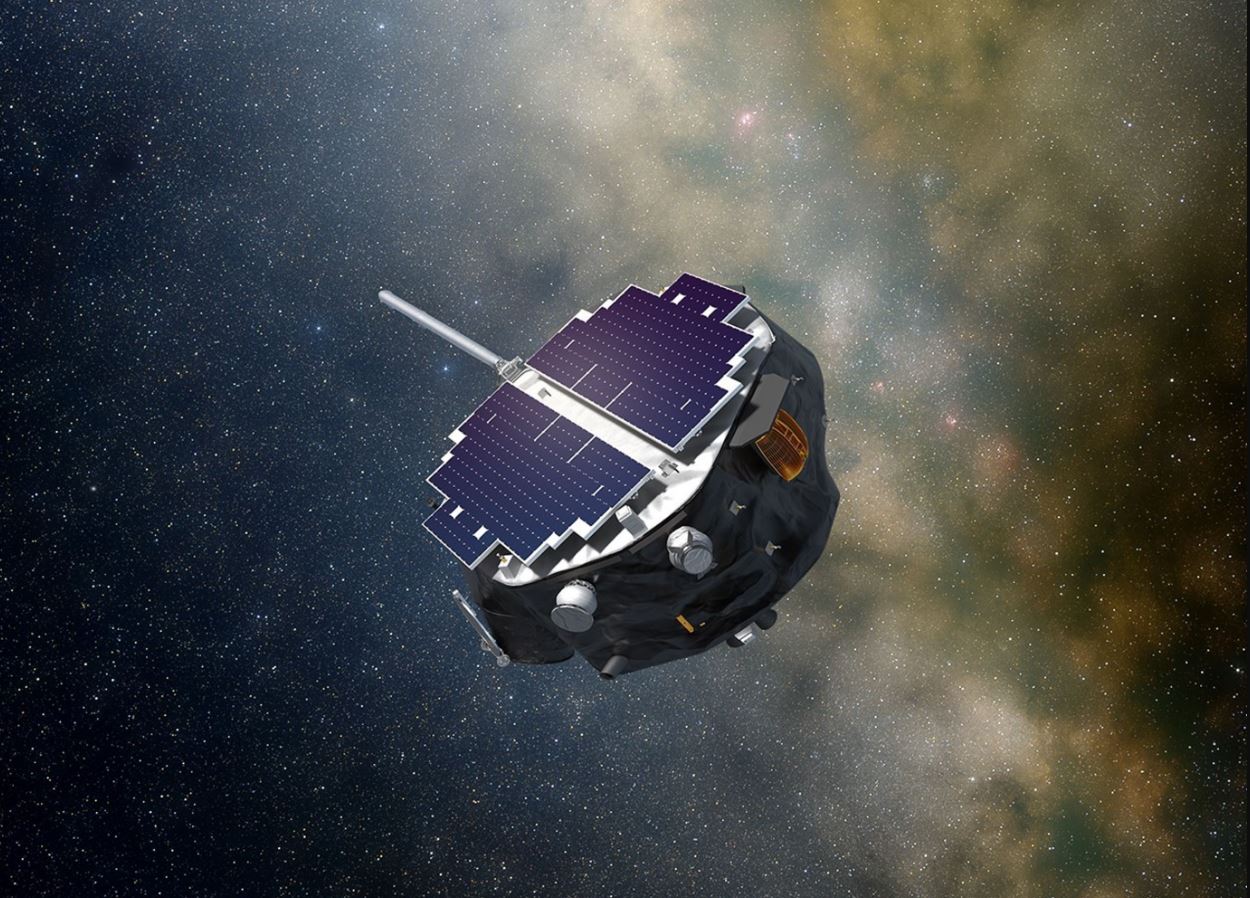
NASA’s Interstellar Mapping and Acceleration Probe (IMAP)
Introduction
Launch : September 2025 (by NASA).
Mission Type: Heliophysics mission.
Primary Objective: To map the heliosphere’s boundary and study how solar particles are accelerated and how the heliosphere protects Earth from cosmic radiation.

Key Concepts
Heliosphere: A vast bubble-like region surrounding the Solar System, created by the solar wind (continuous stream of charged particles from the Sun).
Significance: Shields planets from harmful cosmic rays and interstellar particles, influencing habitability.
Knowledge Gap: Structure, boundaries, and particle dynamics of the heliosphere are poorly understood.

Mission Objectives
Map the heliosphere boundary (where solar wind meets the interstellar medium).
Trace particle acceleration mechanisms within the solar wind and heliosphere.
Improve space weather forecasting to safeguard satellites, astronauts, and communication systems.
Study interstellar neutral atoms (H, D) at the heliopause to distinguish their origins.
Instruments on IMAP (10 in total)
Energetic Neutral Atom Detectors: IMAP-Lo, IMAP-Hi, IMAP-Ultra.
Charged Particle Detectors: Capture solar wind ions & cosmic rays.
Magnetometers: Measure magnetic fields.
Dust Detectors: Study interstellar dust inflow.
Specialised Observation: IMAP-Lo to detect interstellar neutral hydrogen & deuterium populations.
Scientific instruments
- Interstellar Dust Experiment (IDEX)
- IMAP Magnetometer (MAG)
- IMAP-Ultra
- High-energy Ion Telescope (HIT)
- Solar Wind Electron instrument (SWE)
- GLObal Solar Wind Structure (GLOWS)
- Solar Wind And Pickup Ion (SWAPI)
- IMAP-Hi
- IMAP-Lo
- Compact Dual Ion Composition Experiment (CoDICE)
Mission Design
Orbit: Sun–Earth Lagrange Point 1 (L1), ~1.6 million km from Earth towards the Sun.
Why L1? Stable gravitational balance → continuous observation of solar wind with minimal fuel.
Operations: Near real-time data relay to monitor space weather conditions.

Expected Outcomes
Scientific Advances
Most detailed maps of the heliosphere’s boundary.
Insights into particle acceleration & transport mechanisms.
Better understanding of how Earth and exoplanets are shielded from cosmic radiation.
Practical Benefits
Enhanced space weather forecasting → protection of satellites, communications, power grids, and astronauts.
Data will aid future human exploration beyond Earth, by improving shielding designs and mission planning.