
Mining, Water Crisis, and Indigenous Rights in Atacama, Chile
Context:
The Atacama Desert in northern Chile, known as the driest place on Earth, is facing a severe ecological and humanitarian crisis due to extensive copper and lithium mining operations and a 15-year-long mega-drought. Despite the shift toward desalinated seawater, Indigenous communities argue that the environmental damage is irreversible.

Key Issues:
-
Mining and Water Stress:
-
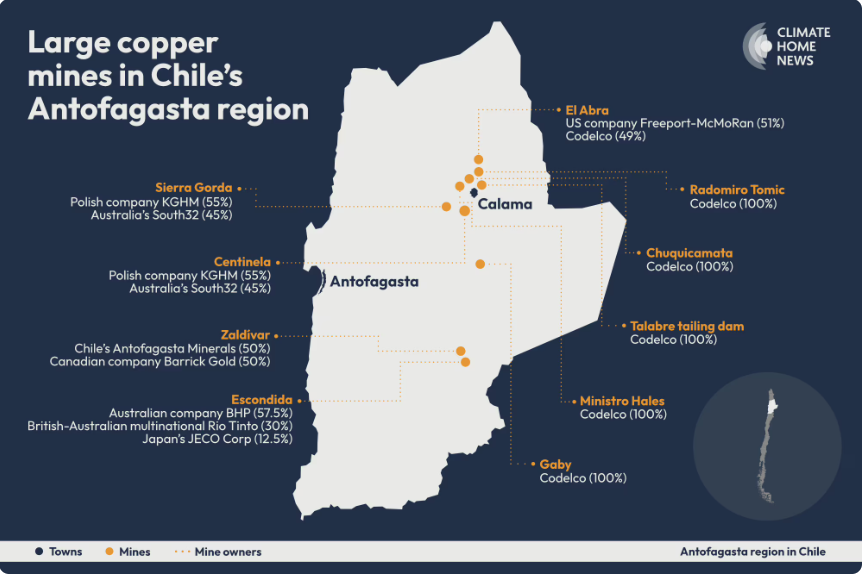
Mining giants such as BHP (Escondida Mine), Albemarle, and Zaldívar have historically extracted groundwater for operations.
-
Over-extraction has led to a drop of over 25 cm in water tables, affecting wetlands, springs, vegetation, and biodiversity in the Monturaqui-Negrillar-Tilopozo aquifer.
-
-
Impact on Indigenous Communities:
-
The Lickanantay de Peine Indigenous community has witnessed destruction of grazing lands and local water ecosystems.
-
Environmental degradation has disrupted traditional livelihoods and cultural practices.
-
-
Desalination: A Double-Edged Sword:
-
Mining firms have shifted to desalinated seawater (approx. 30% of water used in mining now).
-
However, desalinated water does not reach Indigenous lands and has ecological costs:
-
High CO₂ emissions (projected 700,000 tonnes CO₂e/year by 2030).
-
Brine discharge harming marine biodiversity, especially near Antofagasta.
-
-
-
Regulatory and Judicial Actions:
-
In Dec 2024, Chile’s environmental court fined companies $47 million for unsustainable groundwater depletion.
-
A prior $8.4 million fine on Escondida was upheld.
-
-
Green Paradox:
-
Chile is a major global supplier of copper (13%) and lithium (80% of EU imports).
-
These minerals are crucial for the global green transition (EVs, renewables), yet their extraction worsens local ecological and cultural degradation.
-
Important Locations:
-
Atacama Desert: Driest region on Earth, with sensitive salt flat ecosystems.
-
Escondida Mine: World’s largest copper producer, located in the Andes.
-
Peine: Indigenous Lickanantay community settlement within salt flats.
-
Monturaqui-Negrillar-Tilopozo Aquifer: Over-exploited groundwater source.
-
Coloso, Antofagasta: Location of BHP's largest desalination plant.
-
Antofagasta (Port & Coast): Site of brine discharge, affecting marine life.
Other Important Facts :
| Element | Detail |
|---|---|
| Mega-Drought | Longest in Chile in 100 years; 15 years ongoing. |
| Biodiversity Threats | Wetland vegetation loss, marine species decline (fisher testimony). |
| Desalination Dependence | 75% of Chile’s desalination capacity used by mining. |
| CO₂ Impact | Desalination CO₂ emissions may equal Antigua & Barbuda’s emissions by 2030. |
| Green Transition Dilemma | Clean energy minerals sourced via ecologically damaging processes. |
| Indigenous Rights | Court acknowledged violation of traditional ways of life and ecosystem dependence. |
UPSC Syllabus:
-
GS Paper I: Geography – Desert ecosystems, water stress.
-
GS Paper II: Governance – Indigenous rights, environmental justice.
-
GS Paper III: Environment & Economy – Climate change, resource extraction vs sustainability, energy transition.
-
Essay/Ethics: Development vs Environment, Ecological Rights, Cultural Survival.