
Mekedatu Reservoir Dispute: Issue and Background
Context:
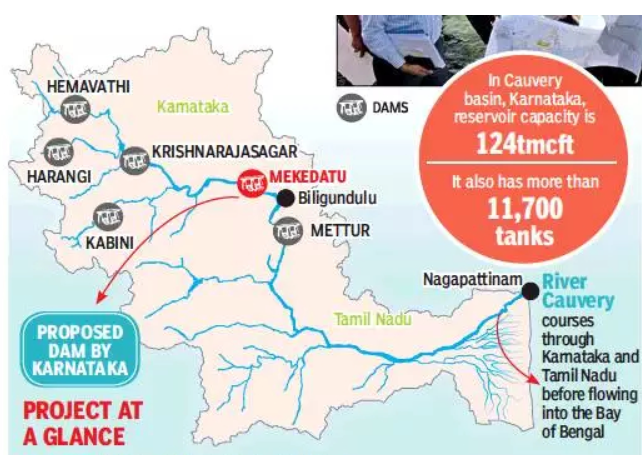
The present dispute concerns Karnataka’s proposal to construct a reservoir at Mekedatu across the Cauvery River, primarily to supply drinking water to Bengaluru and surrounding areas and to augment water storage.
Tamil Nadu opposes the project, arguing that:
It violates the Cauvery Water Disputes Tribunal (CWDT) Final Award 2007, as modified by the Supreme Court judgment of 2018.
It may jeopardise the assured flows that Karnataka must release to Tamil Nadu, a lower riparian State.
Karnataka did not seek mandatory consent of Tamil Nadu before going ahead with the Detailed Project Report (DPR).
Supreme Court’s present position (November 2025):
Tamil Nadu’s plea is premature, as the DPR is still before CWMA ( Cauvery Water Management Authority) and CWRC (Cauvery Water Regulation Committee) experts.
DPR can be approved only after CWMA and CWRC grant clearance.
Even if the DPR is cleared, all stakeholders—including Tamil Nadu—may challenge it legally.
Karnataka remains bound to release the allocated quantum of water to Tamil Nadu and Puducherry.
Background of the Dispute
Historical Context
The Cauvery is a highly contested interstate river involving Karnataka (upper riparian) and Tamil Nadu (lower riparian) with contributions from Kerala and Puducherry.
Disputes intensified post-Independence due to:
Increased irrigation demand
Urbanisation needs (especially Bengaluru)
Monsoon variability
Absence of new inter-State agreements after princely-era accords (1924 Agreement)
The 1924 Agreement
Signed between the Madras Presidency and the Princely State of Mysore.
Allowed Mysore to construct the Krishnarajasagar (KRS) dam; assured waters for Mettur Dam downstream.
Valid for 50 years, expired in 1974, after which disputes escalated.
Formation of Tribunal
Under Inter-State Water Disputes Act, 1956, the Cauvery Water Disputes Tribunal (CWDT) was formed in 1990.
Tribunal’s Final Award (2007)
Total available water at 50% dependability: 740 TMC.
Allocation:
Tamil Nadu: 419 TMC
Karnataka: 270 TMC
Kerala: 30 TMC
Puducherry: 7 TMC
Karnataka must release 177.25 TMC annually to Tamil Nadu at Biligundlu.
Supreme Court Judgment (2018)
Modified allocation:
Tamil Nadu reduced by 14.75 TMC (now 404.25 TMC)
Karnataka increased by 14.75 TMC (now 284.75 TMC)
However, it upheld timely release obligations to Tamil Nadu.
Creation of CWMA and CWRC (2018)
To monitor reservoir levels, water flows, and monthly releases.
Mekedatu proposals must be vetted by these bodies.
About the Cauvery River
Origin and Course
Origin: Talakaveri, Brahmagiri Hills, Kodagu district (Karnataka).
Length: ~800 km.
Flows through Karnataka → Tamil Nadu, partly forming boundary with Kerala; empties into the Bay of Bengal.
Major tributaries:
Left bank: Harangi, Hemavathi, Shimsha, Arkavathi
Right bank: Lakshmana Tirtha, Kabini, Bhavani, Noyyal, Amaravati.
Has multiple dams: KRS, Kabini, Hemavathi, Bhavani Sagar, Mettur.

Prelims Practice MCQs
Q. With reference to the historical agreements governing the Cauvery River before independence, consider the following:
The 1892 Agreement required Mysore to obtain prior consent of the Madras Presidency before constructing any irrigation works on Cauvery tributaries.
The 1924 Agreement permitted Mysore to construct the Krishnarajasagara Dam and was initially valid for 100 years.
Both agreements were made binding on successor States after 1950 through Article 262 of the Constitution.
Which of the statements above is/are correct?
A. 1 only
B. 1 and 2 only
C. 2 and 3 only
D. 1, 2 and 3
Answer: A
Explanation:
Statement 1 is correct.
Statement 2 is incorrect: The 1924 agreement was valid for 50 years (till 1974), not 100.
Statement 3 is incorrect: Article 262 provides mechanism for water disputes, but does not make pre-independence agreements binding; their continuity comes from general principles of succession, not Article 262.
Q. With reference to the Cauvery Water Management Authority (CWMA), consider the following:
It was created under the Inter-State Water Disputes Act, 1956 as amended in 2002.
The Chairperson is appointed by the Centre and holds a tenure not exceeding five years.
It is empowered to issue binding directions to basin States under the 2018 Supreme Court judgment.
Which statements are correct?
A. 1 and 3 only
B. 2 only
C. 2 and 3 only
D. 3 only
Answer: D
Explanation:
Statement 1 is incorrect: CWMA was constituted through a notification of the Union Government in 2018 as per the Supreme Court’s directive, not directly under ISWDA amendment.
Statement 2 is incorrect: The notification prescribes three-year tenure.
Statement 3 is correct: CWMA’s directions are binding on States.
Q. Consider the following pairs of Cauvery tributaries and their characteristics:
Tributary | Characteristic |
1. Bhavani | Originates from Nilgiri Hills and enters the river near Kodumudi |
2. Lakshmana Tirtha | Originates in Kerala and drains into Amaravati |
3. Amaravati | Joins the Cauvery in Tamil Nadu |
Which of the above pairs is/are correctly matched?
A. 1 and 3 only
B. 2 only
C. 1 only
D. 1, 2 and 3
Answer: A
Explanation:
Bhavani: Correct (Nilgiris → Kodumudi).
Lakshmana Tirtha: Incorrect (originates in Kodagu, Karnataka, and joins the Cauvery directly, not Amaravati).
Amaravati: Correct (joins Cauvery at Karur district, Tamil Nadu).