
Mangrove Conservation and Global Initiatives
GLOMIS – Global Mangrove Database and Information System
-
Full Form: GLObal Mangrove database and Information System.
-
Established by: International Society for Mangrove Ecosystems (ISME).
-
Financial Support:
-
International Tropical Timber Organization (ITTO)
-
Prefectural Government of Okinawa, Japan.
-
-
Headquarters: Okinawa, Japan.
-
Function:
-
A centralised information system on global mangrove ecosystems.
-
Documents mangrove species, genetic resources, research data, experts, and best practices.
-
-
Regional Centres: Located in Brazil, Fiji, Ghana, and Malaysia to ensure global coordination and local data integration.
-
Purpose:
-
To facilitate research, policy-making, and restoration efforts.
-
Strengthens mangrove conservation through global collaboration and knowledge-sharing.
Tropical Coastal Ecosystems Portal (TroCEP)
-
Developed by:
-
International Society for Mangrove Ecosystems (ISME)
-
National Institute for Environmental Studies (NIES), Japan
-
-
Purpose:
-
To compile and disseminate scientific information on coastal ecosystems in tropical and subtropical regions.
-
-
Current Focus:
-
The portal presently provides data and research related only to mangroves.
-
-
Future Expansion:
-
TroCEP aims to extend coverage to include:
-
Coral reefs
-
Seagrasses
-
-
-
Significance:
-
Enhances knowledge-sharing and collaborative research on vulnerable coastal ecosystems.
-
Supports ecosystem-based management, climate adaptation, and conservation planning at regional and global levels.
International Society for Mangrove Ecosystems (ISME)
-
Established: August 1990
-
Type: International, non-profit, non-governmental scientific society
-
Headquarters: Okinawa, Japan
Foundational Background
-
Formed to build on the foundation laid by UNDP/UNESCO Regional Mangrove Projects.
-
Governed by statutes that emphasize:
-
Information collection, evaluation, and dissemination on mangrove ecosystems.
-
Promotion of international cooperation in mangrove conservation.
-
Mission
“To collect, evaluate, and disseminate information on mangrove ecosystems through international cooperation for their conservation, rational management, and sustainable utilization.”
Core Areas of Work
ISME operates through three primary pathways:
-
Application of Knowledge:
-
Translating research into localised conservation practices and management strategies.
-
-
Training and Education:
-
Capacity building for scientists, forest officials, community leaders, and NGOs.
-
-
Exchange of Information:
-
Facilitates global knowledge-sharing, workshops, manuals, and atlases.
-
Key Activities and Contributions
-
Supported by collaborations with:
-
Universities, research institutes, local communities, and global organizations.
-
-
Helped establish:
-
GLOMIS (Global Mangrove Database and Information System)
-
TroCEP (Tropical Coastal Ecosystems Portal)
-
World Mangrove Atlas
-
Charter for Mangroves (part of the UN's World Charter for Nature, 1992)
World Atlas of Mangroves
Overview
-
The World Atlas of Mangroves is a comprehensive global reference on mangrove ecosystems, their distribution, ecological importance, and threats.
-
The current version is a revised edition of the 1997 atlas, implemented through a collaborative project launched in 2005.
Project Partners
This atlas was a joint initiative involving several key international agencies:
-
International Tropical Timber Organization (ITTO) – Major funder through a Japanese government grant
-
International Society for Mangrove Ecosystems (ISME) – Project implementation lead
-
Food and Agriculture Organization (FAO)
-
UNEP-World Conservation Monitoring Centre (UNEP-WCMC)
-
UNESCO - Man and the Biosphere Programme (UNESCO-MAB)
-
United Nations University - Institute for Water, Environment and Health (UNU-INWEH)
-
The Nature Conservancy (TNC)
Objectives
-
To revise and update the previous edition published in 1997 by ITTO, ISME, and WCMC.
-
Provide scientific, policy, and conservation communities with:
-
Accurate, high-resolution maps
-
Regional and national data on mangrove coverage
-
Information on biodiversity, carbon storage, ecosystem services, and conservation priorities
-
Significance
-
Serves as a global baseline for:
-
Mangrove conservation policies
-
Coastal ecosystem management
-
Blue carbon accounting and climate change mitigation
-
-
Supports SDG 14 (Life Below Water), SDG 13 (Climate Action), and UN Decade on Ecosystem Restoration
Key Features
-
Maps and geospatial data based on satellite imagery and field surveys
-
Includes country-wise mangrove distribution and status
-
Highlights threats like aquaculture, urbanisation, and rising sea levels
-
Promotes the sustainable use and restoration of mangroves
Mangrove Alliance for Climate (MAC)
Launched at:
-
COP27 (2022) by United Arab Emirates (UAE) and Indonesia
Founding Members:
-
UAE, Indonesia, India, Sri Lanka, Australia, Japan, Spain
Nature:
-
Voluntary, global initiative focused on nature-based climate solutions.
Key Objectives:
-
Raising Awareness:
-
Educate the public, governments, and stakeholders on the carbon sequestration, biodiversity, and coastal protection roles of mangroves.
-
-
Promoting Conservation and Restoration:
-
Encourage policies and actions to protect existing mangroves and restore degraded mangrove areas.
-
-
Scaling Up Efforts:
-
Accelerate plantation, afforestation, and restoration globally to benefit climate resilience and coastal communities.
-
Relevance to India:
-
India, with one of the largest areas of mangroves in South Asia, plays a key role in the MAC for blue carbon, biodiversity, and climate adaptation strategies.
Global Mangrove Alliance (GMA)
Launched at:
-
World Ocean Summit 2018
Stakeholders Involved:
-
NGOs, Governments, Local Communities, Scientists, Industry, Funders
Nature:
-
A multi-sectoral and collaborative global platform aimed at mangrove conservation and restoration.
Strategic Focus Areas:
-
Leveraging Funds for conservation projects
-
Scientific Research and innovation in mangrove ecology
-
Strengthening Coastal Management and community-based governance
-
Education & Awareness
-
Disaster Risk Reduction (DRR)
-
Climate Mitigation and Adaptation policies at local, national, and international levels
Significance:
-
Supports implementation of:
-
Paris Agreement
-
Kunming-Montreal Global Biodiversity Framework
-
UN Decade on Ecosystem Restoration (2021–2030)
-
Importance of Mangroves in Climate Action
-
Carbon Sequestration: High blue carbon potential per hectare
-
Disaster Buffer: Absorbs cyclones, storm surges, and coastal flooding
-
Livelihood Support: Crucial for fishing, aquaculture, honey, and fuelwood
-
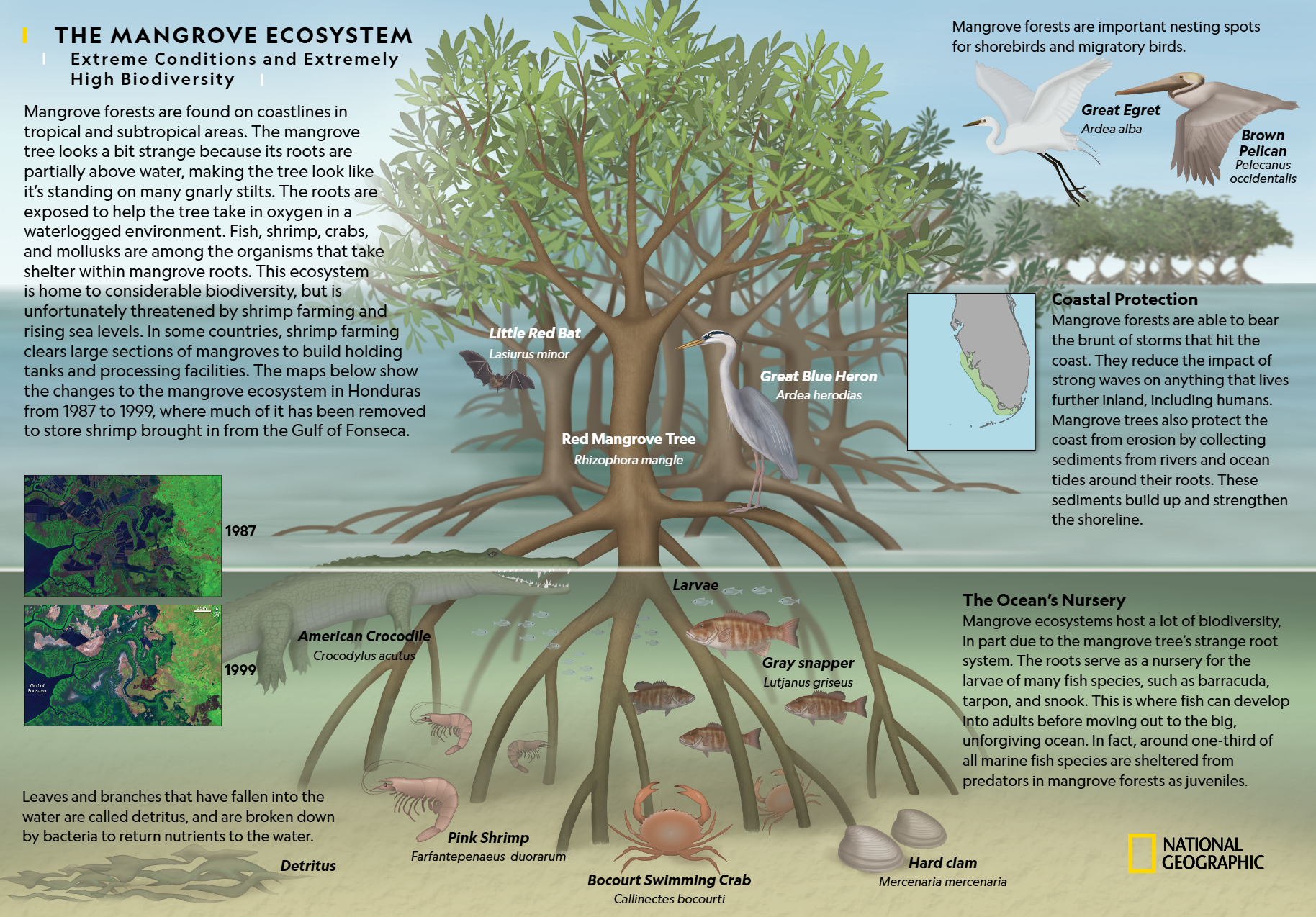
Biodiversity Hotspots: Home to unique flora and fauna in intertidal zones