
Mahad Satyagraha – Human Rights, Gender, and Constitutional Ethics
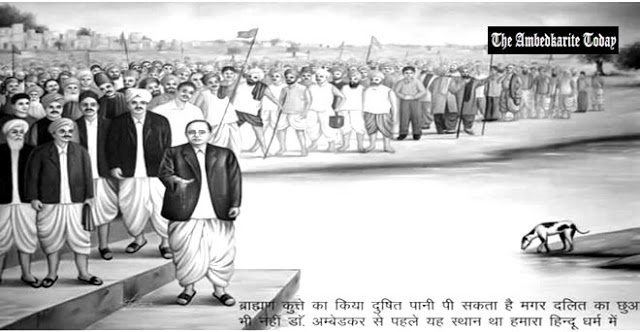
Background: Mahad in pre-Independent India
Mahad tehsil in the Bombay Province was an important economic centre supplying labour to the industrial sector of the Bombay Presidency.
Caste norms were deeply entrenched; Dalits were denied access to public water sources, including the Chavadar Tank.
Untouchability represented a system of social exclusion, backed by Brahmanical hierarchy.
Early developments toward Mahad Satyagraha
S. K. Bole Resolution (1923)
Passed in the Bombay Legislative Council (August 1923).
Recommended that untouchables be allowed access to all public water sources and public institutions maintained with public funds.
This challenged Brahmanical dominance and triggered early equality efforts in villages near Mahad (Goregaon, Dasgaon).
Activists and local mobilisation
Figures like Ramchandra Chandorkar, R. B. More, and Ramji Potdar initiated acts of civil defiance by drinking from public reservoirs.
The region had a strong legacy of anti-caste reformers: Gopalbaba Walangkar, N. M. Joshi, Sambhaji Gaikwad, among others.
This made Mahad an ideal site for Dr. B. R. Ambedkar’s movement for human rights and equality.
Mahad Satyagraha 1.0 (March 19–20, 1927)
Ambedkar and his anuyayis asserted their right to drink from Chavadar Tank as per the Bole Resolution.
Locals denied access, forcing the purchase of ₹40 worth of water for the satyagraha.
After the act, “purification rituals” were performed by caste Hindus to symbolically erase Dalit presence—an attempt to reassert caste supremacy.
Mahad Satyagraha 2.0 (December 25–26, 1927)
Planned due to continuing resistance and a court stay that labelled the Chavadar Tank as “private property”.
Ambedkar launched Bahishkrut Bharat, emphasising democratic truths and human rights.
After violent attacks on Dalits, the Ambedkar Seva Dal was formed for protection.
On December 25, Ambedkar burned the Manusmriti, signalling a decisive rejection of Brahmanical law.
Mahad 2.0 explicitly included women, initiating a gendered discourse on human rights.
Intellectual foundations
Ambedkar’s linkage to the French Revolution
He described Mahad 1.0 and 2.0 as embodying the zeitgeist of the French Revolution—liberty, equality, fraternity.
But unlike the French Revolution, which excluded women, Ambedkar insisted on gender equality, drawing from his earlier (1916) work analysing caste through a gendered lens.
Manusmriti and gender
Ambedkar argued that Manusmriti treated women as equivalent to Shudras, institutionalising subordination.
Burning the text symbolised a new human rights discourse relevant to caste and gender.
Constructing a gendered nation
Ambedkar introduced an existential, non-essentialist nationalism rooted in:
Natural rights
Legal equality
Human dignity
Buddhist ethics of Maitri (compassion)
December 25 is celebrated as Indian Women’s Liberation Day, signifying the gendered dimension of Mahad 2.0.
Significance for constitutional ethics
Mahad Satyagraha shaped ideas that later entered constitutional morality:
Equality
Dignity
Social justice
Liberty and fraternity
It helped lay the foundations of a human rights tradition in India.
Prelims Practice MCQs
Q. The Mahad Satyagraha of 1927 was primarily aimed at:
a) Securing temple entry rights for Dalits
b) Enforcing the Bole Resolution granting Dalits access to public water sources
c) Opposing land revenue policies of the Bombay Presidency
d) Demanding separate electorates for Depressed Classes
Correct answer: b
Q. Which of the following actions symbolised Dr. Ambedkar’s rejection of Brahmanical authority during Mahad 2.0?
a) Formation of the Independent Labour Party
b) Launch of the Kalaram Temple Satyagraha
c) Burning of the Manusmriti
d) Boycott of Round Table Conferences
Correct answer: c
Q. Which of the following statements about the Bole Resolution (1923) is correct?
a) It granted land rights to Depressed Classes in the Bombay Presidency.
b) It recommended allowing untouchables access to all public watering places and institutions maintained from public funds.
c) It mandated reservations in local bodies for Depressed Classes.
d) It was rejected by the Bombay Legislative Council.
Correct answer: b